

Summary: This analysis documents how institutional investors extracted over $10 billion in alpha from the gaming industry through distressed debt (Tepper’s ~$1B Caesars trade), contrarian real estate plays (Icahn’s 305% Fontainebleau return), loan-to-own strategies (Lasry’s Avenue Capital), REIT arbitrage (Land & Buildings’ MGM campaign), sale-leasebacks (Blackstone’s Bellagio), mega-acquisitions (VICI’s $17.2B MGP deal), and activist campaigns (HG Vora’s Penn Entertainment). Each trade is verified with direct source links.
Part I: Distressed Debt Strategies
The foundation of gaming alpha: buying bonds at deep discounts and litigating for recovery.
1. The Caesars Distressed Debt Trade: ~$1 Billion Alpha
The Caesars Entertainment Operating Company (CEOC) bankruptcy produced gaming’s most profitable distressed debt trade.
The Setup
Apollo Global Management and TPG Capital completed a $27.8 billion leveraged buyout of Harrah’s Entertainment in January 2008, assuming approximately $10.7 billion in existing debt as part of the transaction. By the time of bankruptcy, total debt had ballooned to approximately $18 billion.
Source: SEC Filing
In January 2015, just before CEOC filed Chapter 11, second-lien bonds were trading at deeply distressed levels — reportedly in the low-to-mid teens of cents on the dollar according to contemporaneous market reports.
Source: Euromoney Analysis
The Examiner’s Report
In March 2016, bankruptcy examiner Richard Davis filed a comprehensive report finding potential damages of $3.6–$5.1 billion from alleged fraudulent transfers. The report concluded CEOC was “certainly insolvent” during 2013–2014 asset transfers and that Apollo played a substantial role in conflicts of interest.
Source: Forbes Coverage
The Recovery
Initial offer to second-priority noteholders: 9% recovery ($487 million)
Final distribution: 65.5–66 cents on the dollar, totaling $3.62 billion — up from a prior ~27% proposed recovery
Source: Private Debt Investor
Source: Jones Day Analysis
Breakdown:
$1.43 billion in cash
$899 million in 5% Convertible Notes (valued at $1.09 billion)
19.07% of fully diluted new CEC common shares (valued at $1.10 billion)
Tepper’s Profit
David Tepper’s Appaloosa Management, a major second-lien holder, benefited from the ceded equity valued at approximately $950 million. Tepper reportedly made close to ~$1 billion from the restructuring according to press accounts.
Source: Forbes Report
Part II: Contrarian Real Estate Plays
While distressed debt requires litigation expertise, contrarian real estate plays reward patience and operational vision.
2. Carl Icahn’s Fontainebleau: 305% Return
Entry (February 2010): Acquired unfinished 68-story Fontainebleau Las Vegas for $148 million in bankruptcy (property was 70% complete)
Exit (August 2017): Sold to Steven Witkoff and New Valley LLC for $600 million
Profit: ~$452 million (305% gain over 7 years)
Source: Forbes Coverage
Icahn described this as his “contrarian modus operandi” — investing when others are unwilling.
3. Carl Icahn’s Tropicana: ~$1.65 Billion Profit
Entry (2008–2009): Acquired Tropicana Entertainment in bankruptcy for approximately $200 million in cancelled debt
Operational Transformation: Icahn reinvested “every single penny of profits back into the company” over nearly a decade
Exit (October 1, 2018): Sold for $1.85 billion ($1.21 billion to Gaming and Leisure Properties + $640 million to Eldorado Resorts)
Source: Globe Newswire
Part III: Loan-to-Own Execution
When creditors don’t just want recovery — they want control.
4. Marc Lasry’s Avenue Capital: Trump Entertainment
Avenue Capital demonstrated the “loan-to-own” strategy in Atlantic City.
The Trade
Avenue Capital, as lead bondholder, forced Trump Entertainment Resorts into bankruptcy. Marc Lasry became chairman of the board of the reorganized company in July 2010. Avenue held approximately 22% of outstanding shares.
Source: PR Newswire
In a Bloomberg interview, Lasry recounted: “We put his company into bankruptcy…Trump switched sides to partner with us.” Lasry negotiated Trump down from a 50% stake demand to 5% for continuing use of the Trump name.
Source: Bloomberg Interview
Avenue subsequently proposed a 10% stake in an online gambling joint venture with Trump in October 2011.
Source: Forbes Coverage
Part IV: REIT Arbitrage & Sale-Leasebacks
The insight that gaming companies were massively undervalued as operating entities — because their real estate deserved REIT multiples — unlocked billions in value.
5. Land & Buildings: The MGM REIT Campaign
The Thesis (2015)
Jonathan Litt’s Land & Buildings argued MGM’s real estate was “substantially undervalued” and pushed for REIT conversion.
Projections:
Base NAV: $33/share (70% upside)
Bull case: $55/share (180% upside)
Source: Forbes Coverage
Investor Presentation: Land & Buildings PDF
The Result
MGM formed MGM Growth Properties (October 2015), with IPO in April 2016 at $21.00/share (top of range). The stock opened at $22.75 and closed at $22.01 on its first trading day.
Source: Las Vegas Sun
Value Creation: The REIT structure unlocked significant value — MGM Resorts traded at approximately 9.7x EBITDA while REIT valuations commanded materially higher multiples (16x+ P/FFO), creating attractive arbitrage.
Source: Forbes Analysis
6. Blackstone: Bellagio Sale-Leaseback
Acquisition (October 2019)
Blackstone Real Estate Income Trust (BREIT) acquired Bellagio real estate for $4.25 billion (95% ownership, MGM retained 5%).
Source: Forbes Coverage
Deal Structure:
Initial cap rate: 5.75%
Initial annual rent: $245 million
Lease term: Up to 50 years (30 years + extensions)
Triple-net lease: MGM responsible for operations and capex
Value Appreciation (August 2023)
Realty Income invested $950 million for equity interests, valuing the entire property at $5.1 billion.
Source: PR Newswire
Appreciation: ~$850 million gain in 4 years (20% total return)
7. VICI Properties: $17.2 Billion MGP Acquisition
The Transaction (April 2022)
VICI completed $17.2 billion acquisition of MGM Growth Properties (including ~$5.7 billion net debt).
Source: VICI Press Release
Terms:
Exchange ratio: 1.366 VICI shares per MGP Class A share
Based on $43.00/share agreed price (16% premium to August 3, 2021 close)
MGM Grand/Mandalay Bay cap rate: 6.35%
VICI became the largest experiential real estate REIT on the Las Vegas Strip.
Part V: Board Activism & Activist Campaigns
Beyond financial engineering: activists who sought governance influence to drive operational change.
8. Corvex Management: MGM Board Seat
The Engagement
Keith Meister joined MGM Resorts board on January 18, 2019, with Corvex owning approximately 3% of outstanding shares.
Source: PR Newswire
Strategic Focus:
Increase free cash flow
Pursue asset-light model
Drive margin improvement
Meister subsequently characterized casino companies like MGM as “reopening trades” post-COVID, anticipating significant pent-up demand.
9. HG Vora: Penn Entertainment Activist Campaign
The Filing
HG Vora filed 13D/A on January 16, 2024, revealing an 18.5% economic stake (including swaps).
Source: SEC Filing
See also: Investopedia Coverage
The Case
HG Vora launched an investor presentation alleging:
“Poor strategic decisions, failed transactions and poor execution”
“Nearly $4 billion” in reckless spending on overpriced M&A
theScore acquisition (2021): Approximately $2 billion
Barstool Sports: Eventually sold back for $1
ESPN Bet: Overpriced partnership
Source: SBC Americas
theScore Acquisition: Business Wire
Board Action: HG Vora nominated three independent directors: William Clifford, Johnny Hartnett, Carlos Ruisanchez.
Source: Business Wire
Part VI: Accumulation Strategies
Patient capital building positions ahead of anticipated catalysts.
10. Tilman Fertitta: Wynn Resorts Accumulation
Stake Build-Up
October 2022: Initial purchase of 6.9 million shares (6.1% stake)
November 2024: Reached 9.9% stake, becoming largest individual shareholder
April 2025: Increased to approximately 13 million shares (12%+ stake)
Source: Las Vegas Review-Journal (Nov 2024)
See also: Las Vegas Review-Journal (2022)
Investment Thesis: Analysts describe Fertitta’s position as a “fundamental investment in an undervalued company with generational assets that will endure economic cycles.”
Bloomberg reported Fertitta believes Wynn management “has not adequately communicated the company’s performance to investors” and sees opportunities for brand expansion.
Part VII: LBO Failure Case Study
Not every gaming trade works. Timing and leverage can destroy even well-conceived investments.
11. Station Casinos: When Leverage Destroys Value
The 2007 Buyout
The Fertitta family and Colony Capital took Station Casinos private in an $8.8 billion deal in November 2007. Colony Capital contributed approximately $2.6 billion for roughly 75% of the company. The deal included approximately $3.4 billion in assumed debt.
Source: PE Real Estate News
July 2009: Filed Chapter 11 with $6.5 billion in debt against $5.7 billion in assets.
Source: Las Vegas Review-Journal
Creditor Recovery and Restructuring
The company emerged from bankruptcy in June 2011 after shedding approximately $4 billion in debt.
First-lien senior secured lenders (Deutsche Bank, JP Morgan) converted to equity:
Deutsche Bank received 25% stake
JPMorgan Chase received 15% stake
Fertitta family: Invested ~$200 million, securing 45% ownership in the reorganized company.
Unsecured bondholders: Suffered near-total losses on approximately $4 billion in claims.
Source: Las Vegas Review-Journal
Colony Capital founder Thomas Barrack called it “the worst investment ever” due to timing.
Source: PE Real Estate News
Part VIII: Current Opportunities
The playbook continues. Distressed gaming situations emerge globally.
12. Oaktree Capital: Star Entertainment Distressed Offer
The Opportunity (February 2025)
Oaktree Capital Management offered distressed Australian casino operator Star Entertainment Group A$650 million (US$414 million) debt refinancing proposal.
Source: Forbes Australia
Deal Structure: Two five-year debt facilities, subject to comprehensive security package and regulatory approval in New South Wales and Queensland.
Source: Star Entertainment ASX Announcements
Note: The Oaktree proposal ultimately did not proceed as conditions were not met by March 2025.
Howard Marks’ Oaktree is the world’s largest distressed securities investor — this deal exemplifies the firm’s continued focus on gaming distress.
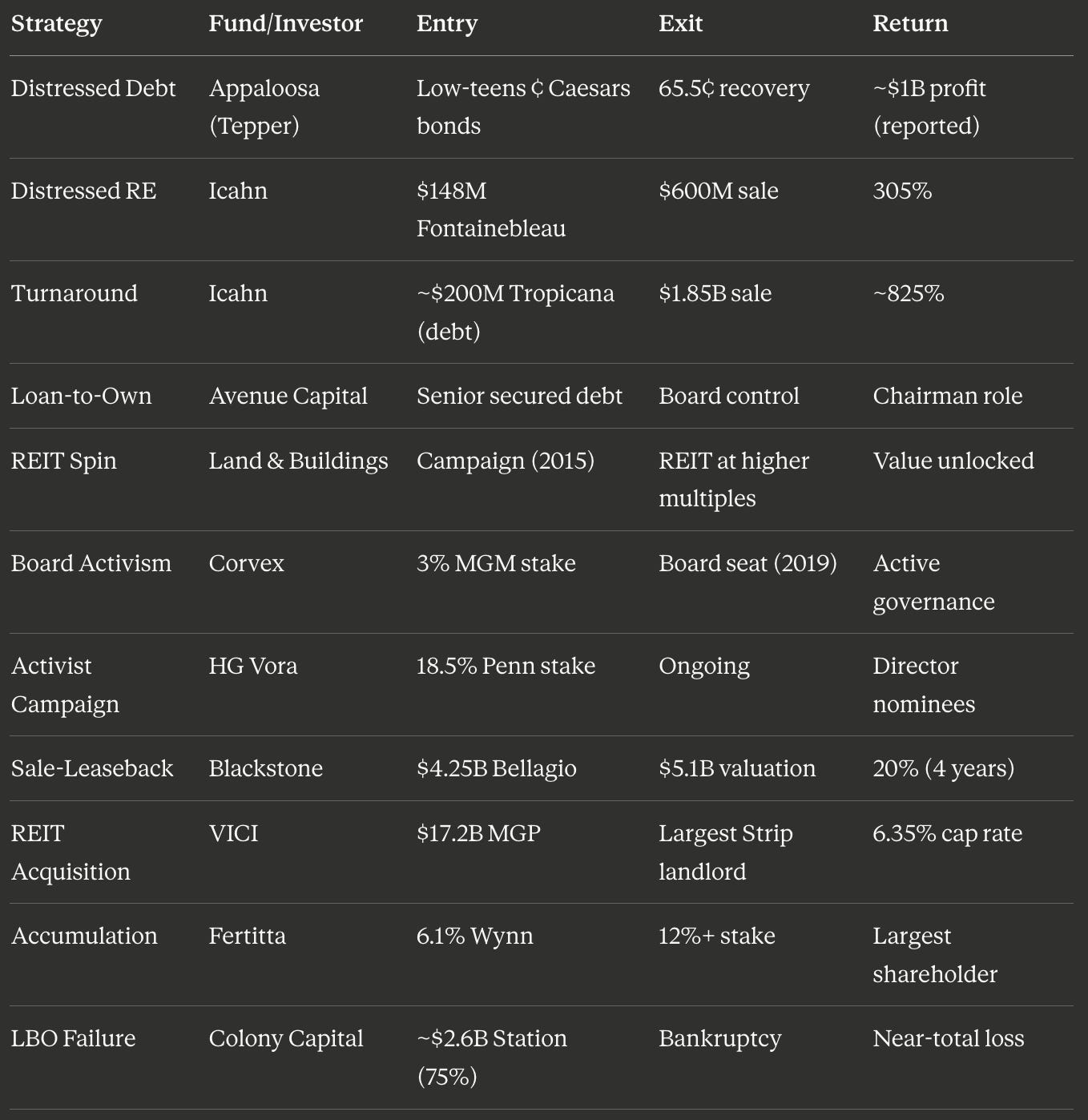
Summary: Key Trades and Returns
Academic Reference
Harvard Business School Case Study: “Bankruptcy at Caesars Entertainment” (HBS Case 216–052) documents Apollo and TPG’s “defensive maneuvers” during bankruptcy, including asset transfers between subsidiaries and elimination of parent guarantees.
Source: HBS Faculty & Research
Additional Context
For a detailed look inside the Caesars bankruptcy battle between creditors and private equity sponsors:
About the Author
For more quantitative finance analysis, trading strategies, and deep dives into institutional alpha generation:
YouTube: The Mathematical Trader
LinkedIn: Navnoor Bawa
Patreon: Join for exclusive research
This analysis is for informational purposes only and does not constitute investment advice. Past performance does not guarantee future results.
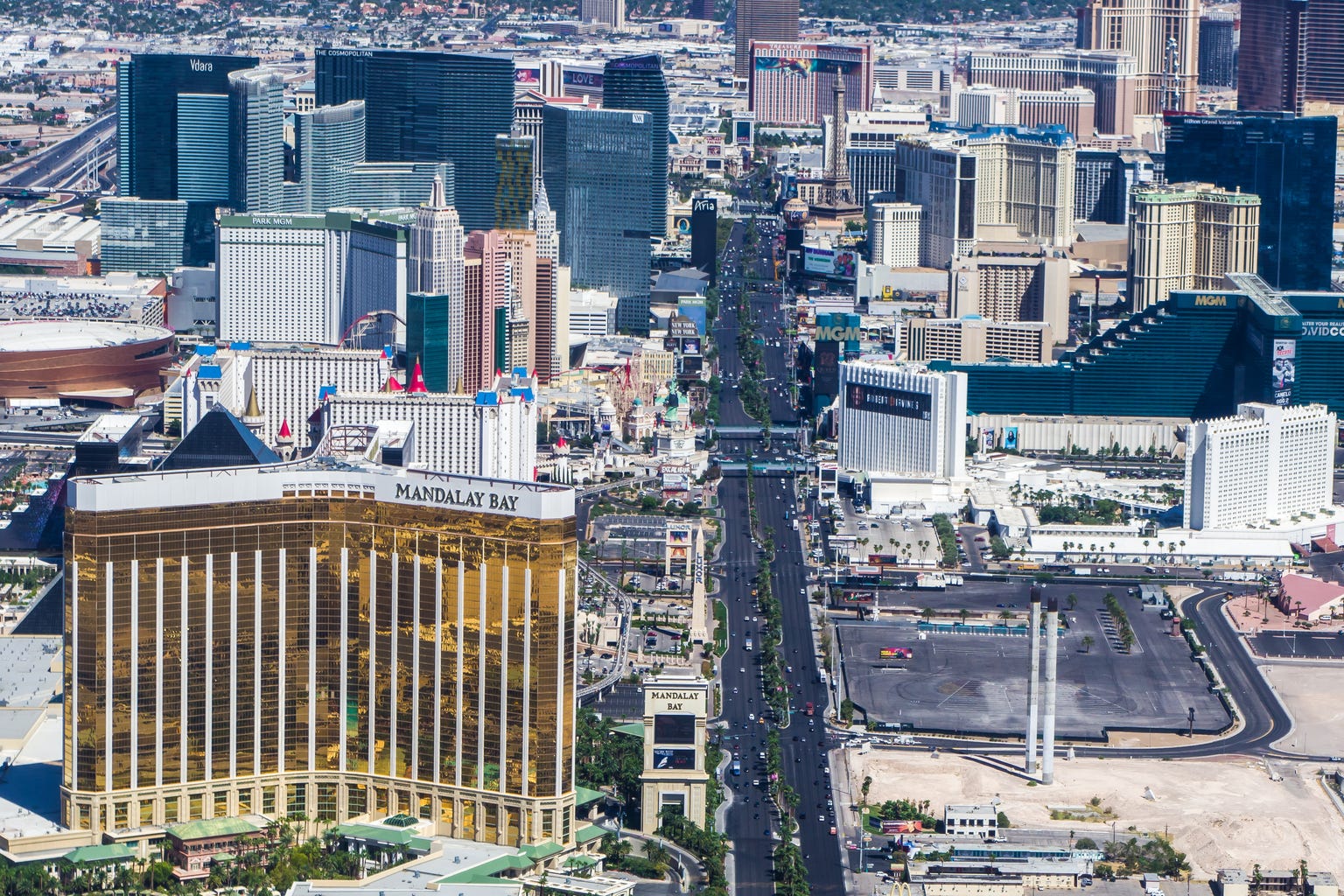
Cover photograph: Ron Reiring, CC BY 2.0, via Wikimedia Commons.