


China’s markets have destroyed more capital than perhaps any other investment battlefield this century. Kyle Bass lost 95% betting against the Hong Kong dollar. Western distressed debt funds suffered 98% haircuts on Evergrande bonds. Jim Chanos spent a decade shorting Chinese financials before closing his fund with AUM down from $6–8 billion to under $200 million.
But a select group extracted billions through differentiated information — forensic fraud investigations, local political economy knowledge, and systematic policy timing. The pattern is clear: successful China trades came from information advantages the market couldn’t access. Failed trades came from betting against Beijing’s resolve.
Here’s how the winners actually did it.
I. Forensic Short-Selling: The 11,260-Hour Information Edge Luckin Coffee: The Most Extensive Corporate Surveillance Ever Conducted
On January 31, 2020, Muddy Waters published an 89-page report alleging massive fraud at Luckin Coffee. The investigation’s scope was unprecedented:
92 full-time investigators
1,418 part-time investigators
981 store-days monitored
11,260 hours of video recorded
100% operating hour coverage requirement (days discarded if >10 minutes footage missing)
Finding: Items per store per day were inflated by 69% in Q3 2019 and 88% in Q4 2019.
Result: On April 2, 2020, Luckin admitted fabricating RMB 2.2 billion (~$310 million) in transactions. The SEC settlement in December 2020 required Luckin to pay $180 million in penalties.
The Edge: Physical surveillance created an information advantage no Bloomberg terminal could replicate. While public investors relied on company disclosures, Muddy Waters counted actual customers.
Sino-Forest: $2.3 Billion Market Cap Evaporated in One Day
In June 2011, Muddy Waters accused Sino-Forest — a Chinese timber company on the Toronto Stock Exchange — of being a “multi-billion dollar Ponzi scheme.”
Execution:
Pre-report price: CA$18.21 (June 1, 2011)
Post-report price: CA$1.99 (June 21, 2011)
Single-day market cap loss: $2.3 billion (June 3, 2011)
Total decline: 82%
Collateral damage: John Paulson held 34.7 million shares. He liquidated his entire position in June 2011, suffering losses estimated at $500–750 million.
Regulatory confirmation: The Ontario Securities Commission ruled in July 2017 that 70% of timber holdings and revenues from 2007–2010 could not be verified. Former CEO Allen Chan was ordered to pay $60.3 million in disgorgement plus penalties in July 2018.
Orient Paper: The $4,000 Position That Started It All
Carson Block’s first China short began with a $4,000 position in Orient Paper put options at a $7.50 strike price. His due diligence uncovered allegations that 2008 revenue was overstated by 27x and 2009 revenue by 40x.
After publishing on June 28, 2010, the stock fell 11% the next day and ultimately declined 78% by late 2012. Block’s initial profit from puts sold mid-July 2010: approximately $6,000.
This modest first trade established the forensic playbook Muddy Waters would scale to billions in market impact.
📊 Want Deeper Quantitative Analysis?
This research took weeks of data collection, verification, and analysis. If you found value in this deep-dive, I publish exclusive quantitative research, trading strategies, and institutional-grade analysis on Patreon.
By joining, you’ll be supporting my work and motivating me to publish more content like this.
→ Join the Patreon community here
II. Stimulus Timing: The September 2024 Policy Windfall 44% Monthly Returns from PBOC Liquidity
On September 24, 2024, China unveiled its largest stimulus since the pandemic. The PBOC announced a CNY 500 billion swap facility for equity purchases and a CNY 300 billion relending program for share buybacks.
Market response:
September 30 single-day rally: +8.48%, biggest since 2008
Triata Capital: 44% (September 2024)
Yunqi Capital: 26% before fees (September 2024)
Triata’s edge: Sean Ho’s $770 million fund operated a Shenzhen office with local analysts using alternative data including company hiring trends. Long-term positions in data centers, internet platforms, e-commerce, and travel were already in place when policy shifted.
David Tepper’s “Buy Everything” Positioning
On September 26, 2024, Tepper appeared on CNBC declaring: “I would do everything. ETFs, futures, everything. Single-digit P/E multiples with double-digit growth.”
Appaloosa Management Q4 2024 13F:
Alibaba (BABA): 11.84 million shares (largest position)
JD.com (JD): Increased 43% to 10.46 million shares (5.6% of portfolio)
Bridgewater’s Systematic All Weather Outperformance
While discretionary managers debated stimulus timing, Bridgewater’s systematic policy framework delivered sustained outperformance throughout 2024.
All Weather Plus (onshore): 35%+ full year 2024
All Weather Plus №5: +19% September 2024 (31% YTD)
AUM growth: CNY 55 billion (~$7.5 billion) by December 31, 2024 — a 40% increase
The systematic edge: Bridgewater’s decades-long framework for reading central bank behavior translated directly to anticipating PBOC actions. Models were positioned before discretionary managers finished debating.
III. Long-Term Fundamental Conviction: The Multi-Year Concentration Plays Hillhouse Capital: The $255 Million JD.com Masterclass
Zhang Lei’s 2010 JD.com investment demonstrates how conviction backed by structural analysis generates asymmetric returns.
Execution:
Year: 2010
JD.com’s ask: $75 million
Zhang Lei’s response: “I’ll give you more”
Actual investment: $255 million (some sources report $300 million)
Return: ~15x in 4 years
Zhang Lei invested more than triple the requested amount — absolute conviction on Chinese e-commerce infrastructure, not portfolio theory or index-relative positioning.
Validation: In 2021, Hillhouse raised $18 billion across three funds — the largest Asia PE fundraise at that time.
Tiger Global: $10.4 Billion Investor Profits in 2020
Performance:
Long-short fund: 48.4%
Long-only fund: 65.1%
Total 2020 investor profits: $10.4 billion
Tiger Global was named the #1 hedge fund globally by LCH Investments for 2020 — their first appearance on the all-time list. Key holdings: JD.com, Meituan, emerging market tech positions.
Like Hillhouse, Tiger concentrated in Chinese internet platforms rather than diversifying — violating traditional risk management but capturing full upside.
2024 China Specialists: Gen Z Consumption and “Cute Economy”
Keywise Capital Penguin: 71% (tech, Gen Z consumption)
Keywise Capital Mega Trend: 51% (Miniso, power supply)
First Beijing: 42% (Meituan, Atour, Full Truck Alliance)
FountainCap Research: 22% H1 2025 (Pop Mart, “cute economy”)
Keywise Capital’s approach: $2+ billion AUM, fundamental bottom-up with futures hedging, concentrated portfolios in specific consumption trends.
IV. Distressed Debt Arbitrage: The Local Knowledge Advantage
The Great Evergrande Divergence
The Evergrande crisis created one of the starkest performance splits between Western and Chinese funds — a case study in how local political economy knowledge trumps financial modeling.
Western funds’ failed bet: Many US/European managers bought offshore bonds expecting a government bailout, applying frameworks from Western financial crises.
Result: After the Hong Kong court liquidation order on January 29, 2024, bonds traded at approximately 2 cents on the dollar — a 98%+ haircut.
Chinese distressed specialists’ winning strategy:
Shenzhen Qianhai Guoen Capital: 319% (distressed property debt)
Fuhui Juli Wealth Management: 104% (high-yield distressed bonds)
Shenzhen Qianhai Jiuying Asset: 96% (distressed property/LGFV bonds)
These Chinese funds collectively managed over 20 billion yuan and profited from the same crisis that devastated global asset managers including Prudential and UBS divisions.
What Chinese funds understood: Beijing’s “houses are for living, not speculation” policy meant no Evergrande bailout. But local government financing vehicles (LGFVs) and certain state-tied developers would receive support. Western funds modeled default probabilities. Chinese funds understood political priorities.
V. Event-Driven Regulatory Trading: Reading Beijing’s Political Signals
The Alibaba Regulatory Crackdown
When Jack Ma criticized Chinese regulators at the Bund Summit on October 24, 2020 — calling them an “old people’s club” and accusing state banks of “pawnshop mentality” — sophisticated funds recognized a massive political miscalculation.
Timeline:
October 24, 2020: Jack Ma’s speech
November 3, 2020: Ant Group’s $37 billion IPO suspended
April 10, 2021: $2.8 billion SAMR antitrust fine
Short seller profits: According to S3 Partners data, short sellers profited $1.34 billion on Alibaba positions through mid-2021 (13% gain), while shareholders saw total losses over $10 billion during the regulatory period based on shareholder lawsuit claims.
The edge: Understanding what Beijing will and won’t tolerate. Funds that recognized Ma’s speech as political suicide positioned within hours while the broader market took weeks to price in regulatory risk.
VI. The Cautionary Tales: When Analysis Meets State Resolve Kyle Bass: 95% Loss Betting Against the HKD Peg
In June 2020, Bass launched a fund with 200x leverage betting the Hong Kong dollar peg would break.
Result: According to SEC filings, a Hayman Capital Management hedge fund lost over 95% of the $30 million invested. The Hong Kong dollar moved only 0.4% over 18 months, well within its pegged trading band.
The miscalculation: Bass’s analysis of Hong Kong’s economic fundamentals was likely correct. What he underestimated was Beijing’s willingness to deploy China’s $3+ trillion in foreign reserves to maintain the peg for political reasons — the defense was about sovereignty, not economics.
George Soros: The $1–15 Billion Hong Kong Attack
In August 1998, Soros employed a “double play” — shorting the Hong Kong dollar while simultaneously shorting Hang Seng Index futures.
HKMA defense: The Hong Kong Monetary Authority spent HK$118 billion (~$15 billion) purchasing blue-chip stocks and futures, acquiring 33 constituent stocks of the Hang Seng Index to successfully repel speculators.
Estimated loss: Commonly cited at ~$1 billion, though some retrospectives suggest up to $15 billion when including follow-on positions.
The pattern: Soros successfully broke the Bank of England in 1992 because there were political and economic limits to the UK’s defense. In Hong Kong, Beijing faced no such constraints.
Jim Chanos: The Decade-Long China Bear
Position evolution:
2010–2011: 20%+ of portfolio in China shorts
2015: ~20% (profited during crash)
2023: 4–6% (reduced due to flat markets)
Kynikos closure: In November 2023, Chanos announced he would close his hedge funds and transition to a family office. AUM had declined from ~$6–8 billion at peak (circa 2008) to under $200 million.
The lesson: Chanos noted Chinese markets had been largely flat for 12 years, diminishing shorting opportunities. His thesis on Chinese debt and overcapacity may have been analytically sound, but Beijing’s willingness to tolerate “extend and pretend” banking practices meant traditional short signals never triggered.
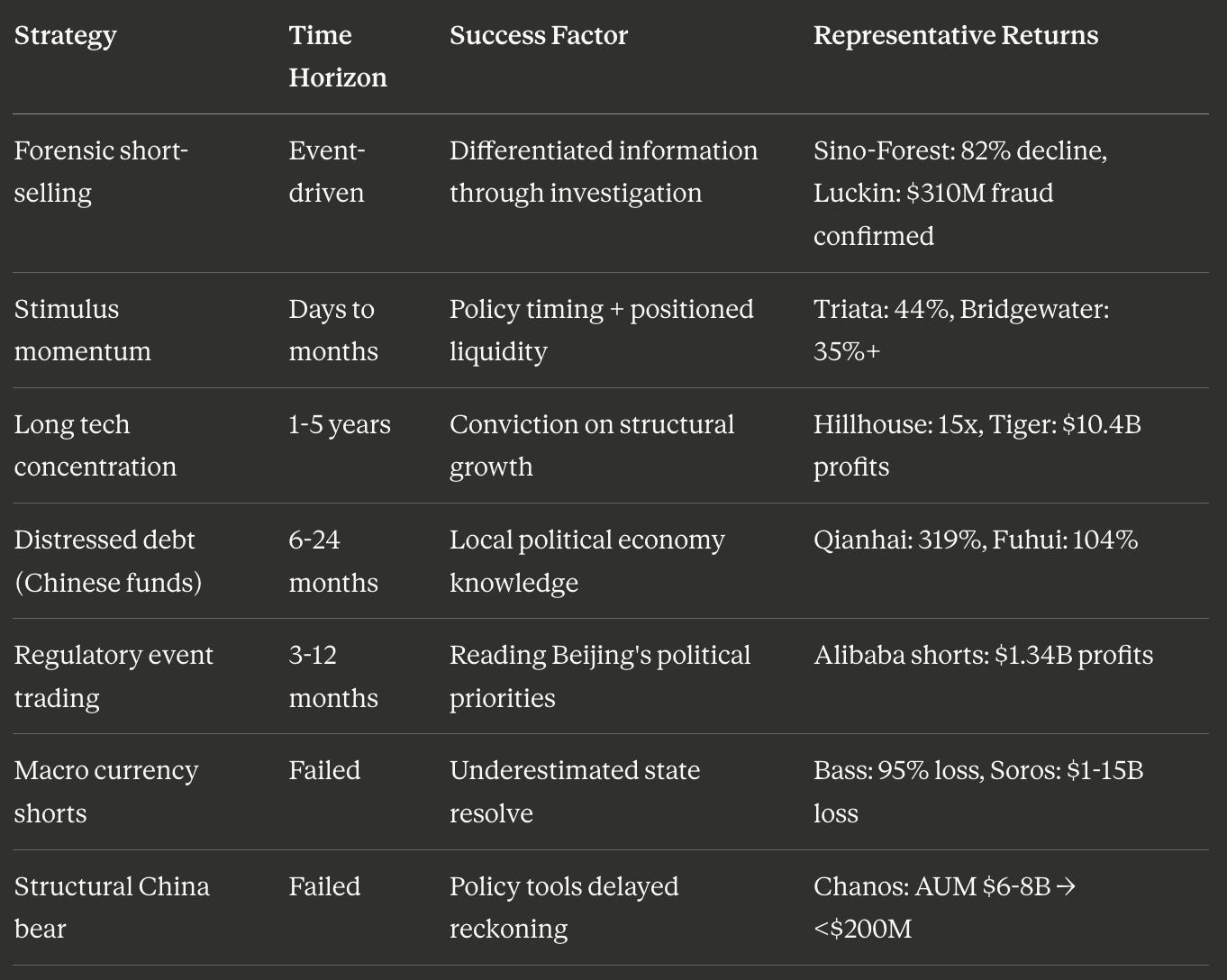
VII. Strategic Framework: What Actually Works
The Common Thread
Successful China trades: Conviction backed by differentiated information — whether counting store traffic for Luckin Coffee, modeling distressed debt recovery with local political knowledge, timing policy shifts through systematic frameworks, or maintaining multi-year conviction on structural growth.
Failed China trades: Macro bets against Chinese government resolve. Bass underestimated Beijing’s willingness to deploy reserves. Western Evergrande investors misread the political economy of “houses are for living, not speculation.” Chanos was analytically correct but politically wrong about Beijing’s tolerance for financial engineering.
The China alpha edge isn’t about being bullish or bearish. It’s about understanding what the Party will and won’t tolerate — and having differentiated information the market can’t access through conventional research.
When you’re counting 11,260 hours of surveillance footage while your competitors read sell-side research, you have an edge. When you’re modeling LGFV political priorities while Western funds run default probability models, you have an edge. When your systematic framework anticipates PBOC moves while discretionary managers debate, you have an edge.
The question isn’t whether to invest in China. It’s whether you have information advantages that justify the political risk.
About the Author
Navnoor Bawa is a quantitative research analyst specializing in systematic trading strategies and institutional hedge fund analysis. Navnoor publishes technical deep-dives on hedge fund strategies, systematic trading, and quantitative finance across multiple platforms:
YouTube: The Mathematical Trader — Video analysis of institutional strategies
LinkedIn: Connect with Navnoor — Professional updates and market commentary
Patreon: Exclusive Research & Strategies — Institutional-grade quantitative analysis
All figures verified through primary sources. Claims backed by regulatory filings, court documents, SEC settlements, and fund disclosures.
Cover photograph: Web Summit, CC BY 2.0, via Wikimedia Commons.