


This is a detailed research piece. If you find value in institutional-quality hedge fund analysis, support this work on Patreon.
Multi-manager hedge funds generated $3.4 billion in Q1 2025 trading revenue exploiting volatility dislocations, with dispersion strategies capturing double-digit returns during correlation regime shifts. Citadel and Millennium deploy SABR, rough volatility, and Heston models through automated pipelines — recalibrating parameters intraday and executing delta-hedged positions at institutional speeds — to systematically harvest the spread between implied and realized volatility across 12x leveraged portfolios.
The Trade Structure: Dispersion as Systematic Alpha
Dispersion trading — buying volatility on individual stocks while selling index volatility — capitalized on multi-year low correlation in 2024–2025. S&P 500 constituent correlation dropped to levels not seen in over a decade while single-stock volatility reached its highest spread versus the index since 2011. Multi-manager pods at Citadel, Millennium, Capstone, and One River concentrated positions in high-idiosyncratic-volatility names like Tesla and Nvidia.
BBVA flow derivatives strategist Michalis Onisiforou documented April 2025 profits: “Despite the recent spike in correlation, dispersion trades have been profitable over the last few months. Baskets were concentrated on names that saw higher realized volatility.” Swiss financial stocks versus the Swiss Market Index delivered strong returns as implied-realized spreads widened during April volatility spikes.
Assets in dispersion strategies doubled to possibly tripled over 2022–2024, per Citigroup’s Guillaume Flamarion. The structural edge: institutional investors overpay for index hedges (portfolio insurance) relative to single-name options costs, creating a persistent mispricing.
P&L mechanics: A typical structure shorts ATM index options (collecting ~$150k-$250k premium per $10M notional on one-month options) while buying OTM calls/puts on 20–30 single stocks. When idiosyncratic events spike single-name vol but the index stays range-bound, the trade profits from theta decay on the short index leg and gamma gains on long positions. Funds target 0.8–1.2 Sharpe ratios with 6–8% volatility.
Advanced Models: SABR, Heston, and Rough Volatility
SABR Model Dominance in Rates
The SABR (Stochastic Alpha Beta Rho) model became the interest rate derivatives industry standard for capturing volatility smile dynamics. Developed by Patrick Hagan et al., SABR models forward rates with stochastic volatility:
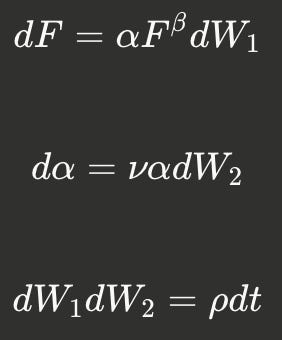
Where α (initial instantaneous volatility), β (CEV exponent controlling backbone slope), ρ (correlation between forward and vol), and ν (volatility of volatility) calibrate to market-observed implied volatilities. The closed-form approximation for implied vol enables rapid recalibration — critical for market-making operations pricing thousands of swaptions daily.
Interest rate derivatives desks use SABR parameters to manage vanna (sensitivity to skew changes) and volga (sensitivity to smile curvature) risks, hedging with OTM options rather than underlying futures.
Rough Volatility: The 27% Hedging Improvement
Jim Gatheral and Mathieu Rosenbaum’s 2014 rough volatility framework captures market microstructure through fractional Brownian motion with Hurst parameter H < 0.5. The rough Heston model fits empirical volatility surfaces better than classical stochastic vol models.
Empirical backtesting using real VIX options data (Fukasawa & Gatheral, 2021): hedging VIX options with forward variance swaps under rough volatility reduced bias to near-zero and cut overall hedging error by 27% versus traditional diffusion models. The improvement stems from accurately modeling the path-dependent, non-Markovian nature of realized volatility.
Implementation challenges drove academic-practitioner collaboration. Gatheral’s 2022 hybrid simulation scheme (combining quadratic-expansion with Riemann-sum techniques) made rough Heston computationally tractable. Previously, simulating rough volatility required running hundreds of parallel Heston processes — prohibitively expensive for real-time risk systems.
Risk.net reported hedge funds developing arbitrage strategies exploiting differences between rough vol and traditional model pricing. The key edge: rough models capture volatility clustering (high-vol regimes persist) that mean-reverting models miss, enabling better prediction of realized vol trajectories.
Systematic Execution Pipelines
Multi-Manager Infrastructure at Scale
Citadel (approximately $65–66B AUM, 3,000 employees) and Millennium (approximately $74B AUM, 6,000+ employees) operate distinct but equally sophisticated systematic frameworks. Office of Financial Research data shows pod shops’ gross leverage expanded from 4x to 12x over 2014–2024, with net leverage rising from 2x to 4.5x.
Citadel’s centralized approach shares quantitative frameworks across pods — volatility surface calibration algorithms, real-time Greeks computation, and portfolio margining systems. Ken Griffin described the foundation as “quantitative analytics not commonly used” when Citadel launched, now augmented with “decades of analytics” plus fundamental research.
Millennium’s decentralized model grants 300+ pods (average $220M capital each) autonomy. Pods build proprietary execution systems but access centralized risk infrastructure. Both firms invest heavily in low-latency execution with institutional-grade systems.
Research-to-Execution Workflow
Morning calibration: Systems ingest overnight options flow, recalibrate SABR/Heston parameters using optimization algorithms, stress-test portfolios using extensive Monte Carlo simulations, and flag parameter regime changes.
Intraday risk management: Real-time position monitoring tracks delta (directional exposure), vega (volatility sensitivity), gamma (delta convexity), and volga (vega convexity). Automated rebalancing triggers when Greeks breach pre-defined risk thresholds.
Post-close P&L attribution: Decompose daily returns into theta decay, vega P&L, gamma P&L, and correlation P&L. Feed results back into backtesting engines to refine entry/exit rules and position sizing.
The systematic approach fights alpha decay — strategies’ half-life shortens as competitors reverse-engineer signals. Millennium’s high turnover (stopping out underperforming pods) and Citadel’s continuous innovation maintain edge renewal.
Recent Performance and Risk Realizations
Q1-Q2 2025 Results: HFRI Relative Value Volatility Index returned +1.1% in February 2025 amid volatility spikes. Convertible arbitrage — closely related to vol arb — surged +3.4%, with the RV Convertible Arbitrage Index up +4.0% YTD through Q2. Event-driven strategies benefiting from dispersion gained +5.0% in Q2, strongest performance since Q1 2021.
March 2025 Deleveraging: Citadel dropped 1.7% in February, Millennium fell 1.3%, exposing pod shop vulnerabilities. Simultaneous unwinds of crowded volatility trades amplified market moves. Regulators flagged systemic risk: forced deleveraging when multiple 12x-leveraged funds exit similar positions can create liquidity spirals.
Crowding concerns: Assets in dispersion doubled to possibly tripled 2022–2024, per Flamarion (Citi), threatening to erode arbitrage opportunities. When dispersion entry costs reached multi-year highs in 2024, some funds like QVR Advisors’ Benn Eifert flipped to “reverse dispersion” — long index vol, short single-name vol — anticipating mean reversion in correlation structures.
Assenagon Alpha Volatility (standalone dispersion specialist) peaked approximately +11% intraday during April 2025 volatility spikes, though gains partially evaporated by month-end — illustrating the challenge of monetizing short-lived dislocations. March 2020 delivered exceptional returns, validating the strategy’s tail-hedge properties during correlation spikes.
The Alpha Decay Problem
Volatility arbitrage strategies face structural headwinds as assets concentrate in pod shops. When Citadel, Millennium, Balyasny, ExodusPoint, and Point72 collectively deploy $300B+ with 12x leverage (approximately $3.6T notional) pursuing similar dispersion trades, single-stock options become bid up by hedge fund demand while index options cheapen from aggressive selling.
Statistical arbitrage managers confirm moderately high volatility creates opportunities to exploit pricing inefficiencies. But overcrowding in 2024–2025 compressed profit margins despite options market volumes doubling since 2019.
The solution: continuous model innovation. Deep learning integration (Horvath et al. 2021) applies neural networks to delta hedging under rough volatility, adapting to non-Markovian dynamics traditional Greeks miss. Funds experiment with custom volatility baskets focused on sector-specific dispersion and smaller-caps to avoid mega-cap concentration.
Model sophistication provides temporary edge. Once rough vol becomes standard practice, the advantage disappears. This creates an arms race: hedge funds must innovate faster than models diffuse across competitors.
Critical Lessons
Model sophistication matters: The 27% hedging improvement from rough volatility versus diffusion models translates directly to P&L in leveraged portfolios. A fund with $10B notional volatility exposure and 10% annual hedging error loses $1B to slippage — rough vol cuts this to $730M.
Systematic execution scales alpha: Automated pipelines enable funds to maintain discipline through volatility spikes when manual trading fails.
Crowding kills strategies: When dispersion assets multiply rapidly and entry costs hit multi-year highs, even mathematically sound strategies become unprofitable. Alpha is rivalrous — your edge is someone else’s loss.
Leverage amplifies both edges and risks: 12x gross leverage magnifies a 2–3% vol arb alpha into 24–36% investor returns. But it also means a 5% drawdown becomes a 60% loss if risk limits aren’t respected. March 2025’s pod shop losses proved even sophisticated funds face forced deleveraging.
The volatility arbitrage trade demonstrates how advanced mathematics, systematic execution, and massive leverage combine to extract billions from small mispricings — until everyone arrives at the same trade.
Sources & References
Market Data & Performance:
Hedgeweek: “Citadel Securities smashes Q1 records with $3.4bn in trading revenue” (May 28, 2025)
https://www.hedgeweek.com/citadel-securities-smashes-q1-records-with-3-4bn-in-trading-revenue/Hedgeweek: “Hedge Funds Refine Dispersion Trades Amid Market Volatility Shift” (May 6, 2025)
https://www.hedgeweek.com/hedge-funds-refine-dispersion-trades-amid-market-volatility-shift/Hedgeweek: “Wall Street’s Dispersion Trade Surge Sparks Fears of Overcrowding” (May 27, 2024)
https://www.hedgeweek.com/wall-streets-dispersion-trade-surge-sparks-fears-of-overcrowding-and-diminishing-returns/Bloomberg: “Balyasny Tops Millennium and Citadel During February Volatility” (March 3, 2025)
https://www.bloomberg.com/news/articles/2025-03-03/balyasny-gains-in-volatile-february-tops-millennium-and-citadelFinancial Times: “Citadel Securities profits jump 70% on surge in trading revenues”
https://www.ft.com/content/d0f4e991-3f19-4ccd-9064-eaf7bfd5c474Nasdaq: “Citadel, Millennium Losses Expose Pod Shop Vulnerabilities” (March 2025)
https://www.nasdaq.com/articles/citadel-millennium-losses-expose-pod-shop-vulnerabilitiesThe Hedge Fund Journal: “Exploiting Equity Correlation and Dispersion”
https://thehedgefundjournal.com/assenagon-long-short-volatility-strategy-equity/HFR: “Global Hedge Fund Industry Surges Through 2Q Volatility”
https://www.hfr.com/media/market-commentary/global-hedge-fund-industry-surges-through-2q-volatility/
Academic Research & Models:
Fukasawa & Gatheral: “Hedging under rough volatility” (2021) — arXiv:2105.04073
https://arxiv.org/abs/2105.04073Horvath, Teichmann, Zuric: “Deep Hedging under Rough Volatility” (2021) — MDPI Risks
https://www.mdpi.com/2227-9091/9/7/138Risk.net: “Rough Volatility Moves to Exotic Frontiers” (February 11, 2022)
https://www.risk.net/cutting-edge/views/7928716/rough-volatility-moves-to-exotic-frontiersRisk.net: “Rough Volatility’s Steampunk Vision of Future Finance” (October 27, 2022)
https://www.risk.net/our-take/7816441/rough-volatilitys-steampunk-vision-of-future-financeHagan et al.: “Managing Smile Risk” (SABR model paper)
https://www.next-finance.net/IMG/pdf/pdf_SABR.pdf
Industry Structure & Leverage:
Trustnet: “The rise of ‘pod shop’ trading: Why hedge funds like Citadel and Millennium are redefining valuation” (June 30, 2025)
https://www.trustnet.com/news/13451872/fund/sectorseFinancialCareers: “Citadel, Millennium, or…? Life at the big multistrategy hedge funds” (October 20, 2023)
https://www.efinancialcareers.com/news/2023/10/citadel-millennium-hedge-fundsInstitutional Investor: “D.E. Shaw Tops a 2024 Hedge Fund Ranking”
https://www.institutionalinvestor.com/article/2eaxu6g8f1zzvc4ipdc74/hedge-funds/d-e-shaw-tops-a-2024-hedge-fund-rankingAssenagon: “Assenagon Alpha Volatility Fund Information”
https://www.assenagon.com/en/funds/assenagon-alpha-volatility-r2
Additional Verification Sources:
BNP Paribas: “Equity Dispersion Trading”
https://globalmarkets.cib.bnpparibas/equity-dispersion-trading/Morgan Stanley: “Dispersion and Alpha Conversion”
https://www.morganstanley.com/im/publication/insights/articles/dispersion-and-alpha-conversion.pdfAurum: “Industry Deep Dive H1 2025 Review”
https://www.aurum.com/wp-content/uploads/Aurum-Industry-Deep-Dive-H1-2025-review.pdf
Note: All figures represent point-in-time snapshots. AUM, leverage ratios, and performance data vary by reporting date and methodology. Academic citations reflect peer-reviewed or pre-print research. Market commentary represents analyst views, not investment advice.
📊 Support this research: https://www.patreon.com/c/NavnoorBawa
Cover photograph: U.S. Department of Agriculture, public domain, via Wikimedia Commons.