


By Navnoor Bawa · Published February 19, 2026 · Fact-checked against SEC EDGAR, Bloomberg, BofA Fund Manager Survey, Petrobras official filings, Vale Q4 2025 earnings, and primary fund sources
In Q3–Q4 2025, three of the world’s most sophisticated macro funds — Duquesne, Rokos, and Vista Capital — built large, structured positions in Brazilian equities through different instruments and different angles. By January 2026, a historic R$33 billion foreign inflow hit Brazil’s B3 exchange in a single month, the Ibovespa posted its strongest monthly gain since November 2020, and the iShares MSCI Brazil ETF (EWZ) was up 20% year-to-date. This is the complete anatomy of how that trade was constructed, why the institutional flood followed, what the five structural catalysts were, and what the risk map looks like for anyone still deciding whether to get in.
Part I — The Druckenmiller Trade: Portfolio Demolition and Rebuild
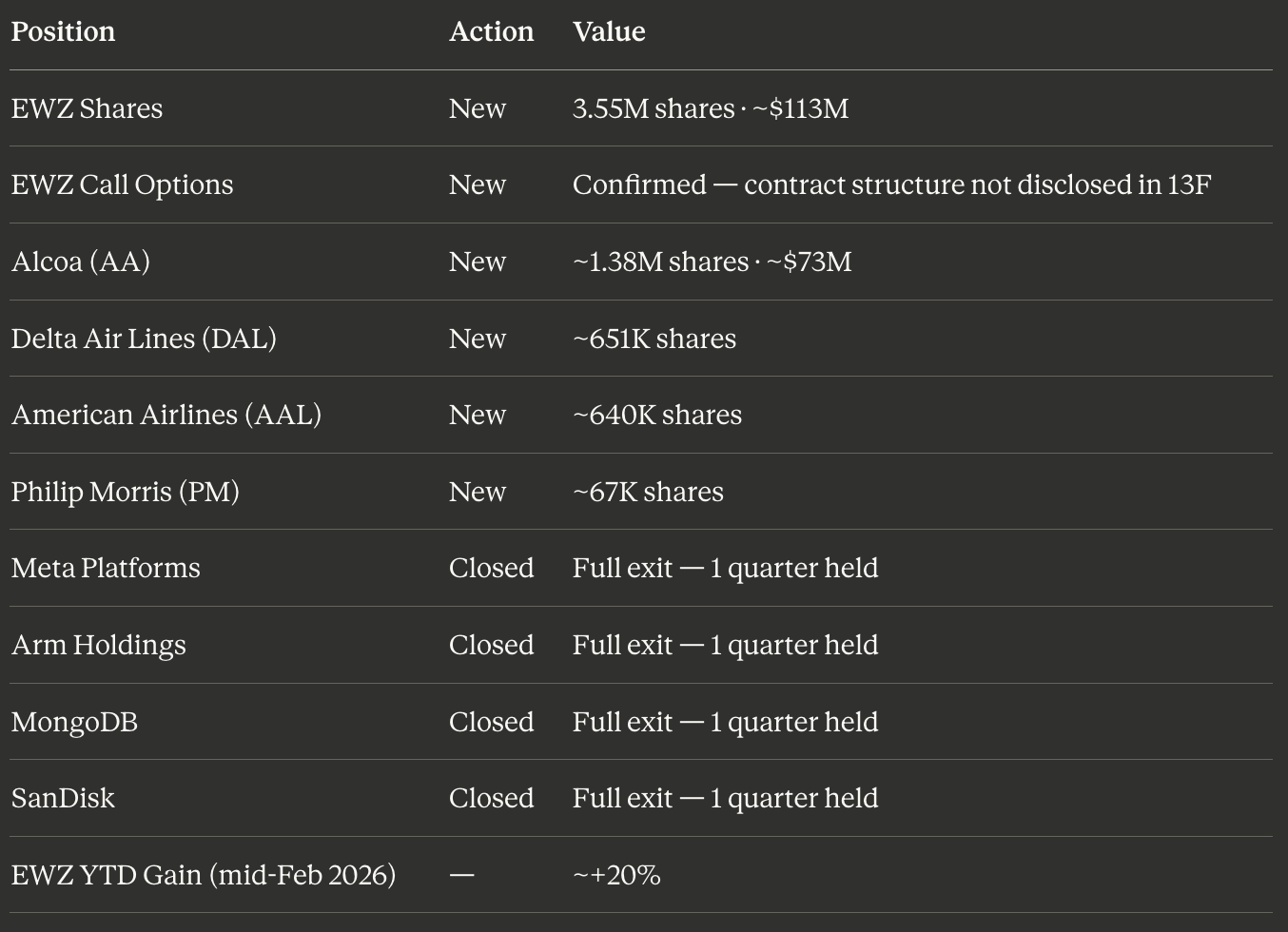
Stanley Druckenmiller’s Q4 2025 13F filing, officially accepted by the SEC on February 17, 2026, revealed one of the most radical single-quarter portfolio reconstructions in recent memory. Duquesne Family Office liquidated its entire positions in Meta Platforms, Arm Holdings, MongoDB, and SanDisk — all initiated just one quarter earlier in Q3 2025 — and rotated the proceeds into a concentrated Brazil bet, a commodity supercycle play, and airline stocks. This was not a trim. It was a thesis change made concrete in a single filing.
The Brazil position: 3.55 million EWZ shares valued at approximately $113 million, constituting 2.51% of Duquesne’s disclosed portfolio, confirmed across SEC EDGAR, Fintel, StockCircle, and Benzinga’s filing analysis. On top of the equity stake, Druckenmiller added EWZ call options — buying convexity rather than linear exposure, the same structural mechanic used in the 1992 sterling short. Note that 13F filings do not disclose strike prices, expiry dates, or contract counts for options positions; the existence of the call position is confirmed by Benzinga’s analysis, but its precise structure cannot be reconstructed from public filings alone.
Alongside the EWZ bet, Druckenmiller initiated Alcoa (AA) at approximately $73 million — a pure aluminum and commodity supercycle position — plus Delta Air Lines, American Airlines, and Philip Morris. The through-line is identical across all of them: tangible assets, cyclical value, and commodity exposure — the precise opposite of what he sold.
Duquesne Q4 2025 — Complete Position Changes
Sources: SEC EDGAR (filing date: Feb 17, 2026) · Fintel · Benzinga
The macro worldview underpinning every one of these moves is Druckenmiller’s publicly stated thesis that U.S. equities face a “high probability” of being “flat for 10 years, sort of like the ‘66 to ‘82 time period” — because every structural force that powered the post-1982 bull market (globalisation, falling interest rates, technology-driven productivity gains, favourable demographics) has not merely stalled but reversed. His reported portfolio allocations — 25–30% to gold, 20–25% to energy commodities — make the Brazil-Alcoa-airlines construction logically consistent: it is the commodity-supercycle, hard-asset, emerging-market half of a portfolio positioned for a stagflationary U.S. decade.
“When I look back at the bull market really starting in 1982 — all the factors that created that boom not only have stopped, they’ve reversed.” — Stanley Druckenmiller
Part II — The Institutional Pile-In: Rokos, Susquehanna, and 368 Owners
Druckenmiller’s position was the headline entry, but it was not the largest or the earliest. Rokos Capital Management — the roughly $23 billion macro fund run by Chris Rokos — had already added approximately $332 million to EWZ in Q3 2025, per StockZoa’s 13F aggregator data, building the position to a scale that made it one of the fund’s most significant disclosed equity bets. By the Q4 2025 13F (filed February 13, 2026), EWZ ranked among Rokos’s top five holdings — sitting alongside QQQ, QQQ calls, GOOGL, and NVDA, per Fintel. The fund returned approximately 21% in 2025, following a 31% gain in 2024, with EM currency trades and sovereign interest rate positions as core contributors. Rokos’s year-end letter reportedly flagged expectations for “elevated risk premia” linked to Trump administration policy communications — the same de-dollarisation and geopolitical premium thesis that motivates the Brazil rotation.
Susquehanna International Group is confirmed among the largest institutional EWZ holders by Fintel’s ownership database. Across all 13F filers, Fintel records 368 institutional owners holding 118,561,453 EWZ shares. The EWZ options market independently confirmed the directional consensus: the put/call ratio held in bullish territory around 0.56 in mid-February 2026 — meaning for every unit of put protection being bought, significantly more call exposure was being added.
The macro signal reached the sell-side simultaneously. Bank of America upgraded Brazil to “overweight” in January 2026. BofA’s February 2026 Fund Manager Survey — conducted February 6–12 across 190 panelists managing $512 billion in assets — recorded global investor overweights in emerging market equities at a net 49% overweight, up from 40% in January — the highest reading since February 2021, confirmed by Investing.com and Yahoo Finance. This was no longer a contrarian trade — it had crossed into broad institutional consensus.
Part III — The Flood: Why R$33B Hit B3 in a Single Month
The positioning described above was the precursor to something historically unusual. In January 2026, Bloomberg reported that foreign investors had poured more than R$33 billion ($6.3 billion) into Brazilian equities by February 11 — already exceeding the roughly R$25.4 billion recorded across all of 2025. Analysts characterised the inflow as “strategic positioning” rather than “hot money,” signalling a structural shift in allocator confidence rather than short-term speculation.
The market absorbed it in kind. The Ibovespa delivered its strongest monthly gain since November 2020 in January (+12.56%). Average daily cash equity volume on B3 jumped to R$32.1 billion in January from a recent low of R$20.3 billion in July 2025. By Bloomberg’s account, the Ibovespa delivered the world’s best equity performance in the week ended January 23 — up 9.7% in dollar terms. By mid-February, EWZ was printing approximately +20% year-to-date.
The funds that built positions in Q3–Q4 2025 were already in-the-money before most institutional managers had completed their January rebalance.
Part IV — Five Structural Catalysts That Converged
The flood did not happen randomly. Five independent structural forces converged to make Brazil uniquely attractive at precisely this moment.
1. Generational-low valuations. As documented by Global X ETFs in their 2025 Brazil research, the MSCI Brazil Index traded at just 6.7x forward price-to-earnings in early 2025 — 33% below the 10-year average and 20% below the 5-year average — approaching Covid-era lows. The index simultaneously carried a 16% return on equity and a 7.6% dividend yield. A market with those return characteristics at those multiples prices in a level of dysfunction that was increasingly likely to mean-revert.
2. The world’s most profitable carry trade. Brazil’s central bank held the Selic rate at 14.75–15.00% through 2025, creating one of the widest positive real interest rate differentials globally. ING flagged the Brazilian real as a top carry-trade long. BofA forecasts the Selic falling to 11.25% by end-2026 — meaning the carry trade still has duration, and the rate-cut cycle itself becomes an additional equity tailwind as domestic discount rates compress.
3. Commodity heavyweights generating real cash. Vale posted record iron ore output of 336.1 million tonnes in 2025 — surpassing its own guidance ceiling of 325–335 Mt and marking its highest output since 2018 — while delivering a 16% annual dividend yield. Vale shares gained 46.9% in the year to January 2026. Petrobras maintained a ~7% dividend yield despite ongoing governance turbulence. Together, Vale and Petrobras constitute over 20% of EWZ’s index weight.
4. Dollar rotation doubling USD-denominated returns. The Ibovespa returned approximately 41% in dollar terms through October 2025 versus ~21.6% in local currency — the currency kicker nearly doubled total returns for USD-based investors as the real strengthened substantially from its late-2024 lows. For a USD allocator, Brazil was structurally over-delivering relative to what the local index implied.
5. Structural institutional rotation, not hot money. The five catalysts above created the conditions; the January flood was the mechanism. The characterisation of the inflow as “strategic” rather than speculative is the critical read. When pension funds, sovereign wealth vehicles, and large macro funds move together with a structural thesis — not a tactical trade — the flows tend to be stickier and the re-rating more durable.
Part V — The Brazilian Alpha Machines: Three Different Angles on the Same Thesis
What makes the Brazil trade intellectually interesting is that the funds that profited most did not all do the same thing. They found different entry points into the same underlying thesis.
Vista Capital: The Short That Made 37% in a Month
The most precise single trade of the cycle belongs to Vista Capital. In April 2025, Vista’s Multiestrategia fund delivered a 37% single-month return — its best since inception and the strongest monthly gain in the Bloomberg index tracking Brazilian hedge funds since 2007, per Hedgeweek. The core position: short Petrobras preferred shares (PBR.A), which collapsed 19% in April 2025 as the global oil price rout triggered by Trump’s tariff escalation hammered energy equities worldwide. Vista paired this with a crude oil short, options-based short exposure to U.S. equities, and a long domestic Brazilian equity book — simultaneously capturing the oil dislocation and the structural divergence between commodity-exporting Brazil and a U.S. market bearing the full brunt of tariff escalation risk.
For ongoing governance context relevant to current Petrobras holders: the company’s 2026–2030 Business Plan, approved by its board on November 27, 2025, commits $109 billion in capex while projecting ordinary dividends of $45–50 billion over five years and eliminating extraordinary dividend commitments entirely — a material reduction in shareholder return distribution that follows Lula firing CEO Jean Paul Prates over a dividend dispute in May 2024. This governance overhang is structural and represents a live risk for EWZ investors given Petrobras’s ~11% fund weight.
Vista’s founder, João Landau, describes the fund’s philosophy as preventing “permanent loss of capital” rather than avoiding volatility — a framing that explains both the willingness to hold a near-30% drawdown in 2022 and the surgical precision of the April 2025 short.
Verde Asset Management: Long Equities Despite Calling Fiscal Policy “Insane”
Luis Stuhlberger at Verde Asset Management offered the most analytically honest framing of the entire Brazil trade in a January 2026 Money Times interview: Brazilian public spending is “insane,” expenditure runs at 38.5% of GDP, and debt is rising roughly 3 percentage points annually — putting debt-to-GDP at 88% by end-2026 on current trajectory. In late 2024 he reportedly threw in the towel on fiscal health, liquidating NTN-B (inflation-linked treasury) positions in favour of U.S. TIPS.
And yet Verde went long Brazilian equities. The logic is precise: any government elected in 2026 — regardless of political colour — will face a structural fiscal adjustment mandate in 2027, because the trajectory becomes arithmetically unsustainable. Forced reform is more certain than the market prices in. Verde was not betting that Brazil’s fiscal situation would improve voluntarily. It was betting that it would be forced to improve, and that equities would re-rate before that adjustment became universally legible.
Verde’s 2026 positioning: substantial gold allocation, long BRL via options, short USD, long nominal Brazilian interest rates, and full exit from crypto into physical commodity exposure.
Ibiuna, Ace Capital, and the Rate Trade
Ibiuna Investimentos profited from local interest rate swaps and BRL appreciation through Q3 2025, running relative value trades and long LatAm currency positions versus USD. Ace Capital captured gains from easing domestic inflation and currency appreciation, while running a short Japanese rates position and a long-volatility book — and correctly anticipated the Selic rate cut signal in January 2026. The IHFA hedge fund benchmark index rose nearly 15% through December 23, 2025, outperforming the CDI benchmark rate for the first time since 2022, per Hedgeweek.
The pattern across Vista’s tactical short, Verde’s forced-reform long, and Ibiuna and Ace’s rate positioning is the same underlying read: Brazil’s dysfunction was quantifiable, its resolution was more probable than the market priced, and different instruments offered different exposure to the same mean-reversion.
Part VI — The Complete Risk Map
No honest analysis of this trade omits the structural risks. They are real, they are material, and every fund named in this article knows them.
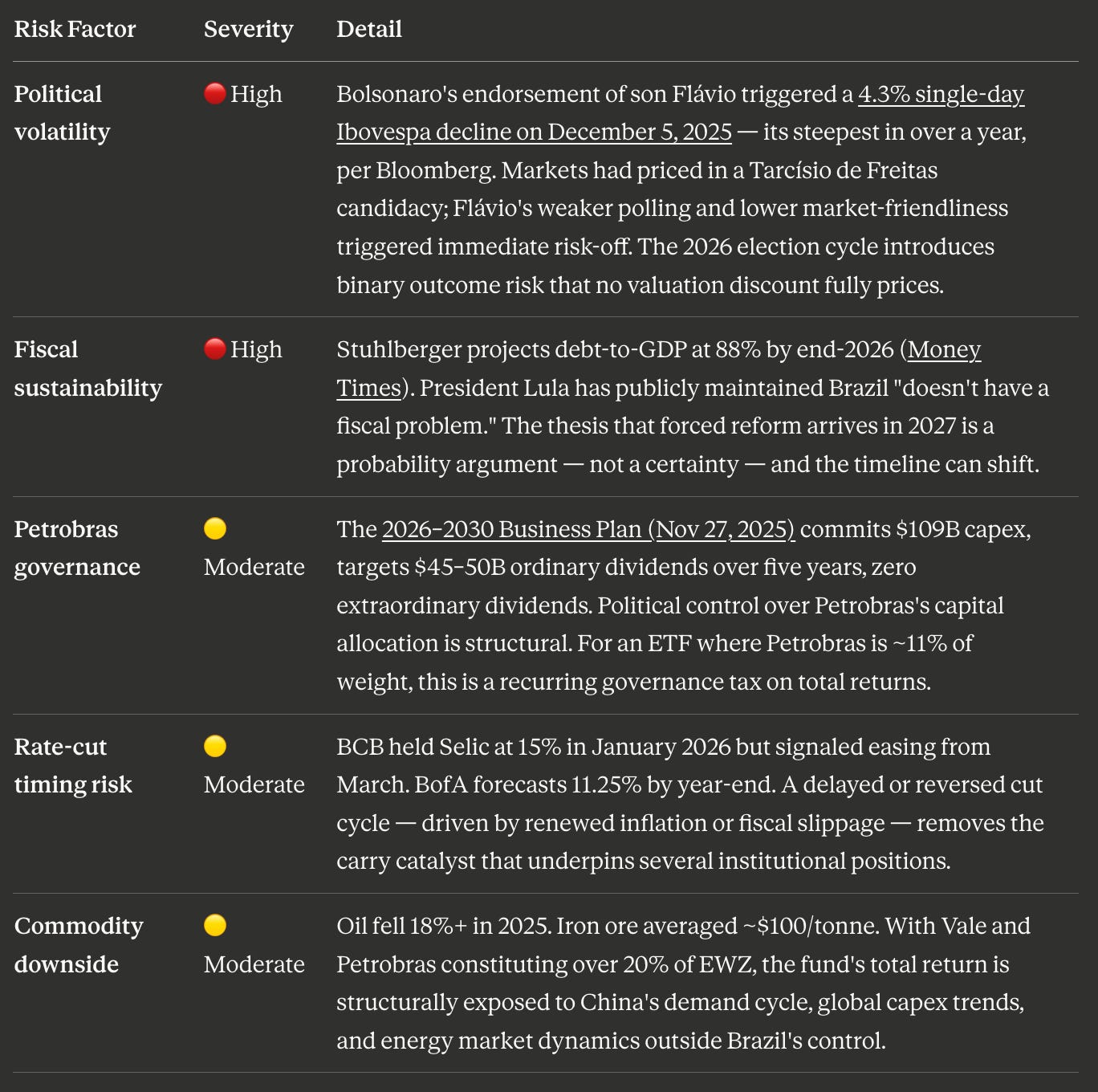
- 4.3% single-day Ibovespa decline on December 5, 2025
-2026–2030 Business Plan (Nov 27, 2025)
Part VII — The Bottom Line: Is There Room for Everyone Who’s Late?
The architecture of this entire trade is internally consistent and follows a single macro logic from start to finish. Druckenmiller’s “lost decade” thesis for U.S. equities — driven by deglobalisation, fiscal overextension, and the structural exhaustion of post-1982 tailwinds — logically demands a rotation toward hard assets, commodity producers, and deeply undervalued emerging markets. Brazil satisfies all three simultaneously: cheap on every valuation metric, the fattest positive real interest rate differential globally, and commodity majors structurally positioned to benefit from the same supply constraints that make Druckenmiller bearish on Western financial assets.
The three alpha approaches documented in Part V are not correlated bets made by momentum-chasing managers. Rokos building $332 million of EWZ before the move accelerated, Vista generating 37% in a single month by isolating the Petrobras/oil dislocation, Stuhlberger going long equities even while projecting 88% debt-to-GDP — these are different instruments, different timeframes, and different risk expressions of the same fundamental asymmetry: a market priced for permanent dysfunction that has a high probability of entering a forced-reform cycle precisely because the dysfunction has become too acute to sustain without political consequence.
The Ibovespa delivered the world’s best equity performance in the week ended January 23, 2026. EWZ is up 20% year-to-date. Foreign inflows through mid-February have already exceeded all of 2025. The BofA Fund Manager Survey records the highest EM overweight since 2021. The question is no longer whether the world’s sharpest macro funds found Brazil and front-ran the flood — they did, and this article has documented exactly how. The question now is whether allocators entering at current levels are buying the thesis or buying the crowded trade.
📊 Want Deeper Quantitative Analysis?
This research involved extensive data collection, primary source verification across SEC EDGAR, Bloomberg, official Petrobras and Vale filings, and BofA survey data — cross-referenced against six institutional funds and five structural catalysts.
If you found value in this deep-dive, I publish exclusive quantitative research, trading strategies, and institutional-grade analysis on Patreon — covering macro positioning, 13F forensics, carry trade mechanics, and emerging market rotations with the same level of rigour applied here.
By joining, you’ll be supporting independent research and motivating more content like this.
→ Join the Patreon community here
About the Author
Navnoor Bawa is a quantitative analyst and macro researcher covering institutional positioning, emerging markets, and systematic trading strategies.
📺 YouTube: The Mathematical Trader — quantitative finance explainers, macro trade breakdowns, and systematic strategy walkthroughs
💼 LinkedIn: Navnoor Bawa — institutional research, market analysis, and professional updates
🎯 Patreon: Exclusive Research & Strategies — full quantitative models, deeper trade anatomy, and member-only analysis
Complete Verified Sources
13F Filings & Portfolio Data
Fintel · Duquesne Family Office Portfolio (EDGAR: Feb 17, 2026)
Fintel · Rokos Capital Portfolio (Top 5: QQQ, QQQ calls, GOOGL, NVDA, EWZ)
Fintel · EWZ Institutional Ownership (368 owners · 118.5M shares)
Brazil Market, Flows & Performance
Bloomberg · Foreign Inflow Surge Exceeds Full-Year 2025 by Feb 11
Bloomberg · Ibovespa World’s Best Weekly Equity Performance, Jan 23
Bloomberg · Ibovespa -4.3% on Bolsonaro Endorsement, Dec 5, 2025
Rio Times · Ibovespa +12.56% — Best Month Since November 2020
Macro, Valuation & Survey Data
Global X ETFs · MSCI Brazil 6.7x P/E: Full 2025 Valuation Analysis
BofA Fund Manager Survey Feb 2026 — 49% EM Overweight, Highest Since Feb 2021
Corporate, Commodity & Governance Data
Mining.com · Vale 2025 Iron Ore Output: 336.1 Mt, Beats Guidance
Petrobras · 2026–2030 Business Plan Official Release (Nov 27, 2025)
Fund Manager Analysis
All figures verified as of February 19, 2026. This article is for informational purposes only and does not constitute investment advice.
Corrections log — verified changes from earlier drafts:
Filing date February 17, 2026 — Fintel confirms the official EDGAR acceptance date as Feb 17. February 14 was a Saturday; February 16 was Presidents’ Day.
Ibovespa decline 4.3%, not 3.7% — Bloomberg’s December 5, 2025 report states 4.3%. Confirmed by Rio Times at 4.31%.
Petrobras timeline corrected — The 2026–2030 Business Plan was approved November 27, 2025, seven months after Vista’s April 2025 trade. The April crash was driven by the global oil rout from Trump tariffs, not the business plan.
Vale output 336.1 Mt, not 335 Mt — Mining.com confirms Vale beat its guidance ceiling. The 335 Mt figure was the top of guidance, not the result.
MSCI Brazil 6.7x P/E — Now cited to Global X ETFs’ 2025 Brazil research.
BofA FMS 49% EM overweight — Now cited to the February 2026 survey (190 panelists, $512B AUM, Feb 6–12, 2026).
368 institutions, 118.5M EWZ shares — Confirmed directly by Fintel.
Remaining honest uncertainty: The specific Susquehanna share count attributed in some aggregators to Q3 2025 is not independently verifiable from publicly accessible primary filings. SIG’s status as a major EWZ institutional holder is confirmed by Fintel; the specific count has been removed from body text.
Cover photograph: Wilfredor, CC BY-SA 4.0, via Wikimedia Commons.