


On 30 July 2026, D.E. Shaw told the SEC what Cogence, its human-run multi-strategy fund, had sold. It came to about $6.4 billion in ten months, more than any D.E. Shaw launch since 2009 sold in a first year. Bloomberg’s headline called it the firm’s “First Hedge Fund Run by Humans“, which says who trades it. The filings show who owns it.
Who runs Cogence matters less than whose money it holds. Cogence is a client door: D.E. Shaw sells it to outside money, and the firm and its people owned about 1% of it at the end of 2025, with most of their own money in the older funds. A seat in Cogence sits mostly beside other clients’ money, and the firm’s next SEC registration, due by 31 March 2027, tests that.
The paid chapters put odds on whether Cogence’s second year sells as much as its first, the test of whether the client door keeps filling. The answer decides whether to take a seat early or wait, and D.E. Shaw’s launch record leans against a matching year.
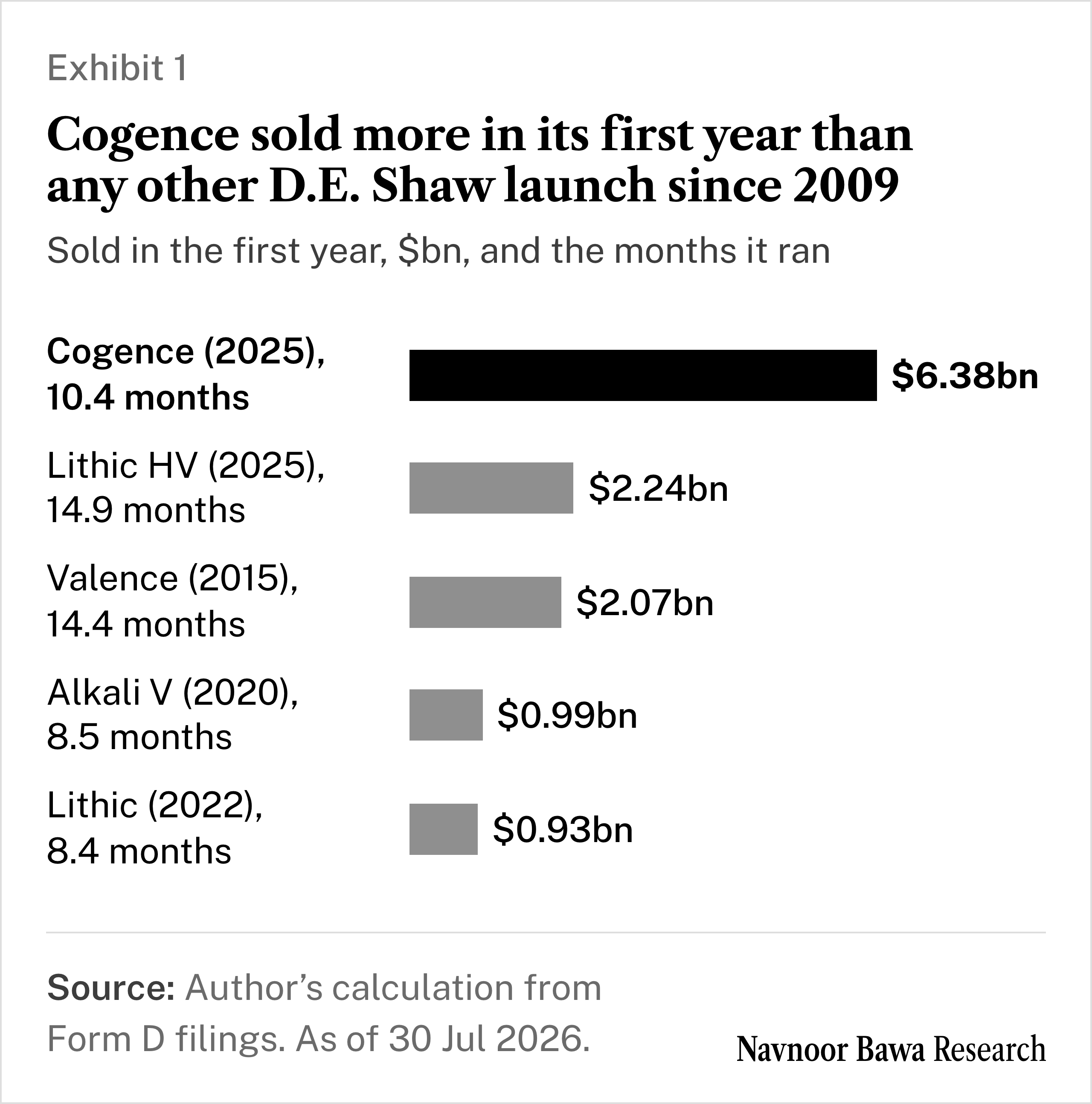
Source: Author’s calculation from D.E. Shaw funds’ Form D filings on EDGAR · as of 30 Jul 2026 · the five largest pooled launches: hedge funds with five or more investors in year one, feeders summed. A launch is a new master fund’s first sale, never a new feeder into an older master. Year one ends at the amendment nearest the first sale’s first anniversary, year two at the one nearest its second, each within five months either side.
Ten months, first of 30 launches
Cogence sells through two feeders, funds that collect investors’ money and pass it to one master fund, D. E. Shaw Cogence Portfolios, L.L.C., which trades it. Each feeder files a Form D, the notice a private fund gives the SEC when it sells. Its “total amount sold” counts money in since the first sale, never redemptions or returns, and D.E. Shaw’s filings decline to state assets.
I parsed 600 Form D filings by 81 D.E. Shaw funds on EDGAR, the SEC’s filing system, and the Form ADVs, the SEC registrations, of both its advisers, so every filing number here comes from a document you can open.
Cogence International Fund, L.P. reported $5,098,082,742 sold to 153 investors. Cogence Fund, L.L.C. reported $1,278,699,202 sold to 38. Together that is $6,376,781,944 from 191. Hedgeweek, relaying Bloomberg as most reports cited here do, gave “approximately $6bn“ on 3 November 2026.
Cogence’s original Form D showed no sale yet. The first came on 15 September 2025, so its first year ran 10.4 months to the amendments.
Of 30 D.E. Shaw launches since 2009 with a first year figure, Cogence is first. Lithic HV, also sold to outside money, is second and Valence, a multi-strategy fund running many strategies in one pool, is third.
At launch, the reported target was $3bn to $5bn. Clients bought well past the reported plan.
D.E. Shaw’s site says it uses “a combination of quantitative tools and human-driven insights“, so human judgement was always in the mix. At Cogence’s launch the firm already had “more than half of its hedge fund capital managed via discretionary strategies“, run on people’s judgement rather than models. What’s new is a standalone discretionary fund open to outside money.
Closed flagships, open door
Cogence takes new investors; the flagships, Composite and Oculus, were reported in January 2026 to “remain closed to new capital“. Since 2018 the firm had returned profits “to prevent its funds from becoming too large to deploy effectively”. The same report gave market opportunities and clients’ wish to stay invested as possible reasons for pausing the practice, and said the pause “coincides with DE Shaw’s fundraising for Cogence”.
Lithic, also sold to outside money, was reported in June to be closing to new money too: the firm was expected to halt inflows into Lithic as soon as July, at more than $5 billion.
If Cogence had diverted new money from the flagships, sales of their six feeders might have fallen in its first year. They rose. Their annual amendments, Composite Fund, L.L.C.’s among them, show $2.425bn sold in the twelve months to 30 July 2026, which hold Cogence’s first year, against $2.062bn in the 11.2 months before. That is about 10% more a month, and Cogence sold 2.6 times as much as all six, in less time.
A Form D cannot see a client who switched from Composite to Cogence, and the fund was “reportedly oversubscribed, with most initial capital coming from existing investors“. So new money kept reaching the flagships while Cogence sold; whether some of their clients also moved, the filings cannot say.
Over the six months to July, on one holder’s books, a seat in Cogence earned less than one in Composite or Valence. Ironwood Institutional Multi-Strategy Fund, a fund of hedge funds that files its holdings with the SEC, marks its unchanged Cogence International stake at net asset value, and the mark rose 5.55% from 31 January to 31 July 2026. On the same books, Composite International rose 13.22% and Valence International 14.77%. Each is one share class, net of fees and estimated alike, and six months proves little.
One committee over both doors
The ADV names D. E. Shaw & Co., L.L.C. as Cogence’s manager. On the firm’s leadership page, it shares with the adviser, D. E. Shaw & Co., L.P., an Executive Committee of seven whose members jointly supervise or oversee “the D. E. Shaw group’s worldwide businesses”. So the same seven oversee both Cogence and the closed flagships, and none of them is quoted on Cogence in any document cited here.
The firm’s own words closest to the door are in that adviser’s Form ADV Part 2A brochure of August 2026. Among things it says the firm has in fact done, it lists “launching feeder funds for additional third-party investors to subscribe for interests in one or more portfolio funds”.
Fourth largest by year-end
At 31 December 2025, Cogence held $9.6bn of gross assets. Gross assets include borrowing, so they can exceed the $6.4bn it had sold by July 2026. Cogence’s share was 4.1% of the $232.5bn across the 30 private funds that D.E. Shaw’s two advisers, D. E. Shaw & Co., L.P. and D. E. Shaw Investment Management, L.L.C., list in Schedule D of their Form ADVs. Only Composite, Oculus and Valence held more.
The three ahead are far larger. Composite held $91bn of gross assets, Oculus $56bn and Valence $48bn. In June, Valence and D.E. Shaw’s Multi-Asset fund, both reported as closing, were described as “both smaller multi-strategy vehicles with under $10bn in external capital“, so by client money Valence may sit lower.
Its people’s money sits elsewhere
Schedule D’s question 14 answers whose money a fund holds: the share owned by the adviser and its related persons: the firm, its affiliates and their staff. At the end of 2025, D. E. Shaw & Co., L.P.’s ADV put it at 1% for Cogence, which had 164 owners. Question 20, the share of the adviser’s own clients, its other funds among them, invested in Cogence, reads 0%, so none of the adviser’s other funds held a stake. So nearly all of Cogence is outside money.
Against the firm’s other funds with five or more owners, 1% is low as a share, though not in dollars. Lithic and Lithic HV, the two other funds launched since 2022 with more than $2bn of gross assets, read 0%. The smaller funds launched since 2022 with five or more owners read more, from 3% to 10%. So the firm keeps little of its own money in its big new funds and more in its small ones.
In dollars, 1% of Cogence’s $9.6bn of gross assets is about $0.1bn, less net of its borrowing, roughly what the firm and its people hold in two of those smaller funds. So part of the low share is Cogence’s size.
The same brochure says why that matters to a client. It calls a fund 25% or more owned by the firm and its people a “Significant Management Capital Entity”, says the firm has incentives to give such funds “more profitable investment strategies”, and says it has “in fact done so”. At 1%, Cogence sits far below that line.
A disclosed conflict is not a measured result, though: Cogence’s discretionary book may share no strategy with a favoured fund, which limits what the 25% line can show.
The shutdown and the staff fund
Both closures were reported on 4 June 2026, when D.E. Shaw was said to be “closing its Valence and Multi-Asset hedge funds“ and offering their investors the option to roll, or move their money, into other D.E. Shaw funds, Composite, Oculus and Cogence among them.
What surprised me was where the firm and its people keep their own money: 43% of Valence, the fund being shut, and 14% of the flagships, against about 1% of Cogence and 0% of Lithic. Valence sits above the brochure’s 25% line. So a Valence client leaves that side of the line whichever door it takes.
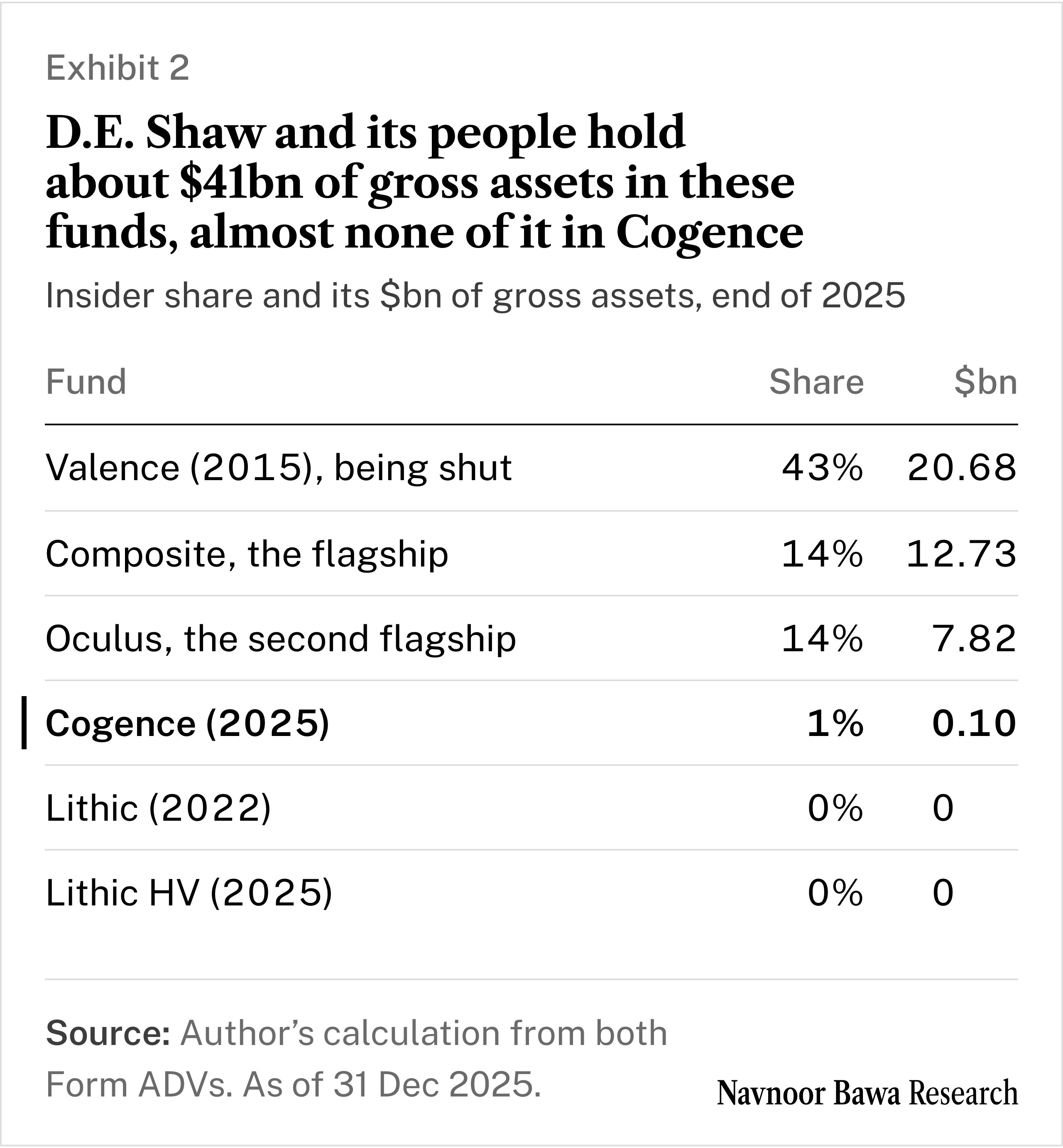
Source: Author’s calculation from the Form ADVs of both D.E. Shaw advisers, D. E. Shaw & Co., L.P. and D. E. Shaw Investment Management: Schedule D, questions 11 and 14 · as of 31 Dec 2025 · gross assets include borrowing · each share is a whole percent as filed, so each dollar figure is approximate · Valence’s excludes affiliated funds’ stakes.
A staff fund is coming too, an internal pool for the firm’s “most capacity-constrained systematic equity and futures strategies“ that outside clients can’t enter. “Roughly half of the new fund will be funded by staff, with the remainder allocated from Composite,” the same report said.
On 5 November 2026 the firm filed Form Ds for D. E. Shaw Phasor Fund and Phasor International Fund, hedge funds yet to make a sale. The employee fund, reportedly named Phasor, would “only be accessible to staff“, at a 4.5% management fee and a 45% performance fee, and start in January 2027.
Cogence’s Form D amendment of about 30 July 2027 will show what its second year sold. Until then, the odds come from the launch record and the roll, the outside money Valence and Multi-Asset move into Cogence, set against the break-even: what they must move for a second year at the launch record’s median pace to match the first.
→ D.E. Shaw’s 2023 fight against a healthcare landlord’s merger, rebuilt from its 13D filings, Trade File No. 10 on Patreon.
Can the money leaving Valence and Multi-Asset make Cogence’s second year sell as much as its first?
Below the paid line:
The verdict on Cogence’s second year, our odds beside the launch record’s, and six launches’ first and second years.
The model of the roll in two sensitivity tables, and the break-even it turns on.
A client’s exit terms, a test in four steps for any new fund, the next firm, and dated thresholds.