


In April, Citadel’s commodities head, Sebastian Barrack, told a Lausanne summit that 2022 raised margin requirements about 15-fold. His frame is volatility, which markets, he said, failed to price adequately before the US-Iran conflict.
The plainer question is how a hedge fund’s unrated trading arm can stand on the other side of producers’ hedges without the producer posting margin. If Citadel’s gas money were exchange volatility trading alone, its trading arm would need no seat in any producer’s bank line, and producers’ agreements show it holding several.
I read part of the answer in those agreements: the $5 million seat, a lender’s place in a producer’s bank line, held by Citadel Energy Marketing, Citadel’s gas trading arm. The seat would secure any swap the arm writes with that producer. It lets a producer hedge with Citadel’s unrated trading arm without posting margin, and it puts a trading house beside its banks in the collateral.
I searched EDGAR for every document that names Citadel Energy Marketing: none was filed by Citadel.
The chapters follow the gas from the producer to the seat:
Citadel’s trading arm ranked sixth by US gas volume in 2024; it buys from producers and, since February 2026, has a contract to sell to an export plant.
Producers’ banks make them hedge, at least 65% of expected output from producing reserves at one line, and the counterparty tests ask for a credit rating the trading arm lacks.
A $5m seat would secure any swap the arm writes with a producer, and one producer says it would post collateral without that security.
Before any seat, the arm lent a gas royalty company up to $100m; Citadel has since bought a gas producer’s assets.
The paid chapter sizes the hedge book one seat sits beside, with every filing in one table.
Citadel buys America’s gas
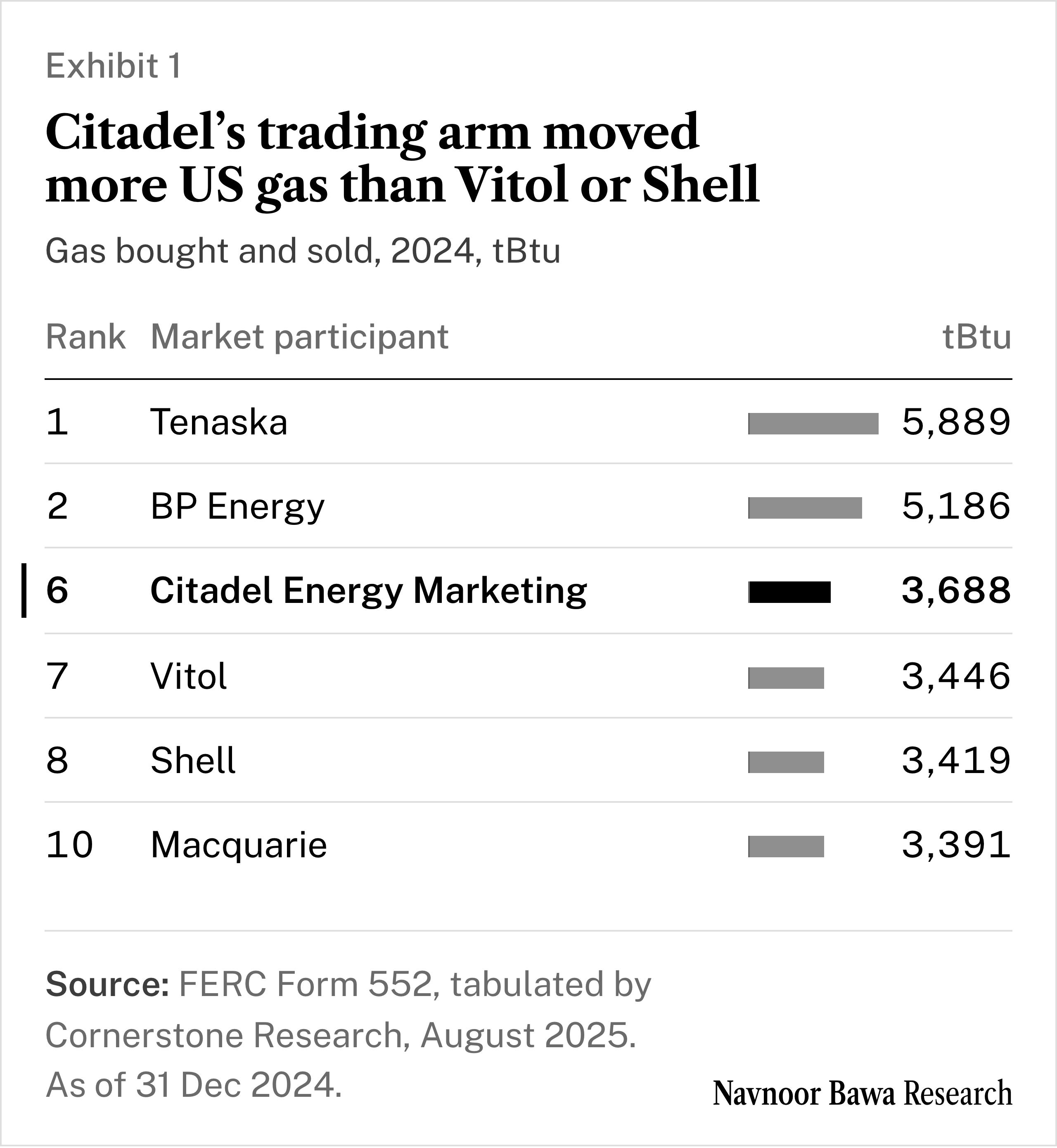
Citadel Energy Marketing trades gas and power for Citadel, the firm Ken Griffin founded. It bought 1,885 trillion British thermal units (tBtu) of US gas in 2024 and sold 1,803. That ranks it sixth among all US gas market participants reporting on the Federal Energy Regulatory Commission’s Form 552, by Cornerstone Research’s tabulation of FERC’s data. The rank adds gas bought to gas sold, so it measures physical volume and says nothing about profit.
On a second base, the country’s use, Hedgeweek, summarising the FT in June, wrote that Citadel Energy Marketing “traded volumes equivalent to roughly 11% of total US natural gas consumption during 2025”.
Both ends of that book are filed by other companies. At the selling end, Venture Global’s Plaquemines liquefied natural gas (LNG) export plant signed a transaction confirmation with Citadel Energy Marketing on 26 February 2026. By its filing to the Department of Energy, “Plaquemines LNG will purchase natural gas on a long-term basis from Citadel”, for two years at 36.5 tBtu a year, about 2% of what the arm sold in 2024. That is a merchant gas book: gas bought, moved and sold physically.
At the buying end, CNX Resources, a large Appalachian gas producer, names a customer only above 10% of its revenue from contracts with external customers: CNX’s 10% line. It named Citadel Energy Marketing for 2021, 2023, 2024 and 2025. Its 10-K for 2025 puts Citadel third of three that year, at $206.0m. NRG Business Marketing bought $223.2m and DTE Energy Trading $208.8m.
Every credit agreement that seats Citadel Energy Marketing as a Lender is signed for it “By: Citadel Advisors LLC, its Manager“, the hedge fund’s own adviser, so the gas book sits in the fund’s commodities business, which Barrack runs.
Hedgeweek, citing Bloomberg’s sources, put that business’s profit at about $8bn in 2022, half the firm’s total. Bloomberg reported about $4bn, half that, in 2023 and again in 2024. By late December 2025, as gas profits fell, the business was on course for only a slight profit for the year, by Hedgeweek’s same account.
The seats can protect that book; they do not show that it pays.
Margin is the merchant’s problem
A producer that sells gas forward at a fixed price owes the buyer the difference when prices jump. So a spike hands the buyer a large claim on a producer whose forward sale is under water. Margin is collateral posted against a contract’s mark, and it is where volatility reaches cash. If the contract is margined, the producer must post cash at the worst moment; if it is not, the buyer carries the producer’s credit risk with nothing behind it.
Producers’ banks have a say in that hedging. A reserve-based loan is a bank line secured by a producer’s oil and gas reserves, and the Federal Reserve’s guidance on them, SR 16-17, tells banks to consider requiring “hedges for commodity price volatility”. It adds that covenants should make borrowers get “the financial institution’s approval prior to lifting any hedges upon which the institution is relying”.
Some lines turn that advice into a duty. Diversified Energy, another producer, must hedge at least 65% of anticipated production from its producing reserves over the next 12 months. The lines of TXO Partners, oil-weighted by revenue, and of PEDEVCO, another, set floors of their own. A producer under such a line must hedge while its floor binds, and where the bank relies on the hedge, it must hedge with a counterparty the line approves.
The tests are written as credit ratings: BBB or Baa2 for a hedge counterparty in Diversified’s line, BBB+ or Baa1 in CNX’s. Citadel Energy Marketing has no rating from a recognised agency, and in July 2025 TXO’s banks put that in writing.
Other lines skip the rating and name approved counterparties, and the names are merchants. PEDEVCO’s credit agreements list Citadel Energy Marketing as an approved hedge counterparty beside BP Energy, EDF Trading, NextEra Energy Resources and Cargill.
Outside the producers, the July 2023 credit agreement of Temple Generation, a gas-fired power plant, which BKV filed in May 2026, names it a “Qualified Commodity Counterparty“ beside the trading houses J. Aron, Shell, BP Energy, Mercuria and four others. Where a line names no one, an unrated merchant has one door left: a lender’s seat.
What a $5 million seat buys
CNX shows the whole mechanism in two documents. Its Fourth Amended and Restated Credit Agreement of May 2024 signs Citadel Energy Marketing “as a Lender“ with a $5m commitment, the amount a lender stands ready to fund, in a $1.4bn line. Citibank and Goldman Sachs Bank USA hold the same $5m. Three definitions turn that commitment into protection:
A “Specified Swap Agreement” is any swap with a counterparty that is “a Lender or an Affiliate of an entity that is … a Lender”, so any swap Citadel writes with CNX qualifies.
A swap there includes a “forward contract … relating to Hydrocarbons or power”, so a fixed-price forward purchase of CNX’s gas would qualify too; an index-priced physical purchase would not.
The “Secured Parties” include “any provider of a Specified Swap Agreement”, so anything CNX owes Citadel on those contracts is secured by the line’s collateral, ranking equally with the loans’ principal, never ahead.
CNX’s 10-K for 2025 says what that security is worth:
“None of the Company’s counterparty master agreements currently require CNX to post collateral for any of its positions. However … if CNX’s obligations with one of its counterparties cease to be secured on the same basis as similar obligations with the other lenders under the CNX Credit Facility, CNX would have to post collateral for instruments in a liability position in excess of defined thresholds.”
Security on the same basis as the banks is what spares CNX the margin; take it away and the margin comes back. Five million dollars is small change for Citadel, so the seat is easy to read as a courtesy. The definitions ask only whether the counterparty is a Lender, and CNX ties its collateral to that security: the $5 million seat buys a status, and the status does the work.
The seat moves margin rather than abolishing it. If Citadel offsets a producer’s fixed-price sale with futures, a price spike calls cash from Citadel at the exchange, and Barrack said the sector met this year’s shock with “larger capital buffers and more robust funding lines“ after the windfall of recent years.
California Resources, an oil-weighted producer, seated Citadel Energy Marketing in November 2024 for $5m, and Citadel signed again in September 2025. BP Energy, a unit of an oil major, holds the identical seat on that line: merchants used the seat before Citadel did.
TXO shows what the banks agreed to. Its Amendment No. 5, dated 31 July 2025, brought in Fifth Third, Mizuho and Citadel Energy Marketing as New Lenders. Its definition of a Potential Defaulting Lender, a lender that may default, takes in one with “a non-investment grade rating from Moody’s or S&P or another nationally recognized rating agency”.
The banks wrote one sentence for the newcomer, which the agreement calls Citadel:
“Citadel shall not, and at no time will Citadel, constitute a Potential Defaulting Lender solely because it does not have a rating from a nationally recognized rating agency.”
They wrote it “for the avoidance of doubt”: the definition catches a lender with a non-investment-grade rating, and the banks shut out any reading that would treat a missing one the same way. TXO’s line also secures “Lender Hedging Obligations”, those “under any Hedge Contract or any Gas Sales Contract” with a Lender. There the seat would also cover physical gas sales, even contracts signed before the counterparty became a Lender.
Diversified Energy shows the seat most plainly. Citadel Energy Marketing first appears in its lender schedule with the third amendment of 30 April 2026, where it holds a $5m maximum credit amount beside the $5m of Mercuria, a rival merchant.
The line’s hedge counterparty is “(a) any Secured Swap Provider or (b) any other Person” rated BBB or Baa2, and a Secured Swap Provider is “a Lender or an Affiliate of a Lender”. Without an S&P or Moody’s rating of BBB, or a guarantor that has one, the seat was the way in.
The four producers’ filings name Citadel as a Lender, and CNX’s as a customer too, but none as a hedge counterparty: the seats show which hedges would be secured, and none shows that one is live.
A loan, then gas wells
Before any seat, Citadel Energy Marketing made a loan. WhiteHawk Income, a gas royalty company, signed a credit agreement “dated as of August 3, 2023, by and among … the Issuer, as borrower … and Citadel Energy Marketing LLC“. Its S-1 describes “a senior secured term acquisition facility with a maximum amount of $100 million … at 12% per annum”.
That loan did not last. In September 2024, notes bought by two outside groups, Pacific Indemnity and three EIG funds, replaced it, and Citadel became the “Initial Swap Counterparty”. The notes’ hedge test reads “(a) Citadel Energy Marketing LLC or (b) any other Person” rated A-/A3, so the trading arm qualified by name, not by rating.
In May 2026 the notes were amended and restated, and WhiteHawk added a bank-led reserve-based loan in which Citadel Energy Marketing holds no seat. Its existing trades with Citadel stay secured, and that agreement contemplates moving them to one of the line’s lenders. Others took the lending; even the trades may follow.
Then Citadel became an owner. In March 2025 it agreed to buy the Haynesville assets of Paloma Natural Gas, a gas producer, for about $1bn by Bloomberg’s count and $1.2bn by East Daley Analytics’, a quarter to 30% of what its commodities business made in 2024.
Said, March 2025: Bloomberg reported that Citadel would not operate the assets directly. A Citadel spokesperson told it: “Investing in the growth of independent gas producers helps to ensure America’s energy independence,” and “Citadel performs an important role in that effort.”
Reported, December 2025: Paloma, renamed Apex Natural Gas, “currently operates nine rigs in northwest Louisiana“, The Center Square wrote, the state’s most active driller by the Louisiana Oil and Gas Association’s count. In May 2025 East Daley had called Citadel’s long-term strategy “a mystery” and its near-term focus to “increase Haynesville drilling”.
Filed, May 2024 to August 2026: the role Citadel performs for four independent producers is narrower: a seat in each one’s bank line that owns nothing.
→ Citadel’s four seated producers, each one’s hedge book against its bank loans from 2021 to 2025, screened from their 10-Ks, a separate note on Patreon.
How large a book of producer hedges can one $5 million seat put beside the banks, and what does that make the seat?
Below the paid line:
The size: the hedge book one seat sits beside at CNX, from CNX’s own figures, against the seat’s cost.
The three seats whose schedules print an amount, on one base, with the arithmetic.
All ten companies’ filings, by role and filing date.
The verdict with our odds, the line that proves it wrong, and three dated checks.