


Primary Sources · Investor Letters · 13F Filings · Verified Trade Mechanics · March 2026
By Navnoor Bawa · YouTube: The Mathematical Trader
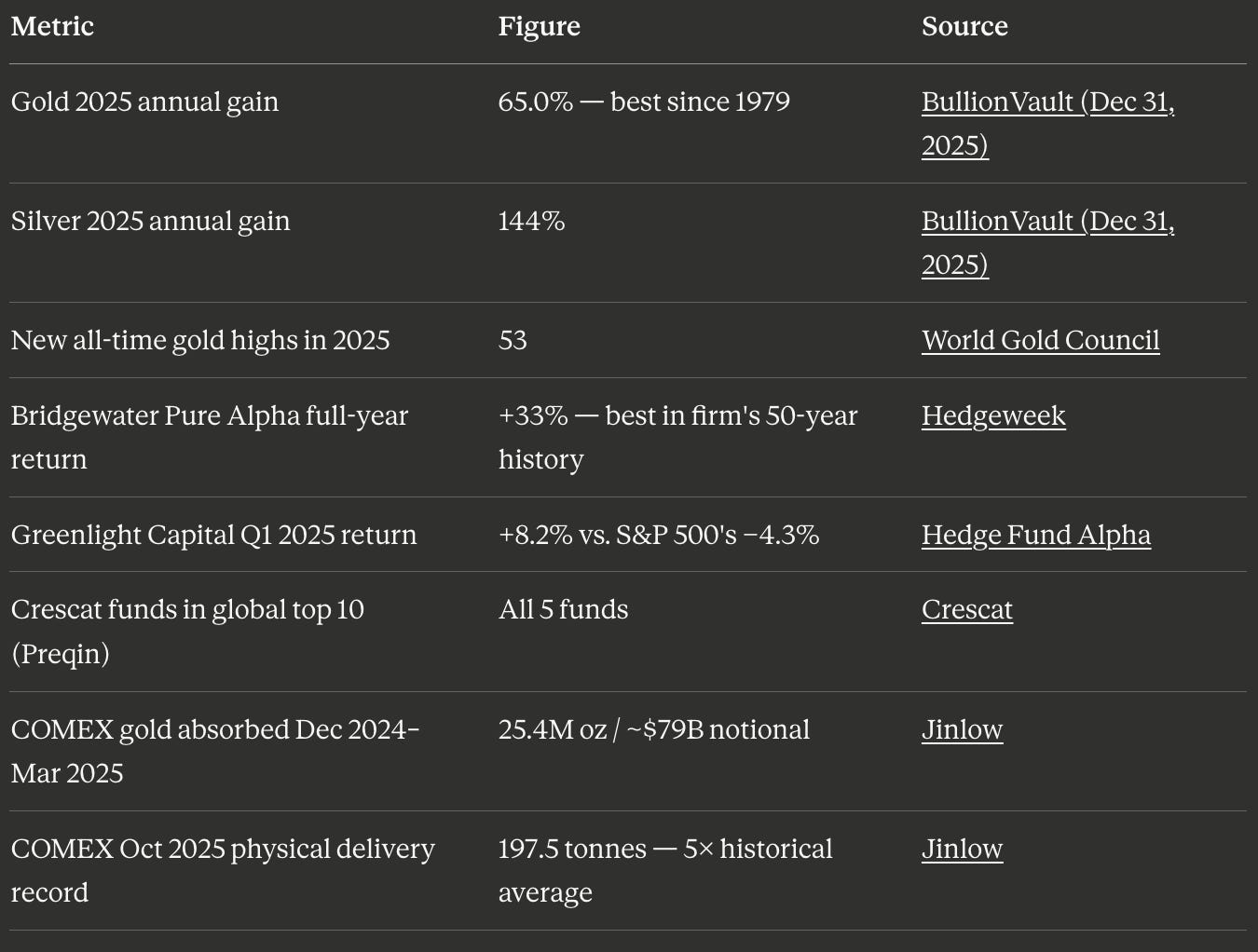
Gold rose 65%. Silver surged 144%. Bridgewater logged its best year in 50 with a +33% gain. Crescat’s Precious Metals Fund hit ~+92% through mid-year, putting all five of its funds in the global top 10. Greenlight’s gold bet was called “by far the biggest winner” in Einhorn’s own investor letter. Tudor Jones increased his GLD position by 49%. Druckenmiller re-entered on a currency thesis. And Brevan Howard’s $34 billion flagship returned just 0.8% — 32 percentage points behind Bridgewater in the same asset class, in the same year. This article traces every trade from primary sources — investor letters, 13F filings, COMEX data, and named interviews — so you can verify everything
📌 This article is also published in full on Patreon with the complete institutional trade log, evidence classification, and sourced mechanics. → Read the full Patreon version here
🎬 Prefer to watch instead of read? I’ve put together a full video breakdown of everything in this article. → Watch the video on YouTube
Key Numbers at a Glance
The Macro Setup: Why Every Signal Fired at Once
Precious metals rallies are not unusual. What made 2025 different — structurally, not cyclically — was that four independent demand drivers fired simultaneously and compounded each other.
The U.S. fiscal deficit hit $1.8 trillion in fiscal year 2025, ballooning the national debt to a record ~$38.4 trillion by year-end — growing at an average of $6.12 billion per day through late 2025. Real yields collapsed as the Federal Reserve reversed its hiking cycle. Tariff threats triggered a continent-scale logistics panic that moved $79 billion of gold across the Atlantic in four months. And full-year 2025 global gold demand surpassed 5,000 tonnes — a new record, driven almost entirely by investment and sovereign buyers.
The convergence produced gold’s highest annual gain since 1979 at 65.0%, with the price setting 53 new all-time highs over the year. This was not a momentum trade. It was a regime repricing — and the funds that recognised it early, through mechanism rather than narrative, captured extraordinary returns.
Crescat Capital’s August 2025 investor letter, titled “America’s Twin Deficit Trap,” framed the structural case precisely:
“The US now faces a textbook twin deficit problem: a swollen fiscal shortfall on one side and a trade imbalance on the other... Today’s imbalance, by contrast, is structural, not cyclical. Pair what we see as a likely multi-year decline in the US dollar with a 7% fiscal deficit and an AI- and onshoring-driven construction boom, and the outcome is unavoidable in our view: inflation is likely to remain an entrenched and unresolved problem.”
Trade #1 — Greenlight Capital: The Investor Letter Speaks for Itself
Most hedge fund gold theses in 2025 are inferred from returns or 13F data. Greenlight Capital’s is different: it is directly documented, in Einhorn’s own words, in a quarterly investor letter published in full on Hedge Fund Alpha — making it one of the best-evidenced precious metals trades of the year.
Primary Source — Q1 2025 Investor Letter, April 2025: Greenlight Capital Q1 2025 Letter — full text, Hedge Fund Alpha
“In the macro portfolio, gold was by far the biggest winner. It advanced 19.0% during the quarter. We hold part of the position in gold bars and part in call options. We also made profits on our previously discussed inflation swaps and SOFR futures positions.”
Greenlight Capital returned 8.2% net of fees in Q1 2025, against the S&P 500’s −4.3% decline, according to Reuters — a 12.5 percentage point outperformance in a single quarter. The fund’s dual structure — physical gold bars providing non-correlated baseline exposure without ETF management fees, combined with call options for leveraged upside without full capital outlay — is a textbook asymmetric precious metals construction.
Institutional Investor confirmed that Greenlight also made money on inflation swaps and SOFR futures during the same period, constructing a full macro book rather than a single commodity bet.
At the Sohn Investment Conference in May 2025, Einhorn told CNBC he’d be “really happy if gold went to $3,500 or $3,800” but “really unhappy if it went to $30,000 or $50,000” — a disciplined expression of range-bound fiscal-default hedging, not hyperinflation panic. The distinction determined his position sizing and exit threshold. Gold briefly peaked near $3,500 in April 2025.
Greenlight gained an additional 3.4% in April, making it one of the year’s top-performing funds with an 11.9% gain through the first four months — a period when the S&P 500 was down 5.3% and the Nasdaq was down 9.65%.
“We suspect we are now in a bear market that is just starting.” — Greenlight Capital Q1 2025 Investor Letter — Reuters · Hedgeweek · Institutional Investor
Trade #2 — Paul Tudor Jones: Fortune Interview → 13F-Verified Execution
Tudor Jones is one of the few managers whose gold thesis is both publicly declared and independently verifiable through SEC filings — a rare combination that allows a clean arc from conviction to capital deployment.
Primary Source — Fortune Interview, October 2024 + SEC 13F Filing, Q3 2025:
In an October 2024 Fortune interview, Tudor Jones recommended investors buy gold because the U.S. was on an “unsustainable fiscal path,” noting that throughout history civilisations have “inflated away their debts” by printing more money — a structural tailwind for hard assets. This was a thesis declared a full year before the 2025 rally peaked.
Tudor Investment Corp’s Q3 2025 13F filing showed Tudor increased its SPDR Gold ETF (GLD) position by 49% while trimming holdings in Apple and Alphabet. GLD gained 64% in 2025. Tudor’s full Q3 2025 13F portfolio — 3,277 holdings with a portfolio value of $57.48 billion — is publicly accessible via GuruFocus.
The 13F covers only equity-style holdings. Tudor’s futures positions and OTC gold contracts — not disclosed in the 13F — are almost certainly larger. The visible 49% GLD increase is therefore a floor on total precious metals exposure, not a ceiling.
Trade #3 — Crescat Capital: The Activist Metals Strategy Nobody Covers
While Tudor Jones, Einhorn, and Druckenmiller attract headlines, the most concentrated and verifiable precious metals outperformance in 2025 came from Denver-based Crescat Capital — a firm most financial media ignore.
Primary Source — Preqin Database Rankings, January 22, 2026:
Through December 31, 2025, all five of Crescat’s funds ranked among the top 10 hedge funds globally according to Preqin, verified against 1,142 funds in the database. The Crescat Precious Metals Fund ranked #1 among all natural resource hedge funds in the eVestment database since its August 2020 inception.
What Crescat Actually Does (Documented in Investor Letters)
Crescat does not buy gold spot, gold ETFs, or gold futures. They take activist stakes in exploration-stage gold and silver mining companies, lead or co-lead private placements at negotiated terms including discounts and warrants, and provide on-the-ground geological expertise via full-time Geologic and Technical Director Dr. Quinton Hennigh.
Entry: Lead or co-lead private placements in exploration-stage mining companies at discounts to market price, receiving warrants. Geographic focus: British Columbia and Yukon, Canada. — Source: Crescat Investor Letter, October 2025
Edge: In-house geological expertise. Dr. Hennigh visits portfolio companies in the field, assessing drill results and resource estimates before the broader market understands the size of the discovery. — Source: “Positioned For What’s Ahead,” September 2025
Leverage to metal price: Junior mining stocks typically provide 3–10x leverage to the underlying metal price through a cycle — a miner finding 1M gold-equivalent ounces at $3,500/oz gold is a fundamentally different economic event than at $2,000/oz.
The Trump administration’s March 2025 executive order on domestic mineral production provided additional tailwind. Crescat’s investor letter noted: “The Trump Administration’s policy shift — led by executive orders, permitting reform, and legislation — has lit a fire under the domestic mining industry unlike anything seen before.”
Trade #4 — Bridgewater Pure Alpha: The Right System in the Right Regime
Primary Source — Reuters, December 31, 2025:
Bridgewater’s All Weather fund gained 20.4%, its Asia Total Return fund surged 36.9%, and the China Total Return fund rose 34.2% — all in the same year, confirming the result was systematic framework performance, not a lucky concentrated call.
Global macro hedge funds on average posted 14.96% year-to-date through end-November 2025 (Goldman Sachs data), meaning Pure Alpha’s 33% was 18+ percentage points above the average macro fund. Bridgewater’s regime-identification framework correctly mapped the H1 2025 stagflation environment — falling growth + rising inflation from tariff shocks — to defensive positioning in hard assets including gold. The framework executed correctly across four different geographic sub-funds simultaneously.
“Macro thrives when markets stop moving together. A year where equities climbed while rates and currencies swung is tailor-made for strategies that can go long and short across asset classes.” — Finimize analysis of Bridgewater 2025 results — Source
Trade #5 — Stanley Druckenmiller: Currency Logic, Not Inflation Bet
Primary Source — Bloomberg Interview, February 2025:
The distinction matters. This is a currency thesis, not an inflation thesis: in a world where every central bank seeks a weaker currency, the only “currency” without a sovereign balance sheet risk is gold. This framing correctly predicted the dollar’s 9%+ decline in 2025, which provided a second layer of return for non-dollar holders.
Druckenmiller’s Duquesne Family Office also held positions in gold mining equities alongside the ETF exposure, constructing a leveraged equity position on top of the direct metal holding. Mining equities in 2025 provided approximately 2–3x leverage to the gold price through the cycle, meaning total return from precious metals significantly exceeded the 65% spot return.
The COMEX–London Basis Arb: $79 Billion in 4 Months
The most technically specific and underreported institutional trade of 2025 was not a directional gold bet. It was a pure geographic arbitrage triggered by tariff fear.
Exact Execution Steps
Leg 1 — Buy London Spot: Purchase gold at London OTC spot (400 oz Good Delivery bars) where price was discounted relative to COMEX futures due to the tariff risk premium. Required: LBMA member relationship, OTC credit line.
Leg 2 — Refine and Ship: Route bars through a Swiss refinery (Valcambi, PAMP, Argor-Heraeus) to convert from 400 oz to 100 oz COMEX-compliant bars. Airlift to a COMEX-approved New York depository. Receive a warehouse warrant. Time: 5–10 days. Cost: ~$5–10/oz.
Leg 3 — Short COMEX Futures: Sell short COMEX futures at the premium price, locking in the geographical spread as near-risk-free P&L.
P&L driver: The tariff-fear premium normalised when the threat either materialised or dissipated. Funds with directional gold longs beneath the arb captured an additional 30–40% price move through Q2–Q4 2025 as an unhedged bonus. — Source: Jinlow COMEX Delivery Analysis
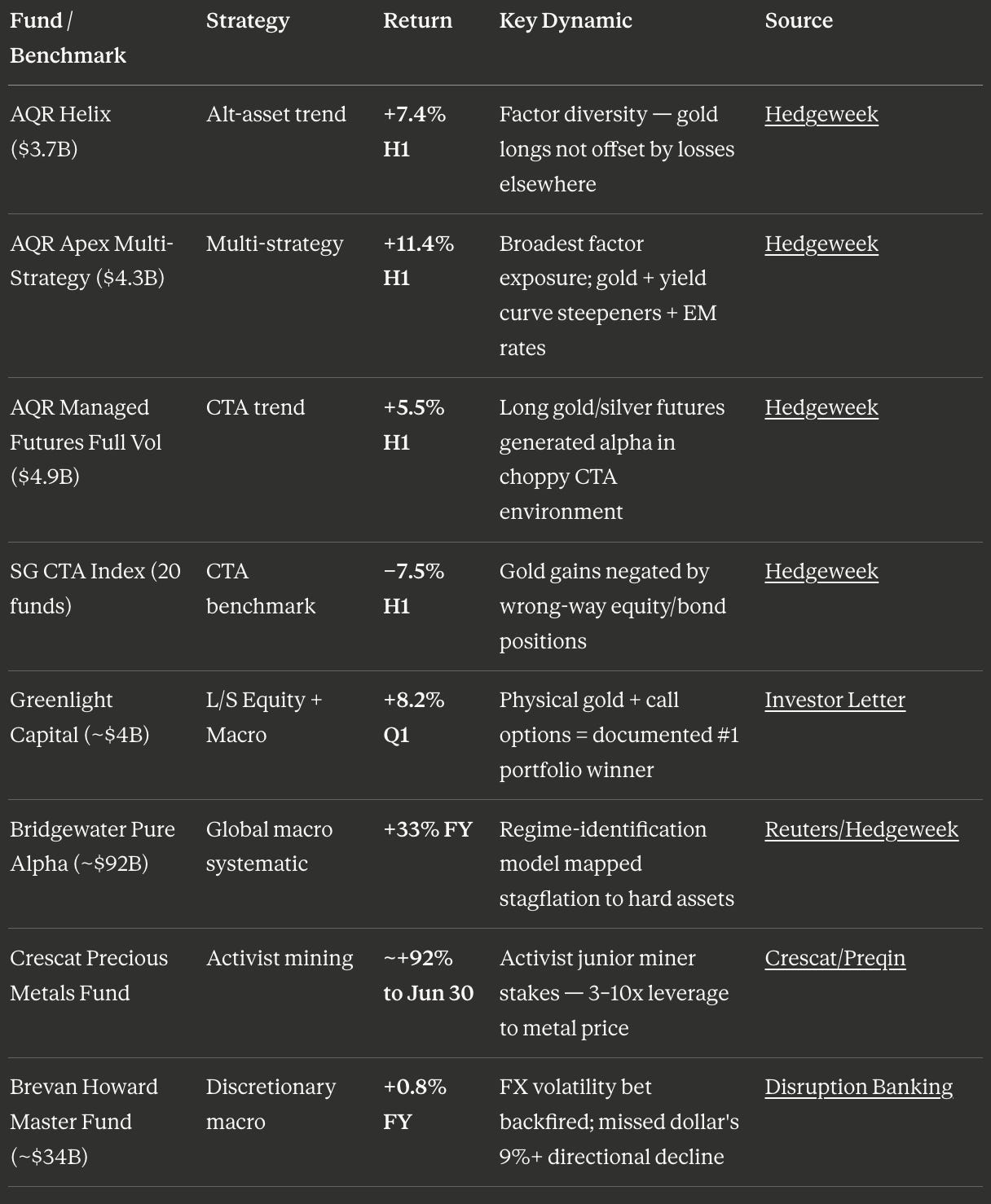
CTA Performance: The 18-Point Dispersion That Proves Mechanism Matters
Why Brevan Howard Lost: The Exact Mistake
Understanding alpha requires understanding the other side. Brevan Howard’s flagship Master Fund gained only +0.8% for 2025 — a full year where macro funds averaged 14.96% (Goldman Sachs), Bridgewater returned 33%, Discovery Capital’s macro fund returned approximately 36%, Rokos returned 21%, and D.E. Shaw’s macro arm posted approximately 28%.
Brevan correctly identified that FX would be turbulent in 2025. But the firm positioned for volatility rather than direction. In a year where the direction of the dollar — down 9%+ — was the primary variable, betting on elevated FX optionality rather than taking an outright directional short was the critical error. The firm was right about the environment; it was wrong about the instrument.
The Bridgewater–Brevan contrast is the cleanest control variable available: two “global macro” funds, same asset class, same year, with a 32+ percentage point gap. The difference isolates exactly what worked — systematic regime-identification with hard asset positioning — and what didn’t — discretionary FX volatility with no commodity allocation.
The Silver Trade: Vehicle Selection Determined Everything
Silver’s 144% return exceeded gold’s 65% by nearly 80 percentage points — the largest silver-gold performance gap in decades. But extracting that return required a specific execution decision. Managers who chose futures struggled; managers who chose ETPs or mining equities captured the move.
CNBC reported that Yung-Shin Kung, CIO of Mast Investments, confirmed some CTA strategies were “outright excluding silver” on execution grounds: “A good meme trade requires low price and low liquidity, and that conflicts with what most trend-following strategies need.” Silver futures markets lack the depth of gold futures — building large positions without creating significant slippage requires patience or an alternative vehicle.
Institutional inflows into silver ETPs reached $40 billion in H1 2025 alone, surpassing all of 2024 — confirming that professional capital entered via ETPs, which sidestep the futures liquidity constraint entirely. Crescat’s November 2025 investor letter noted silver’s designation as a “critical metal” providing an industrial demand floor beneath the monetary narrative, a dual structure that sustained the longer-term hold thesis.
The Physical Delivery Signal That Led the Price
The deepest alpha signal available to institutional precious metals traders is not the futures price or the COT report. It is the CME’s daily Issues & Stops report, which tracks who is converting paper contracts into physical metal — the most direct proxy for structural demand.
Customer “stops” — conversions of paper futures to physical metal — represent permanent extraction. Unlike house-to-house transfers that recycle warrants within the dealer network, customer stops require full reassay to re-enter the COMEX system, creating a one-way flow that tightens available float and provides a structural floor under prices. The October–December 2025 delivery pattern was visible weeks before it hit consensus — an advance warning signal for funds tracking this data.
The 2026 Case: “It Is Still Early”
The most repeated phrase across Crescat’s 2025 investor letters — documented across the September, October, and December 2025 editions — is “it is still early in the cycle.”
The structural drivers remain intact: central bank accumulation continues at 500+ tonnes per quarter, and Goldman Sachs, Bank of America, and J.P. Morgan all forecast gold near or above $5,000/oz by end-2026. Crescat’s August 2025 “Twin Deficit” letter adds: a 7% fiscal deficit, a structurally overvalued dollar, an AI- and onshoring-driven construction boom requiring critical minerals, and 15-year lead times on new mine development — meaning the market cannot supply new production quickly regardless of price.
For institutional allocators, three forward signals are worth tracking:
CME Issues & Stops (daily): Physical delivery acceleration leads price by weeks. The October 2025 record was visible before the price peak.
CFTC Managed Money COT (weekly): Significant de-risking events create reentry opportunities at lower futures crowding levels.
Junior miner valuations vs. gold price: Crescat tracks this ratio obsessively; by their analysis it remains historically cheap despite 2025’s gains.
The funds that made money in 2025 were early, mechanism-specific, and patient through volatility. The ones watching from the sidelines built theses. That gap — between mechanism knowledge and narrative construction — is where alpha is found and lost in equal measure.
📊 Want Deeper Quantitative Analysis?
This research took extensive time of data collection, verification, and analysis — cross-referencing investor letters, 13F filings, COMEX delivery data, and named primary sources across seven major funds.
If you found value in this deep-dive, I publish exclusive quantitative research, trading strategies, and institutional-grade analysis on Patreon. By joining, you’ll be supporting my work and motivating me to publish more content like this.
→ Read the full institutional trade log on Patreon — complete evidence classification, all exhibit tables, and the full post-mortem on every trade including the losing positions.
All Sources
Claim Source Greenlight Q1 2025 investor letter full text Hedge Fund Alpha “We suspect we are now in a bear market” Reuters · Hedgeweek · Institutional Investor Greenlight +8.2% Q1, gold “by far biggest winner” Reuters / Yahoo Finance Greenlight +11.9% through April 2025 Institutional Investor Einhorn at Sohn Conference — gold price targets CNBC / Yahoo Finance Tudor Jones 13F — GLD +49%, Fortune interview Motley Fool Tudor Investment Corp Q3 2025 13F portfolio GuruFocus Crescat all 5 funds top 10 globally (Preqin) Crescat Capital Crescat Q1 2025 — “primary driver of returns” Crescat Q1 Letter Crescat ~92% YTD through June 30, 2025 Hedge Fund Alpha Crescat “America’s Twin Deficit Trap” letter Crescat Aug 2025 Crescat “Positioned For What’s Ahead” Crescat Sep 2025 Crescat “Opportunity to Buy the Pullback” Crescat Oct 2025 Crescat “2025 Strong Performance” Crescat Dec 2025 Crescat Precious Metals Fund strategy page Crescat Bridgewater Pure Alpha +33%, best year in 50 Hedgeweek Bridgewater All Weather +20.4%, Asia +36.9% Reuters / Yahoo Finance Bridgewater regime-identification system Substack deep dive Bridgewater 50-year record analysis Finimize Brevan Howard 2025 underperformance Disruption Banking Druckenmiller currency thesis — gold re-entry Dec 2024/Jan 2025 Monex / Bloomberg Druckenmiller mining equity exposure alongside ETF Vaulted COMEX $79B tariff arb, 153% inventory spike Jinlow Wells Fargo 42,900 oz, Morgan Stanley 44,000 oz delivery Jinlow World Gold Council — tariffs and COMEX/London basis World Gold Council World Gold Council — 5,000t record demand 2025 World Gold Council AQR vs. SG CTA Index H1 2025 Hedgeweek PivotalPath CEO Caplis / Mast CIO Kung on CTAs CNBC $40B silver ETP inflows H1 2025 AInvest Gold 65.0%, silver 144%, best since 1979 BullionVault (Dec 31, 2025) 53 new all-time highs in 2025 World Gold Council Full Year 2025
For informational purposes only. Not investment advice. All fund returns as reported by cited sources from primary filings and contemporaneous reporting. Some fund figures unaudited at time of publication.
Follow Navnoor Bawa: YouTube — The Mathematical Trader · LinkedIn · Patreon — Exclusive Research · 📄 Full Trade Log on Patreon · 🎬 Watch on YouTube
Cover photograph: Web Summit, CC BY 2.0, via Wikimedia Commons.