



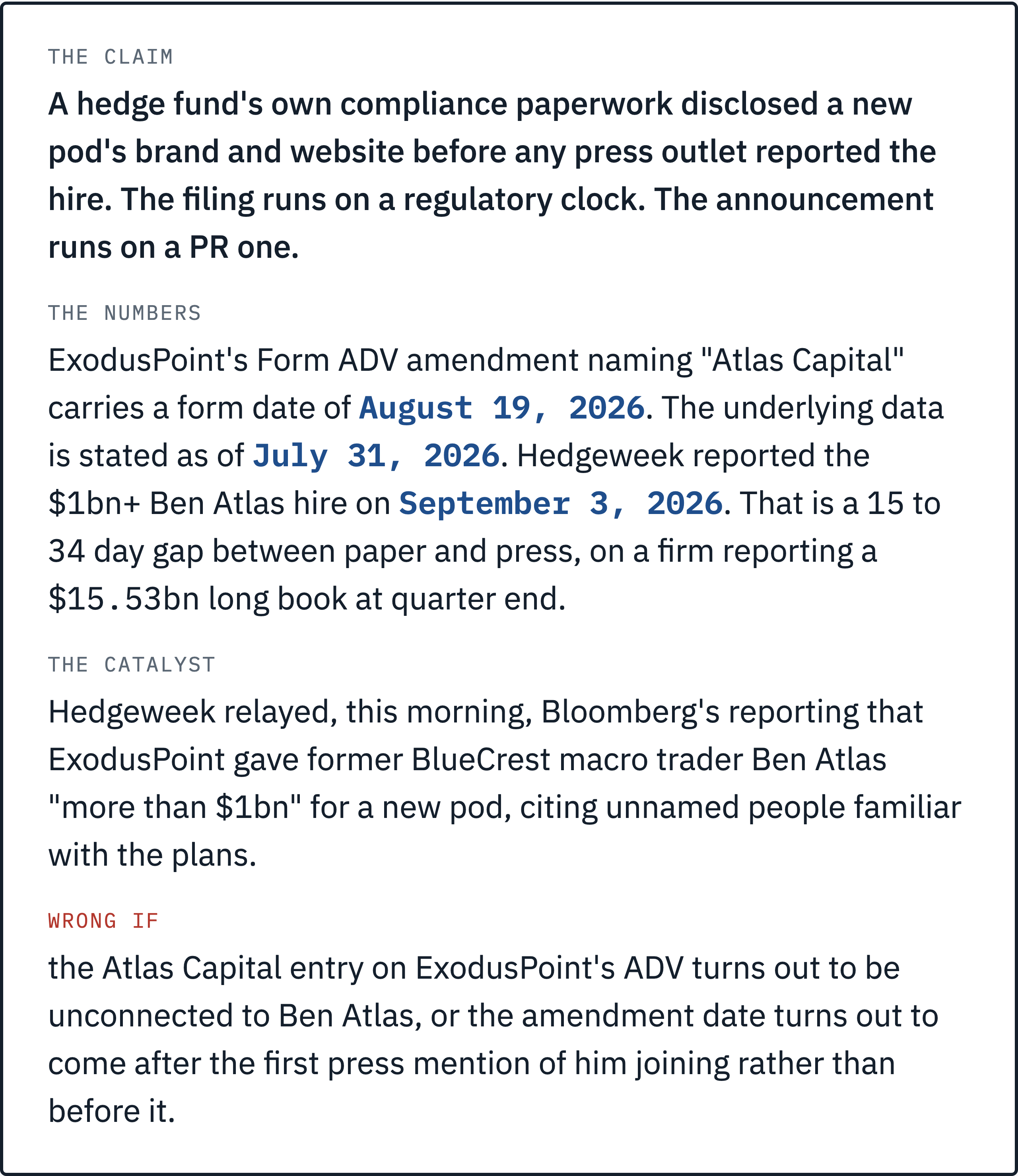
A hedge fund’s own compliance paperwork disclosed a new pod’s brand and website before any press outlet reported the hire.
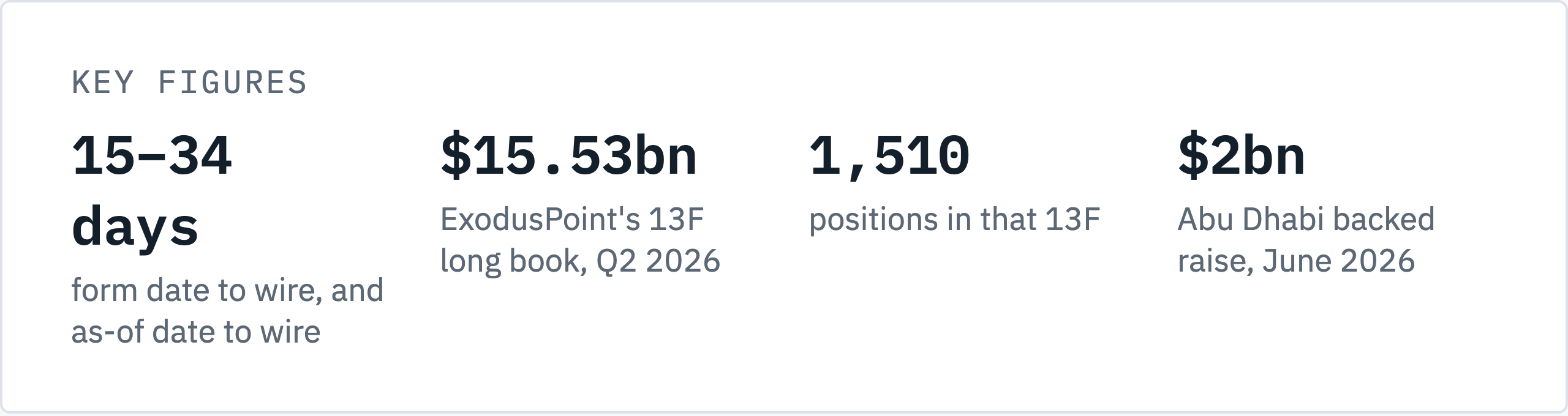
The figures behind all of it, pulled straight from the filings:
Below the paid line:
The full timeline: July 31 (data as of), then August 19 (form date), then September 3 (Hedgeweek)
The exact Schedule D miscellaneous language ExodusPoint filed, quoted verbatim, plus the CIK, CRD and 801 numbers to pull it yourself
ExodusPoint’s June 30, 2026 13F snapshot: $15.53bn reported long book, 1,510 positions, the options split
The $2bn Abu Dhabi backed raise this pod draws against, and what fraction of it $1bn+ represents
WestWind Asset Management: ExodusPoint’s only other prior other name, the 2021 loss event tied to its era, and why its ADV entry is still a live check today
A dated, falsifiable trigger: what to watch for at ExodusPoint’s next annual amendment, due by March 2027
The consensus: a hedge fund hire is a press event
Trade coverage of the multi strategy pod shops treats a new portfolio manager’s arrival the way it treats an earnings beat. A fact exists the day it gets reported. Hedgeweek’s story this morning follows the standard shape. A senior macro trader with a name, Ben Atlas, formerly of BlueCrest, leaves one platform and lands at another with a headline allocation of “more than $1bn.” The story runs. The aggregators pick it up. LinkedIn does the rest. Simple. Familiar.
That reading captures something real. It’s where the information turns usable for a reader. State it at its strongest: trade journalism is the primary record for personnel moves at private funds, because private funds don’t issue an 8-K when they hire someone. There’s no earnings call. There’s no proxy statement. A private multi manager platform’s staffing stays opaque, by design, until somebody with sourcing inside the industry writes it down.
One correction before the variant view: this isn’t the first time someone read an ADV filing
The consensus above has already moved once, and I want to be honest about where. Mining Form ADV for staffing news isn’t unknown. eFinancialCareers already tracks headcount, year over year, at Millennium, Point72 and Jain Global, straight from ADV’s own employee count item, published before those firms say a word about it themselves. That practice is real, and it isn’t what I found. Headcount is one number, filed once a year, aggregated across an entire firm. Different field. Different clock. Schedule D’s other business names section is a different field entirely, filed the moment it changes, naming one pod at a time. Nobody appears to be reading that field yet.
I don’t think the press comes first, not here. I can point to the document that says so.
The variant view: the SEC already had it
ExodusPoint Capital Management, LP is registered with the SEC as an investment adviser under CRD number 294156, SEC file number 801-112901. I expected its filing history, if it showed anything at all, to read as routine housekeeping. I pulled its SEC investment adviser record directly, on the IAPD system the SEC runs specifically for adviser filings, separate from EDGAR, to check. It did not read as housekeeping. The most recent filing on record is not the annual amendment every adviser owes once a year. It is an “Other-Than-Annual Amendment, All Sections,” and the generated form itself carries the date 8/19/2026 5:50:30 PM. A specific name. A specific date. Not housekeeping.
Schedule D’s miscellaneous section exists so an adviser can explain, in its own words, what an amendment actually changed. Here is ExodusPoint’s own ADV brochure, quoted verbatim:
“This Other-than-Annual Amendment reflects the addition of Atlas Capital in Schedule D, Section 1.B and the associated website for Atlas Capital in Schedule D, Section 1.I. Further, Item 5.B(3), Schedule D(1.F), and Schedule R(4.A) were updated as of July 31, 2026.”
Section 1.B of that filing lists “Name: ATLAS CAPITAL,” registered in New York. I checked the actual jurisdiction grid rather than trusting the label list a plain text export throws back: of the 55 state and territory boxes on that page, exactly one is checked. Section 1.I lists its website, atlas-capital.com, next to ExodusPoint’s own site and its LinkedIn and Glassdoor pages. That’s the same name AlphaMaven’s aggregation of the Ben Atlas story carries for the pod he’s said to be launching later this month, though AlphaMaven’s own byline field credits Hedgeweek, so this is one wire syndicated twice, not two separate confirmations. Weigh it that way rather than as double corroboration.
Three dates, one document, one wire story. July 31 is when the underlying change was already true. August 19 is when ExodusPoint told the SEC. September 3 is when Bloomberg told the market, with Hedgeweek and AlphaMaven both relaying the same reporting. The compliance record beat that story to this hire by at least fifteen days. Measured against the date the underlying change was reported true, it beat it by more than a month. Paper first. Wire second.
I checked the obvious falsifier before writing a word of this. Is Atlas Capital a name ExodusPoint has used for something unconnected to Ben Atlas? I found no other candidate. The name is new to this amendment. Nothing in ExodusPoint’s filing history before August 19 carries it. No prior use. The falsifier does not land. I also checked the domain live while drafting: atlas-capital.com doesn’t currently resolve. A registered brand, waiting on its own launch.
The mechanism: why the paperwork runs ahead
The credit belongs to SEC Rule 204-1, a function of how the rule actually works, no leak and no clever detective work on my part.
Registered advisers file Form ADV’s annual amendment once a year, within 90 days of fiscal year end. The SEC’s own General Instructions require something else too. Additional amendments, filed promptly, whenever information reported under Item 1 becomes inaccurate. Other business names live inside Item 1, in Section 1.B. The instructions carry real teeth: “failure to update your Form ADV, as required by this instruction, is a violation of SEC rules or similar state rules and could lead to your registration being revoked.” Real teeth. Compliance does not wait for a press cycle.
A firm cannot wait for its annual cycle to disclose a new trading name once that name is actually in use for advisory business. That’s the exact phrase the form uses: Section 1.B asks for any additional names under which the adviser conducts its advisory business. Registering Atlas Capital is not a marketing flourish. It is ExodusPoint telling the SEC it is, or will imminently be, legally doing business under that name. A regulatory act with a deadline attached. Nothing softer than that.
A press announcement runs on an entirely different clock. It waits for the hire to close. It waits for both sides to agree on language. It waits for a trade reporter’s sourcing to come together. None of that carries a regulatory deadline. The compliance filing has one. The news story doesn’t. That asymmetry is the whole mechanism, and it isn’t personal. Nobody at ExodusPoint is trying to bury this in EDGAR. The filing exists because the rule requires it, on a timeline the rule sets, whatever the trade press decides to do with the story later.
I turned the actual checking process into its own walkthrough, the exact CRD lookup, the PDF field to read, and the jurisdiction checkbox mistake that cost me a correction inside this very piece. The Five-Minute ADV Check has all of it, so you can run this same check on any adviser yourself, not just this one.