



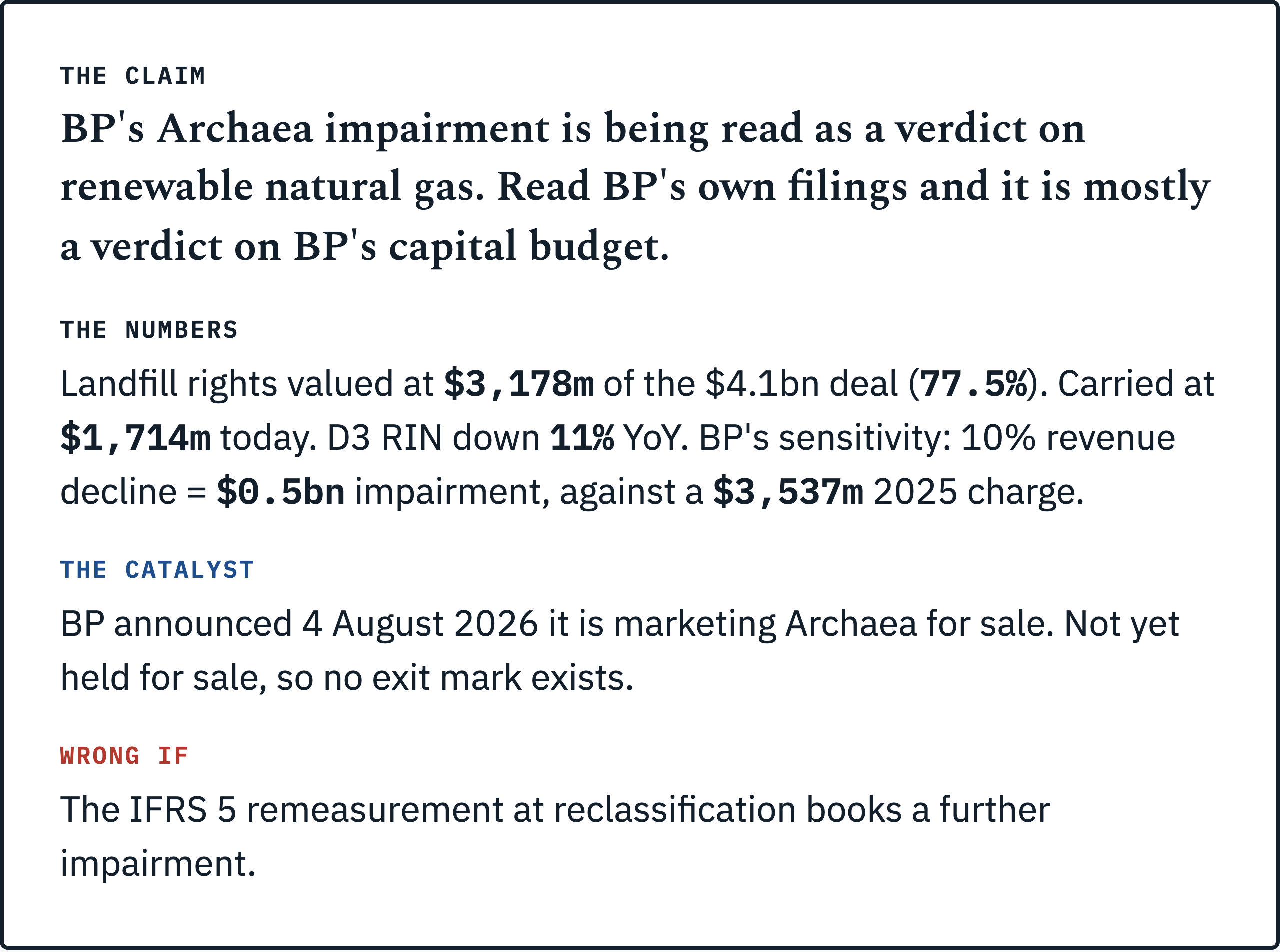
BP’s Archaea impairment is being read as a verdict on renewable natural gas. Read BP’s own filings and it is mostly a verdict on BP’s capital budget: the company impaired an asset it had decided to stop funding, and is now selling it.
The consensus is that Elliott won and the green bet died
I want to state this at its strongest, because the strong version is largely true. Elliott Management built a stake near 5% in BP through early 2025, worth roughly £3.8bn, about $4.75bn, and pushed for a return to hydrocarbons (Financial Times, via BOE Report, February 2025). The February 2025 reset cut transition spending and raised oil and gas investment. Murray Auchincloss stepped down as CEO in December 2025. Meg O’Neill took over in April 2026, after an interim stretch under EVP Carol Howle. Chairman Albert Manifold, in the seat only since October 2025, was ousted in May 2026 over “governance standards, oversight and conduct” concerns (Al Jazeera, May 2026). That was a conduct scandal, not another domino in the strategy story, though the board has now turned over almost completely regardless. Since the reset, BP has sold the Gelsenkirchen refinery, agreed to sell Austrian retail, announced its exit from the UK North Sea, and now Archaea.
On that reading, Archaea is the tombstone. BP paid $4.1bn at the top of the transition trade in October 2022, promising around a five fold increase in Archaea’s own RNG production by 2030 and total bp biogas supply near 70,000 boe/d (bp, October 2022). Nearly four years later it is selling into a repriced category. A $4bn round trip, and a shareholder base that got what it asked for.
My read is that this story is right about the politics and wrong about the asset. It does not survive contact with BP’s own sensitivity disclosures.
BP bought contracts, and 77.5% of the price was the contracts
The most useful line in BP’s accounts is one I have not seen quoted anywhere. When BP finalized its purchase price allocation for Archaea in 2023, it recognized $3,178m of intangible assets, down from a provisional $3,475m. The filing describes these as “primarily the biogas rights agreements Archaea Energy has with landfill owners” (20-F 2023, Note 4).
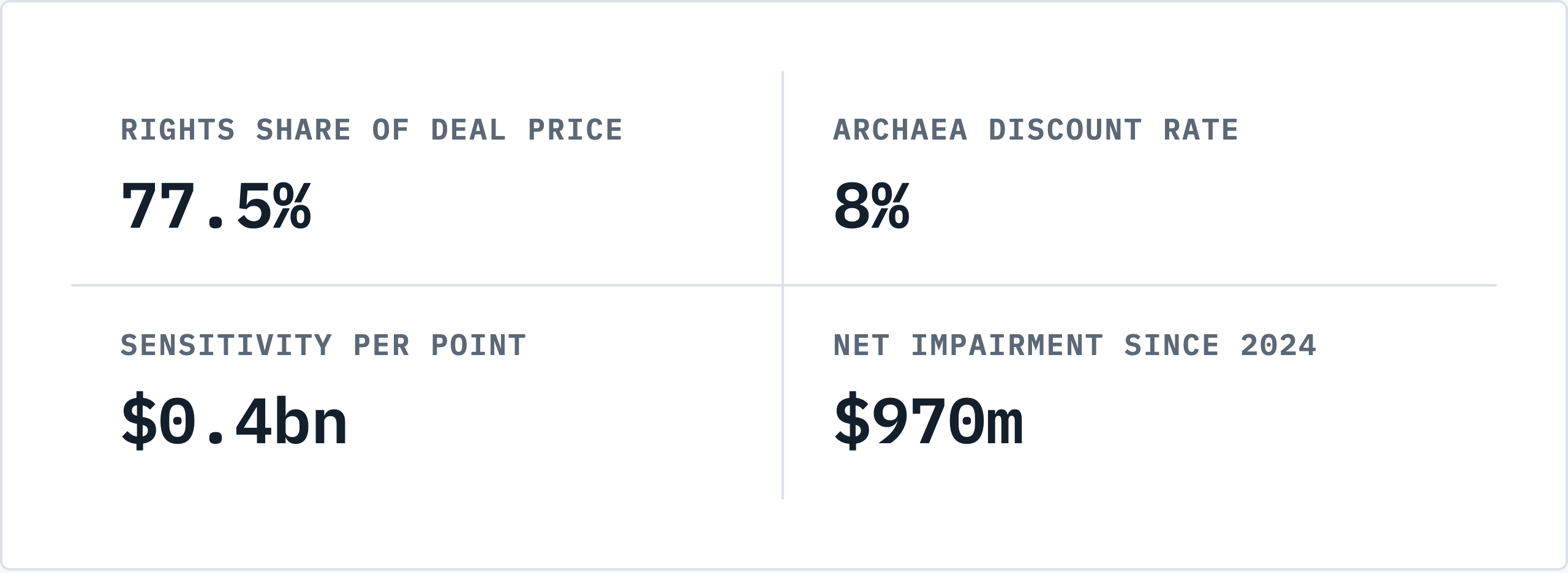
That is 77.5% of the $4.1bn enterprise value, and I make it the single most important number in the whole file. More than three quarters of what BP actually booked was the contractual right to landfill gas, not the plants that turn it into pipeline methane. Archaea was an option strip: long agreements with landfill owners, each giving BP the right to take the gas, each worth nothing until a plant gets built on top of it.
For anyone who hasn’t underwritten one of these, a landfill gas rights agreement sits closer to an undrilled acreage position than a producing well. You pay today for the option to spend capital later. It’s worth what you expect to spend, and it collapses when you stop spending.
By 31 December 2025 the intangible was carried at a cost of $2,983m and a net book value of $1,714m. Two measures matter here. The clean, single year, impairment only figure: $710m of impairment against this line in 2025, less an $84m reversal, net $626m, or 25.7% of the $2,433m the rights were carried at going into the year. The blunter since acquisition figure runs from the finalized $3,178m acquisition value to today’s $1,714m, a 46% decline, but that blends impairment with three years of ordinary amortization and the 2023 remeasurement, so it overstates the write down. The itemizable pure impairment total is $344m in 2024 plus $710m in 2025 less $84m reversed, net $970m, roughly 31% of the acquisition value, taken almost entirely since the reset began.
The same annual report says Archaea grew
This is the part I keep coming back to. In the year BP impaired its transition businesses by $3,537m, BP’s own strategic report says: “Our biogas business, Archaea Energy, continued its growth, starting up eight new renewable natural gas (RNG) landfill plants in 2025.” Two came online in the fourth quarter, Middle Point and NW Tennessee, for “a total capacity of more than 6 million mmBtu.” Since 2023 Archaea has added 19 landfill plants and 18 million mmBtu per year of capacity. In December it signed a biomethane offtake with Osaka Gas Trading and Export.
Deloitte brought in its own “Landfill Production Specialists” to test the long run production rates, which I’d read as a risk flag rather than a health signal. More useful is a different line in the same audit passage: Deloitte tested BP’s plan for “consistency with bp’s capital frame” (20-F 2025, auditor’s report), real corroboration of the capital reading, sitting in the same paragraph as the plant count.
Set that against the national picture. The American Biogas Council counts 20 new landfill gas projects online across the United States in 2025, and says all of them produce RNG (ABC, July 2026). Archaea built eight of them, two in five by project count. On a capacity basis it’s smaller still: the Council’s 20 projects added 39.9 Bcf nationally in 2025, against roughly 6 Bcf from Archaea’s eight plants, call it 15% of the country’s new landfill biogas capacity. That’s a meaningful minority, not the “close to three quarters” I derived in an earlier pass. I’d mispaired a different sentence in the same release, about a separate, larger 2020-2025 count, onto the 20 projects of 2025 alone.
I still don’t read any of this as the audit trail of a business falling over. A company that added nineteen plants in three years, signed international offtake, and grew capacity every year, while its owner impaired $626m of the core intangible in that same year: those facts only reconcile through the discount rate and the capital plan.
The build rate is where I can see the capital decision
BP’s 2022 plan was about 70,000 boe/d of biogas supply by 2030. Archaea’s disclosed additions since 2023 come to 18 million mmBtu per year. I can convert that against BP’s own factor from the Q2 glossary: 5.8 billion cubic feet equals 1 million barrels.
At roughly 1,000 Btu per cubic foot for pipeline quality methane, 18 million mmBtu is 18 bcf a year. Divide by 5.8 and I get 3.10 million barrels a year, roughly 8,500 boe/d of capacity added across three years. I’m rounding deliberately; the Btu/cf factor is itself an approximation.
Two caveats. The 70,000 boe/d target covered BP’s total biogas supply including bought and traded volumes. And 8,500 boe/d is capacity added since 2023 alone. So this indexes the build rate and nothing finer. Even so, a run rate near 2,800 boe/d a year never reaches 70,000 boe/d this decade, and that gap in gas is the same gap that shows up in dollars: BP’s own sensitivity prices a 10% Archaea revenue shortfall at $0.5bn, and a build rate running roughly half of what 2030 requires implies a revenue shortfall well past that threshold. The capital decision and the impairment are the same number, read two ways.
What the credit price can and cannot explain
The obvious objection is that RNG revenue collapsed and any owner would have taken the same charge. I tested that first, and the numbers don’t carry it, though the test is less clean than I first made it.
RNG monetises D3 RINs, a separate market from the D4 and D6 credits most energy readers track. OPAL Fuels reported a realised D3 price of $2.41 in Q1 2026, down $0.30, a fall of 11.1%, sized at roughly $4m of EBITDA. Real, and nowhere near a collapse. Montauk Renewables produced 1.4 million mmBtu in Q1 2026, flat year over year, and lifted adjusted EBITDA 22.8% (Montauk, Q1 2026). One operator growing EBITDA 23% while another gives back $4m is a sector with dispersion in it. It is not a sector being liquidated. BP’s own sensitivity prices an 11% revenue move at roughly $0.5bn, against a $3,537m charge.
I priced only one leg of RNG revenue, though. RNG also earns a California LCFS credit, and that one moved much harder. LCFS fell from a peak above $200 a tonne to a $57.77 average in mid-2025, spot as low as $40.25 on 10 June 2025 (Sylvera), inside the year of the $710m rights impairment. That complicates my price argument. It doesn’t reverse it, but it’s a real second input I should have priced.
There’s also a regulatory mechanism specific to unbuilt rights. California’s Air Resources Board amended the LCFS in November 2024, effective 1 July 2025: pathways certified before that date claim three ten year avoided methane crediting periods, pathways certified through 2029 claim two, and projects breaking ground after 2029 see avoided methane credits stop by 2040, whatever capacity they build (Advanced BioFuels USA, on the adopted CARB amendment). That’s a dated, non capital reason unbuilt rights specifically are worth less this year than last, on any owner’s discount rate. I can no longer treat RNG pricing and policy as settled.
The discount rate explains none of the remainder. BP’s post tax impairment rate “was 8% (2024 8%)”, unchanged, confirmed again at the half year. Price and policy moved. The rate didn’t. The capital decision is what’s left to explain the gap.
The third variable is the one BP controls
BP names all three inputs itself: “Management considers discount rate, renewable natural gas prices, and the level of capital expenditure and its consequential impact on production volumes to be the key sources of estimation uncertainty” (20-F 2025, Note 1). Its impairment note gives the fuller version, worth quoting in full: the charges “arose as a result of revised assumptions including capital and operating expenditure and the impact of market conditions on project development“ (20-F 2025, Note 4). Operating expenditure is a cost cause I can’t rule out from outside. What I can say: across three separate notes, capital sits first every time it’s named, and RNG prices are never named as a cause at all.
Capital expenditure is a decision, and BP took it in February 2025. Investment across every transition business in 2025, EV charging, bioenergy, Archaea, Lightsource and the rest, came to $2.3bn including $0.8bn of inorganic spend. Call it $1.5bn of organic capital for the whole portfolio, against a single asset BP had paid $4.1bn for a little over two years earlier.
Value in use runs off the approved business plan. Cut the capital, and you cut the plants. Cut the plants, and you cut production. Cut production, and the rights are worth less. For Archaea, BP discounts a plan running “up to 2050”, a twenty five year forecast, against ten years for Lightsource bp. A lower build rate compounds against you over that much longer a stream.
My working read at this point: BP impaired Archaea largely by deciding not to fund it. The next two disclosures are what actually earn that reading, rather than just restating it.
First, why the next revision hit immediately. BP publishes goodwill headroom by test, and the transition businesses carry none, a dash against $2,917m for upstream gas. I don’t read that as a hidden signal. It’s the mechanical result of having just impaired to recoverable amount. But it does mean no buffer was left going into 2026.
