


Follow: LinkedIn | YouTube | Medium | Twitter
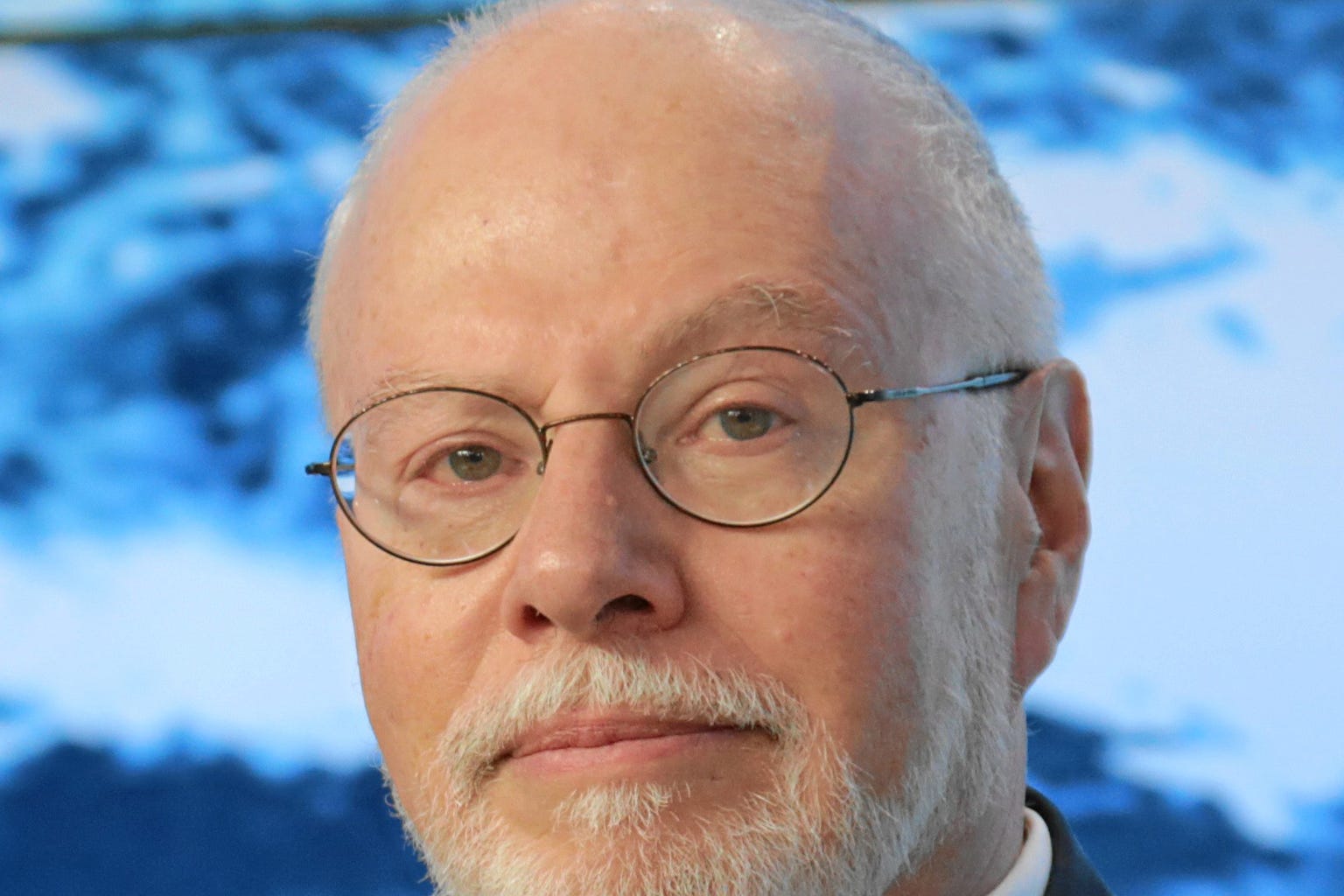
Between 2017 and 2026, Paul Singer’s Elliott Management — the hedge fund that seized an Argentine warship to collect sovereign debt — executed one of private equity’s most instructive operational turnarounds through AC Milan. What appears as a simple football club acquisition was actually a multi-layered financial engineering trade: predatory credit origination, distressed debt enforcement, deep capital deployment (~€700 million), operational restructuring, and vendor-financed exit with compounding interest.
This analysis reconstructs the complete financial mechanics — from the initial €303 million loan designed to convert to equity upon default, through €504 million in absorbed operating losses, to the €1.2 billion exit generating an estimated 1.7–1.9x return. We examine both profit centers: the equity appreciation from operational turnaround, and the €120+ million in vendor loan interest that continued accruing until January 2026.
What This Analysis Covers:
The Structured Acquisition — How Elliott engineered a €303M loan designed to convert to equity upon default
The Foreclosure & Takeover — The mechanics of seizing control when Li Yonghong defaulted
The Operational Turnaround — €700M capital deployment, €504M loss absorption, and Wall Street restructuring (2018–2022)
The Exit Strategy — €1.2B sale to RedBird with vendor financing structure
The Second Profit Center — €120M+ in vendor loan interest income (2022–2026)
Complete P&L Reconstruction — Verified breakdown of all capital flows and returns
Strategic Lessons — Why this trade is instructive for distressed credit investors
The Structured Acquisition: Predatory Loan as Credit Default Mechanism
In April 2017, Chinese businessman Li Yonghong purchased AC Milan from Silvio Berlusconi for €740 million through Luxembourg vehicle Rossoneri Sport Investment Lux. Li couldn’t self-fund the acquisition. Elliott provided a €303 million loan structured across two tranches:
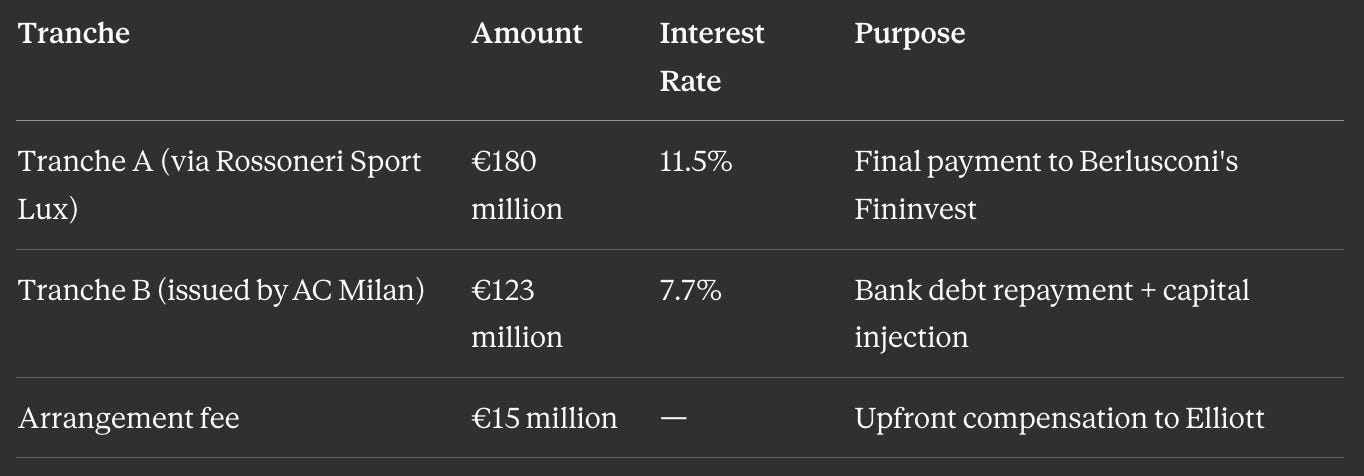
Total annual interest: €30.2 million on an 18-month maturity expiring October 2018. The loan wasn’t designed to be repaid — it was designed to convert to equity through default.
The collateral structure was the kill shot. Forbes reported Elliott secured its loan against Li’s controlling shares in the Luxembourg holding chain, with liens extending to AC Milan’s trademarks, intellectual property, revenue accounts, media contracts, and commercial agreements. A single missed payment would trigger forfeiture.
The Default and Seizure
On July 6, 2018, Li Yonghong missed a €32 million installment. Four days later, Elliott enforced its security interests and assumed 99.93% ownership of AC Milan. Effective acquisition cost: approximately €400 million — roughly half the €740 million valuation from 15 months earlier, factoring in the €303 million loan principal, €15 million arrangement fee, and ~€30 million in accrued interest.
Paul Singer declared Elliott’s objective was “to create financial stability, establish sound management, achieve sporting success” and immediately committed €50 million in equity capital to stabilize the club. Li Yonghong was later declared bankrupt in Hong Kong.
The Operational Turnaround: Wall Street Meets Serie A
Rather than the typical distressed-asset flip, Elliott executed a four-year operational value-creation program unprecedented for a hedge fund in football.
The Management Team
Ivan Gazidis — Poached from Arsenal as CEO in December 2018. When he arrived, the club was losing €150 million annually with risk of reaching €200 million. Gazidis told The Guardian: “We have brought Milan back. People said it was impossible.”
Paolo Maldini — Club legend appointed Sporting Strategy & Development Director in August 2018, later promoted to Technical Director in June 2019. Maldini brought credibility that attracted top talent willing to accept below-market wages.
Hendrik Almstadt — Former Goldman Sachs analyst with LSE degree and Harvard MBA who held final say on player acquisitions from an economic standpoint. A Wall Street quant running football transfers.
Geoffrey Moncada — Recruited from AS Monaco, built a data-driven scouting network tracking players before wider recognition.
Financial Discipline and Revenue Transformation
Elliott’s operational improvements delivered measurable financial restructuring:
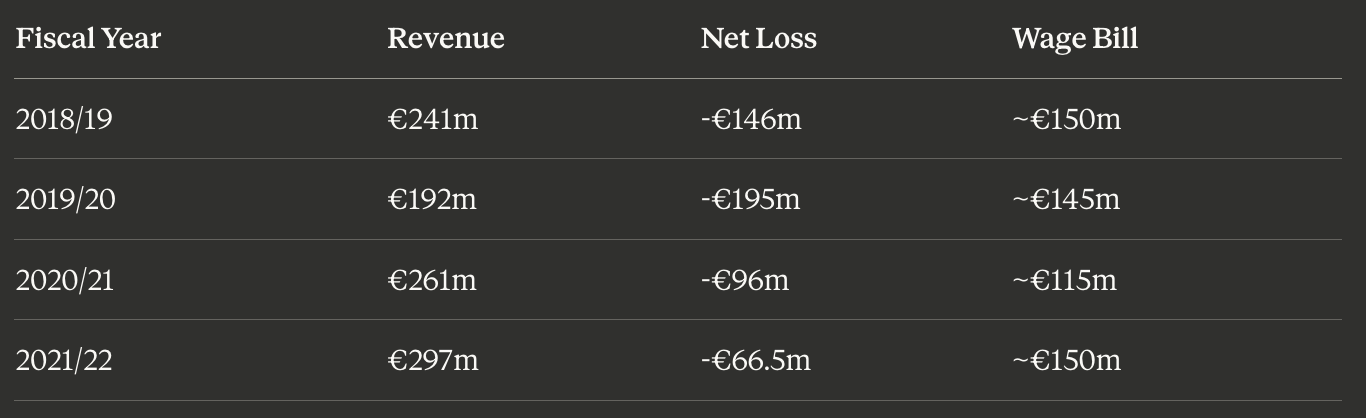
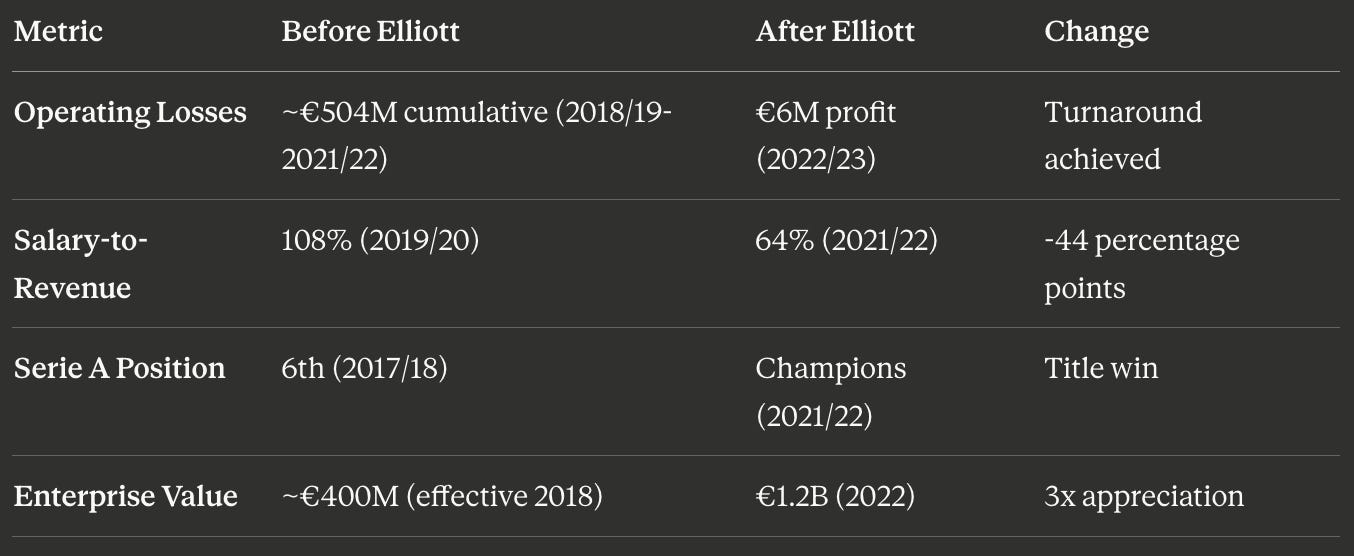
Note: While 2021/22 still recorded a net loss, AC Milan achieved positive EBITDA of €29.3 million for the first time. The club’s first actual profit (€6 million) came in the following fiscal year, 2022/23.
Critical metrics:
Salary-to-revenue ratio: Dropped from 108% (2019/20) to 64% (2021/22) — a dramatic improvement that reflected wage discipline during the pandemic years when revenues collapsed
Net debt: Reduced from €101 million to ~€28 million
EBITDA: Turned positive at ~€30 million
Total Elliott investment: Over €700 million during ownership (original loan + subsequent injections)
Revenue transformation included overall sponsorship revenue growing from ~€37M (2019/20) to €54M (2020/21), with both the Puma kit deal and Emirates shirt sponsorship later doubling to €30 million each annually. Core revenues rose 75%, from €164 million to €287 million between 2019/20 and 2021/22.
The Free Agent Hemorrhage
Elliott’s cost discipline had a hidden price. Multiple high-value players departed as free agents, generating zero transfer revenue: Gianluigi Donnarumma (2021), Hakan Çalhanoğlu (2021), Franck Kessié (2022), and Alessio Romagnoli (2022). Total estimated forgone transfer fees: €100–200 million. Elliott accepted this leakage because the salary-to-revenue ratio improvement was worth more to enterprise valuation than any individual transfer fee.
The Scudetto
In May 2022, AC Milan won the Serie A title — its first in 11 years. Gordon Singer, Paul’s son and head of Elliott’s London office, was celebrating on the team bus with fans in Milan’s streets.
The timing was perfect for an exit. Elliott had transformed a distressed asset into a championship-winning club with cleaned-up financials. Within three months of the title win, they would execute one of private equity’s most sophisticated exit strategies.
The Exit: Precision Financial Engineering
In August 2022, Elliott sold AC Milan to Gerry Cardinale’s RedBird Capital Partners for an enterprise value of €1.2 billion. The structure:
Cash from RedBird: ~€550 million
Vendor loan from Elliott: ~€550 million at 7% interest with three-year maturity
Elliott minority financial interest retained
Elliott board representation: Gordon Singer retained his board seat; Dominic Mitchell would join the board in January 2025
At ~7% on ~€550 million, Elliott was generating approximately €38.5 million per year in interest income. The vendor financing converted what appeared to be a sale into a high-yield credit position — the hedge fund equivalent of selling a house but holding the mortgage.
Refinancing and Compounding
In December 2024, RedBird and Elliott agreed to a partial refinancing. RedBird injected €170 million, reducing the vendor loan principal to €489 million and extending maturity to July 2028. Between August 2022 and December 2024 (~28 months), Elliott accrued roughly €90–100 million in interest income on the vendor loan.
Full Exit
On January 30, 2026, Elliott fully exited AC Milan. RedBird completed a refinancing led by Comvest Credit Partners (owned by Manulife Investment Management). The total new financing was approximately €650 million, with repayment extending to 2031.
Gordon Singer stated: “We are proud of what AC Milan has accomplished since Elliott acquired the club in 2018. Under Elliott’s ownership and subsequently RedBird’s, the club’s financial and sporting performance have improved significantly and the team has won two major trophies, including the 2021/22 Scudetto.”
The P&L: Reconstructing Total Return
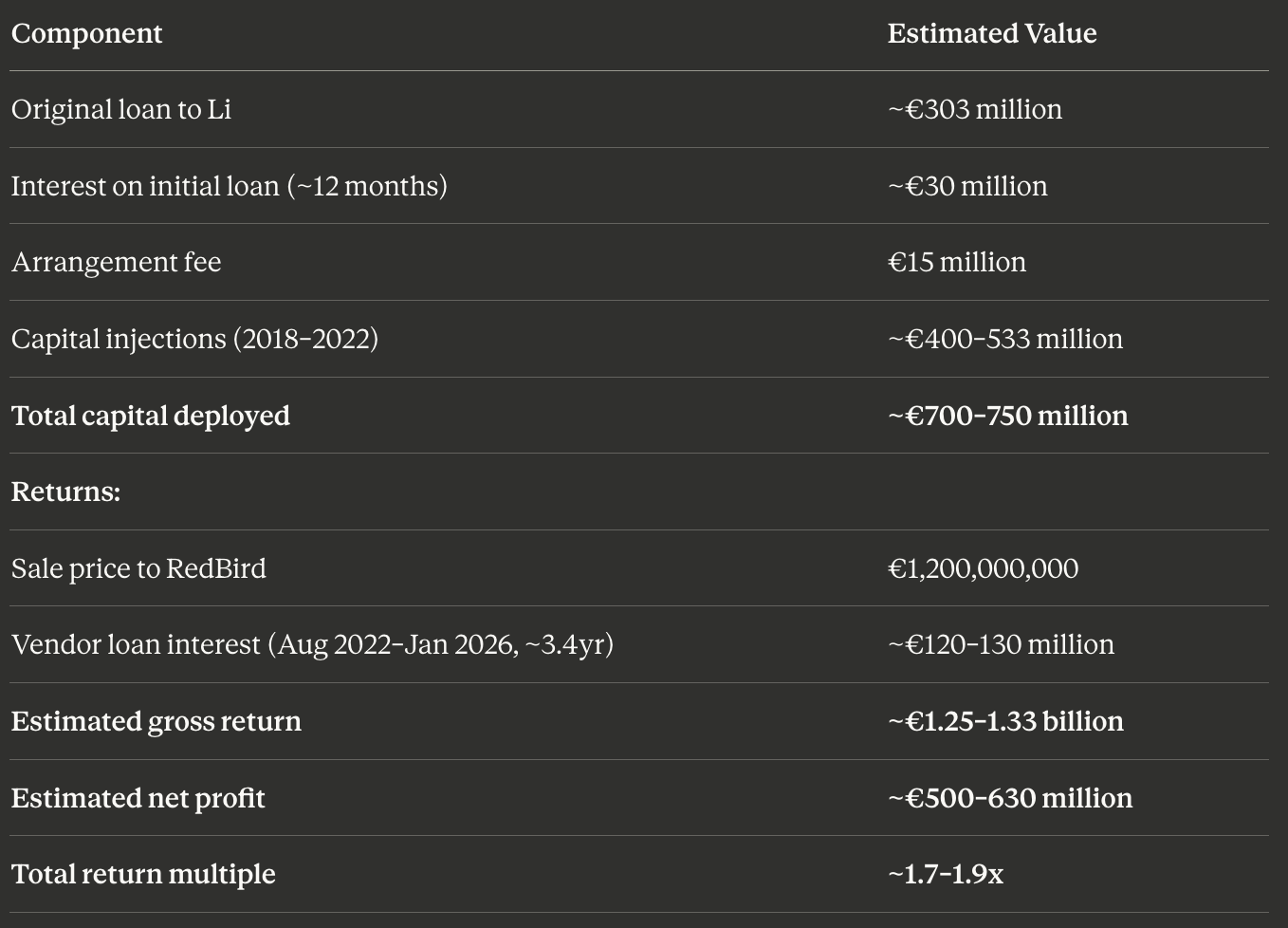
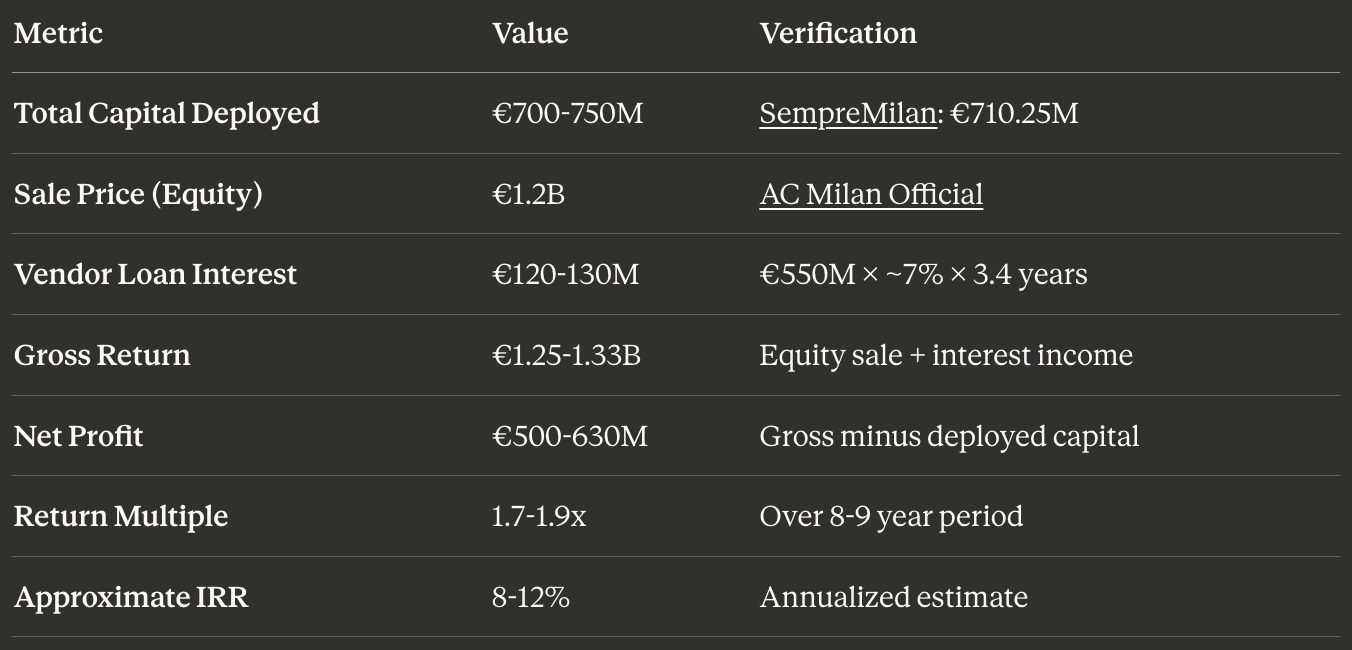
Combining public disclosures, financial statements, and press reports, we can reconstruct Elliott’s approximate returns. The table below consolidates capital deployed, sale proceeds, and vendor loan interest income:
Key Findings Summary
Financial Performance Overview:
Operational Metrics:
Transaction Timeline:
April 2017: €303M loan to Li Yonghong at 11.5% interest
July 2018: Foreclosure; Elliott assumes 99.93% ownership
2018–2022: €400–533M capital injections to cover losses
May 2022: Serie A championship (first since 2011)
August 2022: €1.2B sale to RedBird + €550M vendor loan at ~7%
January 2026: Vendor loan refinanced; Elliott fully exits
Profit Centers:
Equity appreciation: €1.2B sale price minus ~€700M deployed = ~€500M gain
Vendor loan interest: €120–130M over 3.4 years at ~7% rate
📊 Want Deeper Quantitative Analysis?
This research took very long time of data collection, verification, and analysis. If you found value in this deep-dive, I publish exclusive quantitative research, trading strategies, and institutional-grade analysis on Patreon.
What you’ll get:
Forensic breakdowns of hedge fund trades (like this one)
Systematic trading strategies with backtested results
Derivatives pricing models and volatility arbitrage studies
Alpha generation techniques from institutional playbooks
Early access to all research before public release
By joining, you’ll be supporting my work and motivating me to publish more content like this.
→ Join the Patreon community here
What Makes This Trade Instructive
1. The Loan Was the Trade
Elliott structured the €303 million loan with collateral guaranteeing ownership upon default. An 11.5% interest rate on an 18-month loan to a buyer with no visible cash reserves was a structured acquisition via credit default mechanism. The trade was profitable in every outcome scenario.
2. The Vendor Financing as Independent Profit Center
By providing ~€550 million vendor financing at ~7%, Elliott created a second compounding profit center. Even if the equity had been sold at cost, the vendor loan interest alone would have generated €120–130 million over 3.4 years.
3. Operational Turnaround as Value Creation
Unlike typical distressed debt plays, Elliott deployed €700+ million over four years to absorb ~€504 million in cumulative operating losses (2018/19 through 2021/22). Wall Street talent (Goldman Sachs/Harvard MBA) running analytics cut salary-to-revenue from 108% to 64%, driving enterprise valuation from ~€400 million effective acquisition cost to €1.2 billion exit — a true operational turnaround, not financial engineering alone.
4. The Argentina Parallel
Elliott’s most famous trade — buying Argentine sovereign debt at ~$0.20 on the dollar and litigating until Argentina settled for $2.4 billion — follows an identical template: source distressed debt, secure legal/contractual protections, wait for default, extract maximum value. With AC Milan, the mechanism was the same; the extraction method was operational improvement — a more sophisticated playbook than litigation.
The Bottom Line
Elliott Management’s AC Milan trade is the most complete expression of the hedge fund’s investment philosophy:
Predatory credit origination — a loan at 11.5% with collateral designed to convert to equity on default
Deep capital deployment — €700+ million invested over four years to absorb ~€504 million in cumulative operating losses
Wall Street operational turnaround — Goldman Sachs/Harvard MBA talent running analytics, cutting salary-to-revenue from 108% to 64%
Peak-valuation exit — selling months after a title for €1.2 billion
Vendor financing — second compounding profit center at ~7% on €550 million
Patient capital withdrawal — fully exiting only when Comvest/Manulife offered optimal terms in January 2026
Estimated total take: north of €1.25 billion in gross returns over nine years. Net profit: ~€500–630 million. A ~1.7–1.9x multiple on deployed capital.
Not bad for a trade that started with a predatory loan to a Chinese businessman who was always going to default.
Frequently Asked Questions
How much did Elliott Management invest in AC Milan?
Elliott Management deployed approximately €700–750 million total: €303 million in the initial predatory loan (2017), plus €400–533 million in capital injections during ownership (2018–2022). SempreMilan documented €710.25 million in total investment.
How much profit did Elliott make on AC Milan?
Elliott’s estimated net profit was €500–630 million. This comes from: (1) €1.2 billion sale price minus ~€700M deployed = ~€500M equity gain, plus (2) €120–130 million in vendor loan interest income from August 2022 to January 2026. Total gross return: €1.25–1.33 billion.
What was Elliott’s return multiple on AC Milan?
Approximately 1.7–1.9x over an 8–9 year period (2017–2026), representing an annualized IRR of roughly 8–12%.
How did Elliott Management acquire AC Milan?
Elliott provided a €303 million loan to Chinese businessman Li Yonghong in April 2017 at 11.5% interest, structured with collateral guaranteeing equity conversion upon default. When Li missed a €32 million payment in July 2018, Elliott foreclosed and assumed 99.93% ownership.
What was the vendor financing structure in the AC Milan sale?
When Elliott sold AC Milan to RedBird Capital for €1.2 billion in August 2022, RedBird paid ~€550 million cash and Elliott provided ~€550 million vendor financing at approximately 7% annual interest. This vendor loan generated €120–130 million in interest income before being refinanced in January 2026.
How much did AC Milan lose under Elliott’s ownership?
AC Milan recorded approximately €504 million in cumulative operating losses from 2018/19 through 2021/22: €146M (2018/19), €195M (2019/20), €96M (2020/21), and €66.5M (2021/22). The club achieved its first profit (€6M) in fiscal year 2022/23, after the RedBird sale.
What operational changes did Elliott make at AC Milan?
Elliott reduced the salary-to-revenue ratio from 108% (2019/20) to 64% (2021/22), implemented data-driven scouting under Geoffrey Moncada, brought in Wall Street talent (Hendrik Almstadt from Goldman Sachs), and focused on young player development. The club won the Serie A title in 2021/22 under Stefano Pioli.
Who bought AC Milan from Elliott Management?
Gerry Cardinale’s RedBird Capital Partners acquired AC Milan in August 2022 for an enterprise value of €1.2 billion. RedBird is also a minority shareholder in Fenway Sports Group (Liverpool FC, Boston Red Sox).
When did Elliott completely exit AC Milan?
Elliott fully exited in January 2026 when RedBird refinanced the €489 million remaining vendor loan with financing from Comvest Capital and Manulife Investment Management. Gordon Singer and Dominic Mitchell stepped down from AC Milan’s board on January 30, 2026.
How does Elliott’s AC Milan trade compare to their Argentina debt case?
Both follow Elliott’s template: acquire distressed debt at discount, secure contractual/legal protections, wait for default/crisis, extract maximum value. Argentina: bought at $0.20, litigated, settled for full payment ($2.4B). AC Milan: structured predatory loan, foreclosed, operational turnaround, vendor-financed exit. Same mechanics, different extraction method.
Primary sources: Financial Times, Seattle Times/AP, AC Milan Official, The Guardian, GOAL Analysis, SempreMilan, Forbes, MilanReports, Bloomberg
About the Author
Navnoor Bawa is a quantitative researcher specializing in institutional trading strategies, hedge fund forensics, and systematic alpha generation.
Connect:
LinkedIn — Professional updates and networking
YouTube — Video breakdowns of quantitative strategies
Patreon — Exclusive research and trading strategies
Medium — Long-form analysis
Twitter — Real-time market insights
Author note: This analysis is for educational purposes only and does not constitute investment advice. All figures are estimates based on publicly available information.
Cover photograph: World Economic Forum, CC BY-SA 2.0, via Wikimedia Commons.