

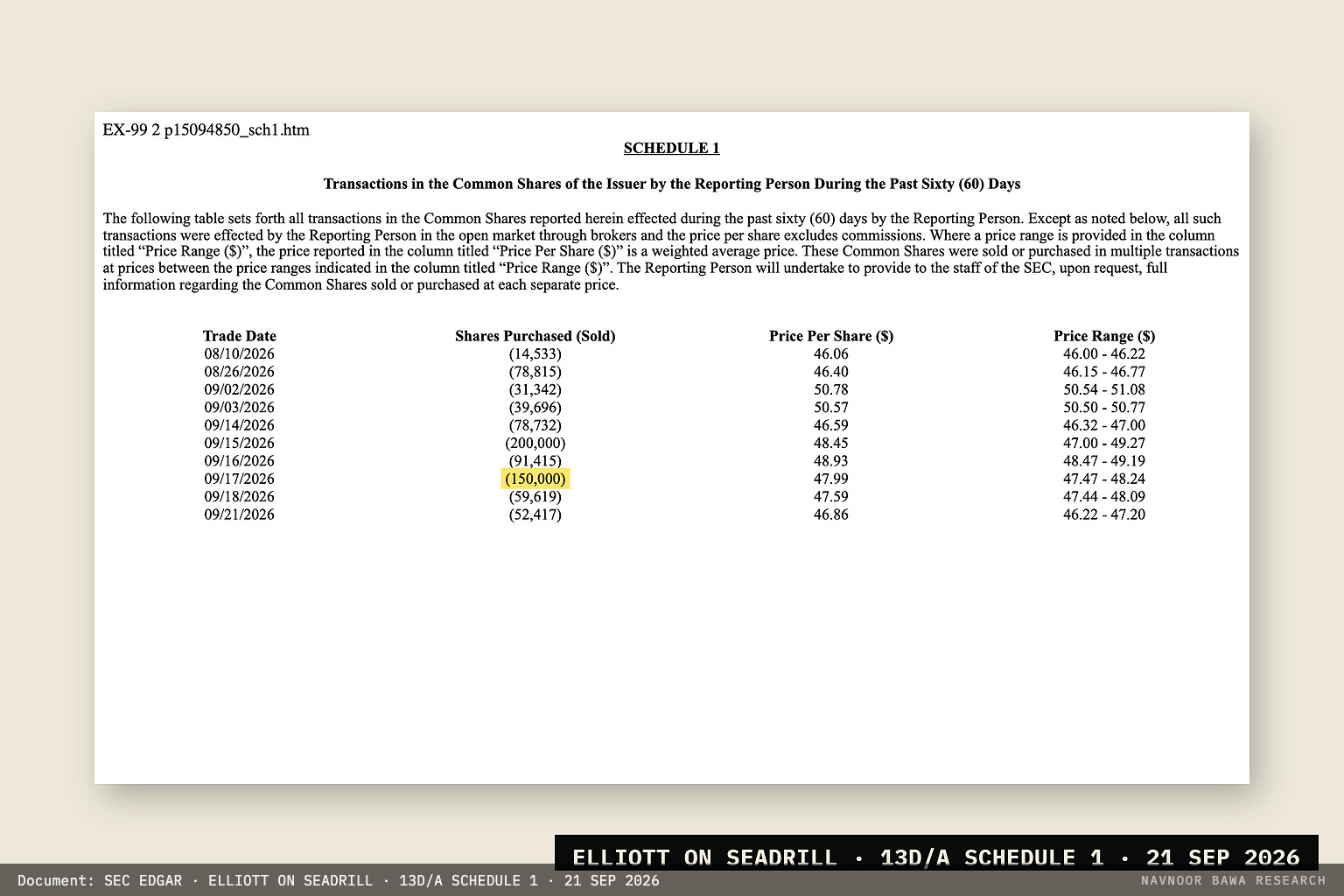
Elliott kept cash settled swaps on 4,042,300 Seadrill shares while it sold voting stock through September, its latest Schedule 13D amendment shows. Anyone holding SDRL trades beside a fund with 12.3% economic exposure that has sold in 2023, in 2024 and again this year. After my read of Elliott’s hedged Synopsys campaign, whose call is open until 16 November, I rebuilt its Seadrill record, which shows a trading book around a swap held since 2023.
The claim: Elliott trades Seadrill’s voting shares around a swap position it has kept between 3.9 million and 5.4 million shares since July 2023, on average buying lower than it sells, and September was its largest selling window since the spring of 2024.
The stake: 92.5% of the shares Elliott has had to itemise since 2023 sold at $44 or higher, while its unitemised buying came in a quarter when SDRL averaged under $40. A holder at the 30 September close of $44.67 is trading against the remainder of that supply.
The catalyst: Seadrill’s buyback, with $188 million of its $500 million authorisation left at 30 June, runs to 31 December 2026. Every share it retires lifts Elliott’s percentage without Elliott trading, which lengthens the selling Elliott can do before its filings stop.
Wrong if: Elliott’s next Schedule 13D amendment, filed by 31 March 2027, itemises a session sold at a weighted price below $44, or reports swaps on fewer than 3,917,981 Seadrill shares, its lowest count since July 2023, per EDGAR.
Seven of nine analysts rate Seadrill a Buy
The consensus on Seadrill is a Buy. Nine analysts rate it, seven of them Buy or Strong Buy, and their average target of $59.40 sits about a third above the price on MarketBeat’s tally, read on 30 September. Put Elliott’s 12.3% beside that and it reads like a second vote for the same upside.
The filings read differently. Elliott has sold, repeatedly, in the same price zone, and its buying has come lower down.
Nine filings show a seller’s band
Nine filings show Elliott selling Seadrill in one price band and buying lower down. It received 7,413,399 Seadrill shares on 3 April 2023, in exchange for its Aquadrill units when the two drillers merged, according to its first Schedule 13D, filed two days later. That filing said it believed the shares were undervalued and might propose changes to the board, the capital structure or a sale. It carried the stake at $163.6 million, $22.07 a share.
Eight amendments later, the tape of trades it had to itemise runs to 70 sale lots. I summed them: 4,759,651 shares for $230.5 million, a weighted $48.43. The cheapest lot went at $35.45 in May 2023 and the dearest at $55.09 in July 2024. The same filings show five purchase lots, 609,400 shares at a weighted $33.38.
Elliott’s purchases came after falls. It bought 100,000 shares at $46.94 on 5 August 2024, a session SDRL fell 5.7% to $46.96, and 509,400 more at $29.95 to $32.02 in December 2025. Between those purchases SDRL traded as low as $17.74 in April 2025, about 69% under its July 2024 high of $56.46. Elliott’s 13Fs show 3,703,746 shares at every quarter end from September 2024 to September 2025. It sat through the fall and bought after it.
The swap is the core position
The swap is the core position and the voting stock is the trading book, in a chain of five links, each with its own filing.
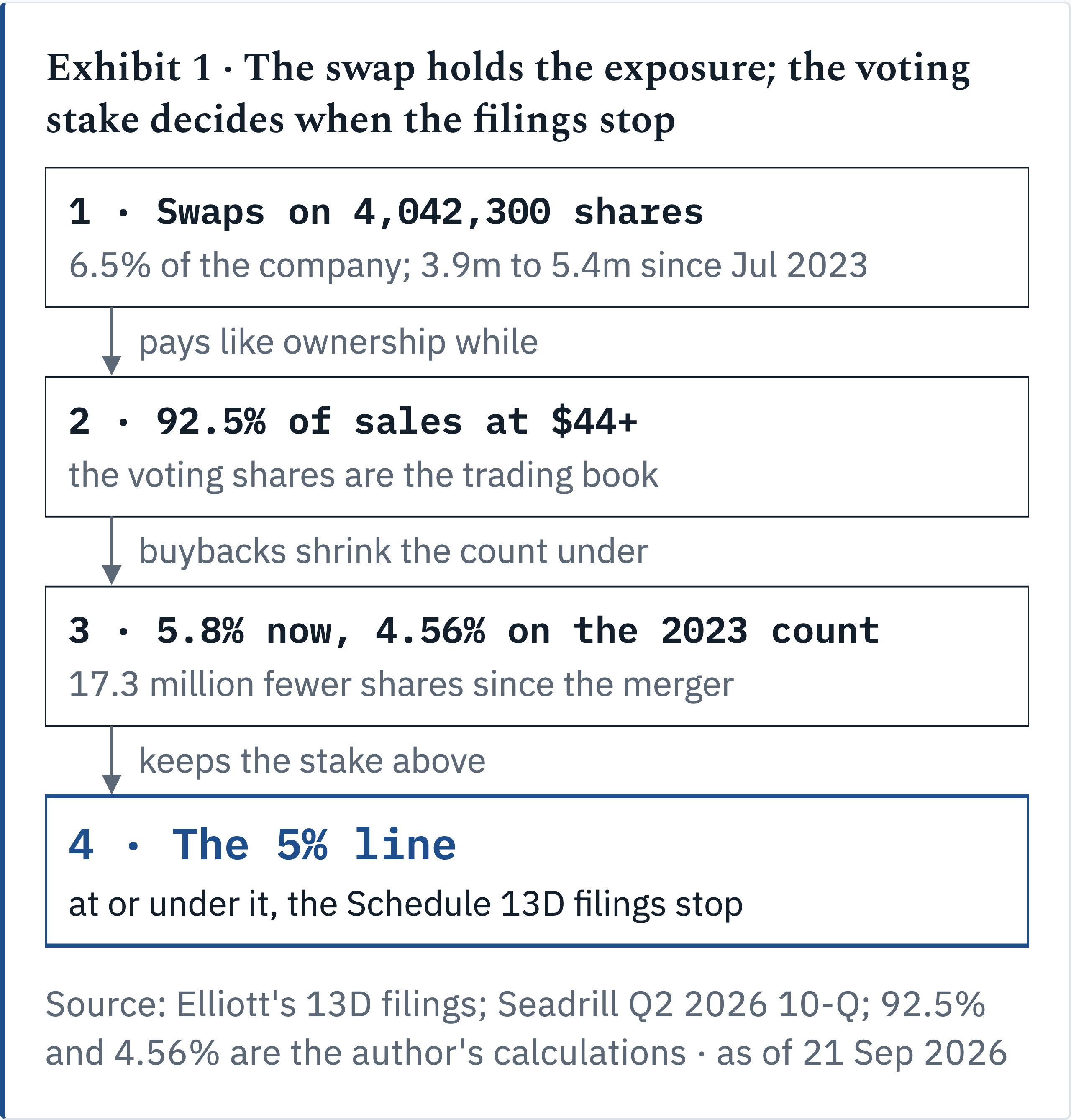
The swap is the core. It has referenced 3,917,981 to 5,444,919 shares in every filing since July 2023 that states it, and 4,042,300 now, 6.5% of the company.
The voting shares are the trading book. 92.5% of the itemised sales printed at $44 or higher; most of the itemised buying came near $30.
Seadrill’s buybacks hold the percentage up. The share count on the latest 10-Q is 17.3 million below the count after the merger. On the 2023 count, Elliott’s voting stake would read 4.56%, not 5.8%.
Small moves wait. Rule 13d-2 forces an amendment within two business days of a 1% change; a smaller move waits for the next amendment or the quarter end 13F.
The 5% line ends the filings. A holder at or under 5% owes no Schedule 13D.
A cash settled swap lets the two halves move apart. Elliott’s filing describes its swaps as giving “economic results that are comparable to the economic results of ownership” without the power to vote or dispose of the shares, and it disclaims beneficial ownership of them. So the swaps count toward the 12.3% of exposure it reports and not toward the 5.8% that keeps it a Schedule 13D filer. Elliott can shrink the stake the filing rules see while keeping most of its price exposure.
Its first filing reserved exactly that. Item 4 lets Elliott “enter into transactions that increase or hedge their economic exposure to the Common Shares without affecting their beneficial ownership”, and no amendment has changed it. The swap book was then built between the first two filings, as the voting shares started going out. Since July 2023 Elliott has cut the leg that votes by half and the leg that only pays by a quarter.
The worked case is 17 September. Elliott sold 150,000 shares that day at a weighted $47.99, in a range of $47.47 to $48.24. Nasdaq’s quotes put the day’s volume at 443,170 shares, so Elliott was 33.8% of everything that traded. SDRL closed at $48.11, up 0.6% after a 3.9% fall the session before, and by 30 September it was 7.2% lower at $44.67. One session proves nothing about demand; it shows how much of the tape this seller can take.
The filings leave one count open: how many more voting shares Elliott can sell before it passes 5% and its filings stop, and how far Seadrill’s buyback moves that line.
Whether to own SDRL beside Elliott, at what price, and after which filing turns on that number.
Below the paid line:
A table of all nine filings: voting shares, swaps, cost and percentage at each amendment.
The ten sessions of Elliott’s September Schedule 1, each against Nasdaq’s traded volume.
Elliott’s runway before its filings stop, on two share counts, with the buyback’s addition.
The position: instrument, trigger, levels, size and dated exit.
