



The popular arithmetic sets a 54% equity claim against 100% of consolidated debt. Correcting that halves the gap, and then a harder problem shows up underneath.
On 2 September, Bloomberg reported that Elliott Investment Management had built a position in Deutsche Telekom and wanted the company to drop a full combination with T-Mobile US in favour of larger buybacks. Reuters matched it the same day with its own source. Within hours the framing had set: more than 70% of Deutsche Telekom’s value is the American stake, Europe’s largest telecom business is therefore nearly free, and an activist has arrived to prise it out.
I spent two days rebuilding that arithmetic from the filings, and I got it wrong twice before I got it right. The popular version is wrong. My first correction was also wrong. What survives is a claim I can defend line by line, and it doesn’t need a peer table or a valuation opinion to stand up.
Deutsche Telekom owns controlling stakes in three other listed telecoms companies. All three trade in public markets every day. And the German business inside Deutsche Telekom is being valued at less than they are.
There is a film of this piece. It works the sum of the parts on screen, the minority-interest add-back, the lease double-count that produces a ratio Deutsche Telekom does not publish, and the thirty-second check that catches it, with the two SEC filings marked at the figures they carry.
Below the paid line: the 4.7x sum of the parts on one basis, the correction line by line with the two joint ventures the residual absorbs, the EUR 8.5bn segment lease split DT never discloses, the ratings notch a merger costs, and what would change my view.
The term the popular arithmetic drops
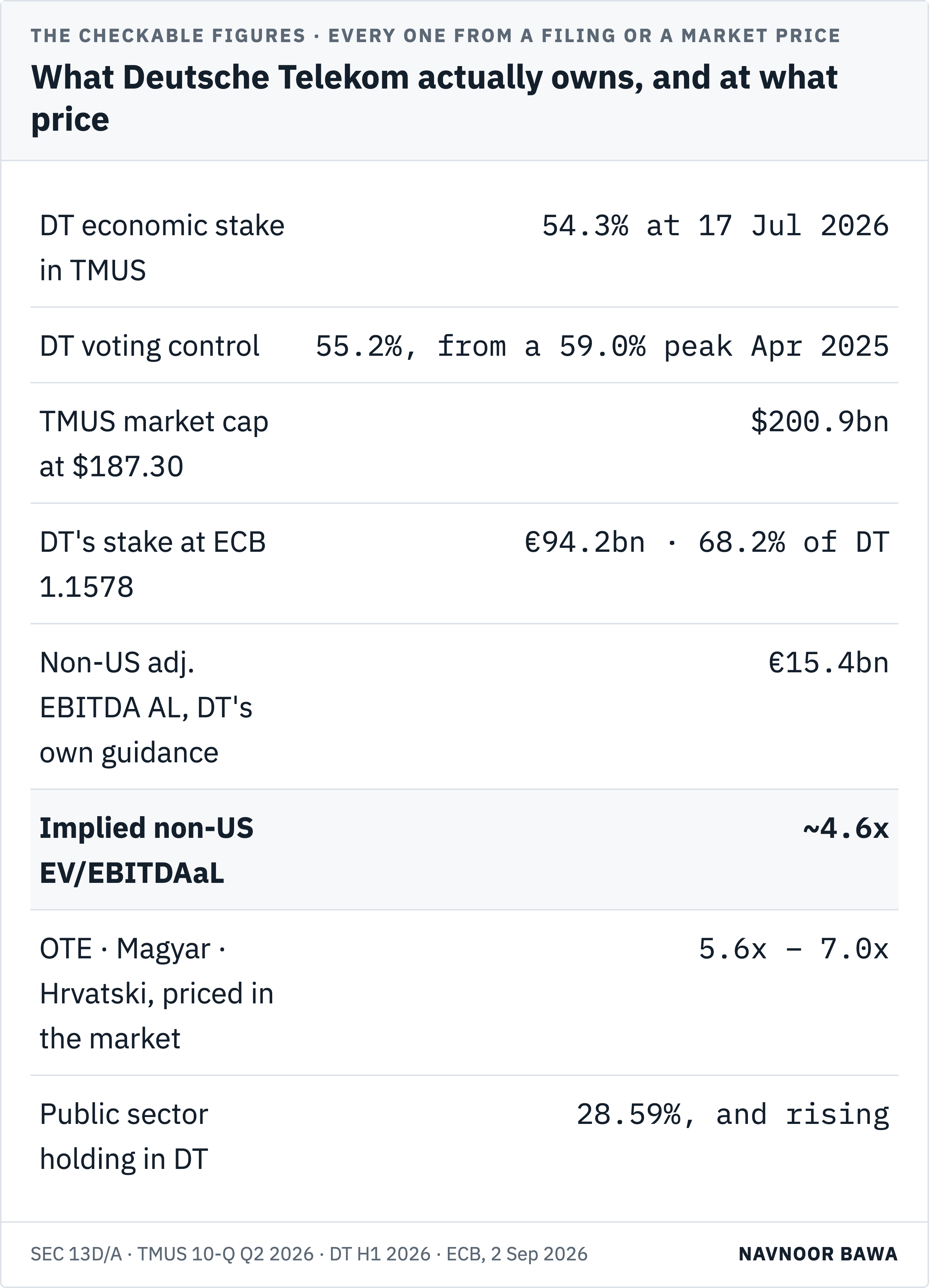
T-Mobile’s Q2 10-Q puts shares outstanding at 1,072,671,613 as of 17 July, of which Deutsche Telekom holds 582,065,875 directly, per its latest Schedule 13D/A. At the 2 September close of $187.30 that stake is $109.0bn, or €94.2bn at the ECB rate. Against a market capitalisation near €138.0bn, the stake is 68.2% of the parent, not “more than 70%”.
Subtract and you get about €43.8bn for everything outside America. Written that way it looks like the market is giving Germany away.
It isn’t, and the reason is a term the subtraction drops. Deutsche Telekom consolidates 100% of T-Mobile’s borrowings, because consolidation follows control, while its equity reflects only its 54% of T-Mobile’s equity. That comparison is a category error. You have to add back the roughly €79bn of minority interest DT consolidates but doesn’t own, and put net debt on both sides on one basis.
Do that and the non-US business comes out near 4.7x EBITDA after leases. Which is where I stopped, and where I was still wrong.
Two mistakes, because both are instructive
The first was leases. Deutsche Telekom’s H1 2026 report publishes net debt two ways: €138,387m including lease liabilities, €104,352m excluding them. I took the figure that includes leases and divided by EBITDA after leases. EBITDA AL is already struck after lease cost, so that charges for leases twice. I then ran a “second, independent” calculation that agreed to the euro and treated the agreement as confirmation. It was the same equation rearranged. A rearrangement confirms nothing.
The second was the residual, and it’s the one that matters. My €72.5bn of non-US enterprise value is what’s left after a €274bn subtraction, and a residual absorbs everything you failed to model.
Two things sit in it that shouldn’t. Deutsche Telekom’s 49% of GD Towers and 50% of GlasfaserPlus are joint ventures carried at equity. Their value sits inside DT’s market cap, and therefore inside my residual, but their earnings are not in my €15.4bn denominator. DT prints a table of zeros in its annual report to make the point: since February 2023, GD Towers “has no longer been part of the Group.” DT’s own Level 3 fair value marks are €7.5bn and €1.1bn.
Pulling in the other direction, DT consolidates 100% of the EBITDA of three listed European subsidiaries whose minorities are worth about €6.6bn at market, and those minorities belong in enterprise value.
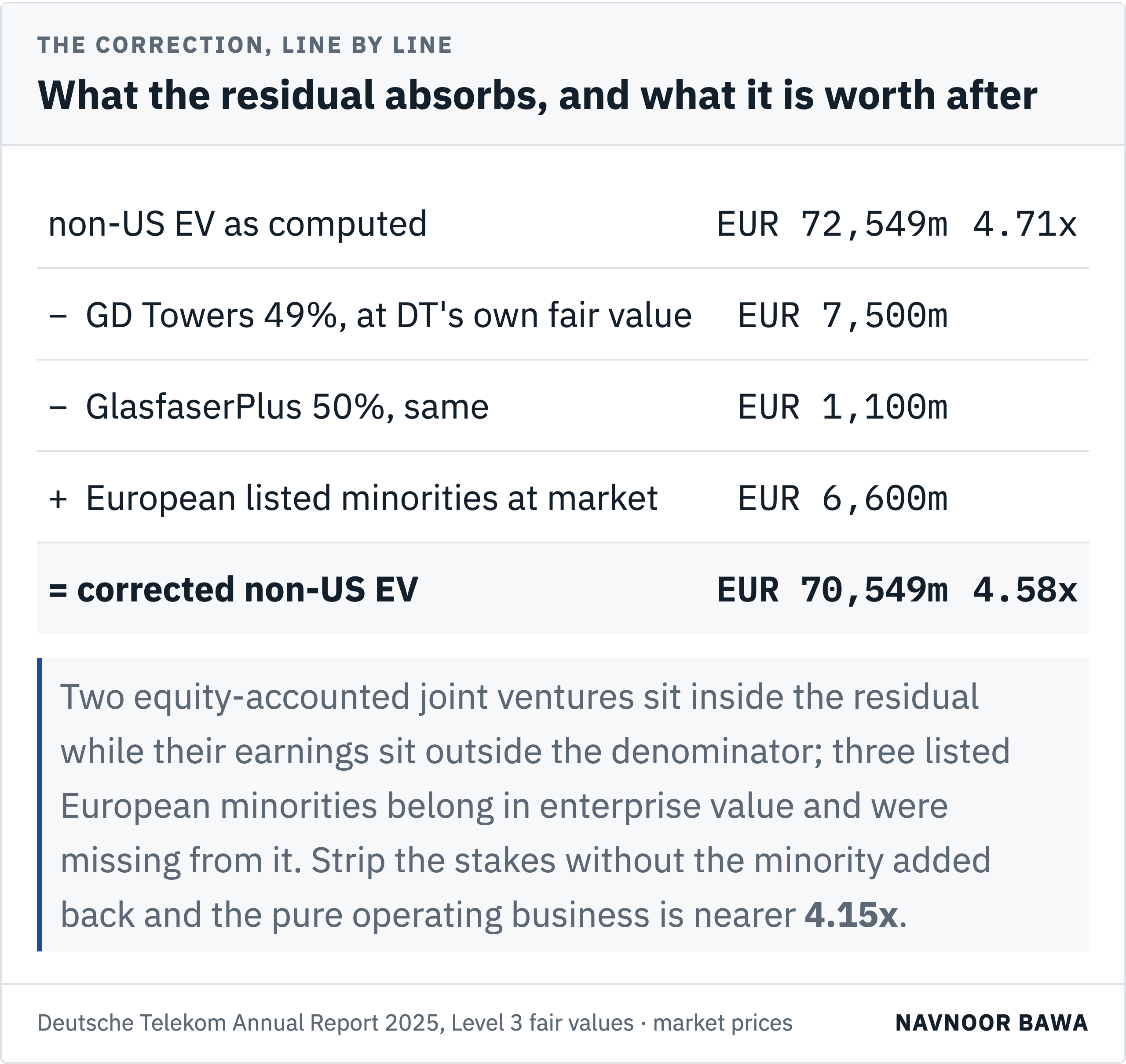
Strip the stakes without the minority added back and the pure operating business is nearer 4.15x.
I want to be clear that I am not confident to two decimal places here, and nobody should be. What I am confident about is the direction: every correction I have been able to make to the naive number has moved it the same way, and the corrections that would move it back are ones I looked for and could not find.
The comparison that needs no opinion
Here’s why I stopped worrying about peer tables. There is no free data source that publishes EV/EBITDAaL for European telecoms, and the same company can span 40% across four providers on one day. Any argument resting on a “European telco average” is averaging across a 2.7x spread.
So use Deutsche Telekom’s own subsidiaries instead. DT is the parent of four listed companies, not one. Alongside T-Mobile US it controls OTE in Greece, Magyar Telekom in Hungary and Hrvatski Telekom in Croatia. All three are quoted daily. All three carry almost no net debt, which removes the leverage argument entirely. And together they are roughly half the Europe segment’s earnings.
When I pulled their market prices I got this: OTE at about 5.6x forward and 6.4x trailing. Magyar at 5.6x and 6.8x. Hrvatski Telekom at 7.0x and 6.9x.
The non-US block blends to roughly 4.6x. Since half of it is marked in the open market between 5.6x and 7.0x, the other half has to be lower. Telekom Deutschland, which produces a 41% EBITDA after leases margin and takes 44% of all German telecom revenue, per the Bundesnetzagentur, is implied at less than its Hungarian and Croatian subsidiaries.
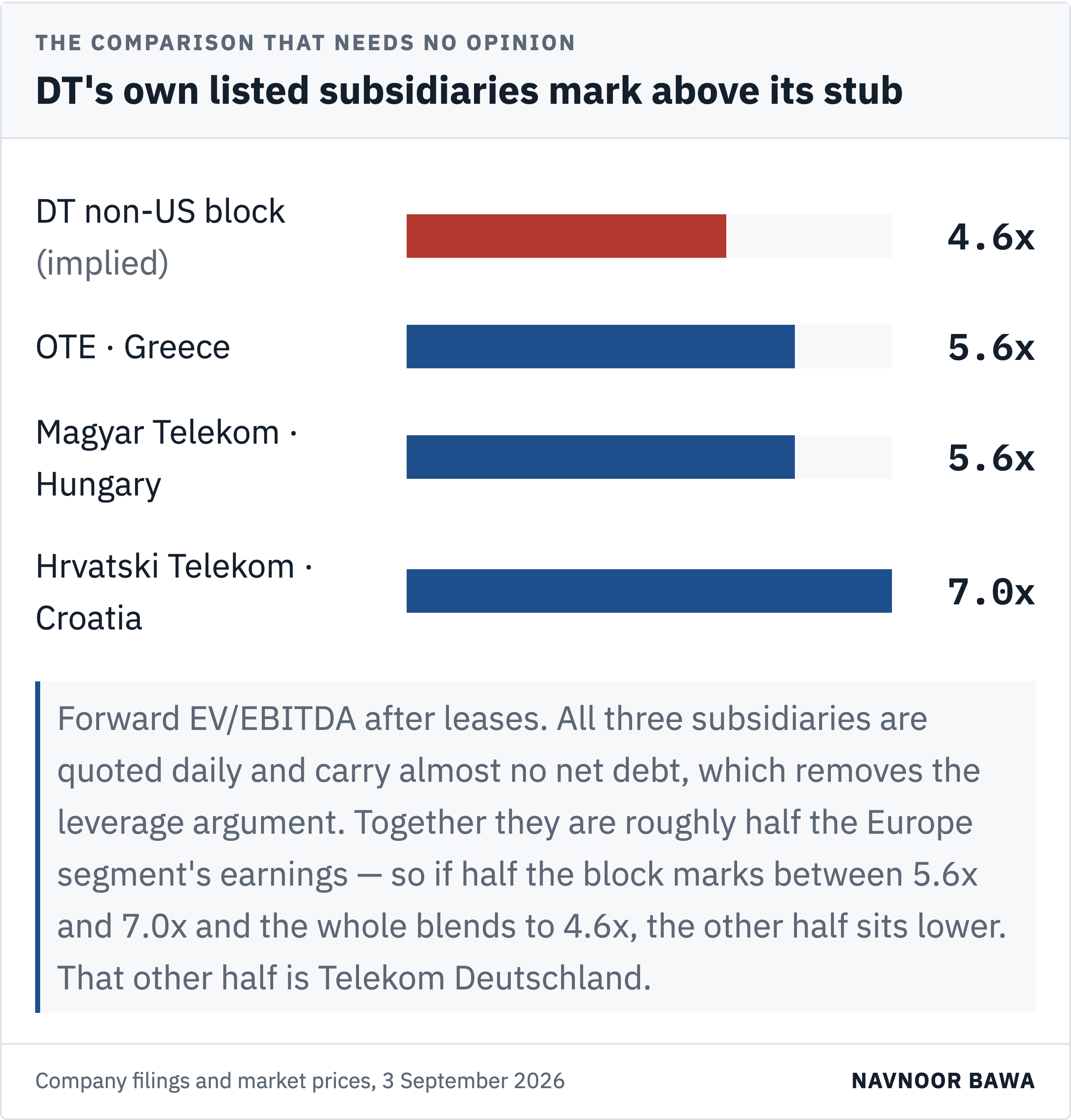
That argument needs no convention, no peer set and no judgement from me about what a fair multiple looks like. It is market prices on both sides of the comparison, which is why I trust it more than the number I spent two days deriving.
I’d still hold it loosely. The stub is a levered residual, so a $10bn move in T-Mobile’s net debt shifts it half a turn. But the direction survives every version I’ve run.
The ten million shares that show how this structure really works
There is a transaction buried in Amendment No. 35 that explains the whole architecture better than any ownership percentage.
SoftBank’s residual holding in T-Mobile is now exactly ten million shares. On 19 March three agreements were executed at once. A novation moved something called the SB-DT 2029 Call Option to a SoftBank entity called Signal Bright. Signal Bright then entered a variable prepaid forward sale contract with an unaffiliated dealer over those shares, pledging them as security. And Deutsche Telekom took a right of first refusal over the pledged stock.
A variable prepaid forward contract lets a holder take cash now against shares delivered later. It is the standard way to monetise a concentrated position without selling outright. So SoftBank gets its money, and I think that is the whole point of the structure.
The votes, though, do not travel with it, and that asymmetry is what I want you to notice. The filing is explicit that Deutsche Telekom “will continue to have the right to direct the vote of the Pledged VPF Shares under the Proxy.” Economics to the dealer, votes to the controller.
One caution against reading too much into it, which I’ll make because I nearly did. The 2029 call option’s strike is the previous day’s closing price. It can never be in the money. It functions as an access and blocking right, and carries no intrinsic value at all. What the arrangement shows is how control gets assembled here: out of contracts instead of purchases, durable enough to survive a counterparty selling out from under it.