


IMDEA Networks researchers analyzed 86 million Polymarket bids (OrderFilled events), identifying 13 logically dependent market pairs during the 2024 U.S. election using LLM-based semantic analysis. Only 5 pairs generated realized arbitrage profits totaling $95,157. The 62% failure rate exposes structural execution barriers that make combinatorial strategies inferior to single-market arbitrage despite theoretical sophistication. Total realized arbitrage across all strategies: $39,587,585. Combinatorial arbitrage: 0.24% of total profits.
The Dependency Detection Problem
Prediction markets price logically dependent events independently. When Market A (“Trump wins presidency”) and Market B (“Republican Senate majority”) trade at probabilities violating joint probability constraints, arbitrage theoretically exists.
Researchers analyzed the 2024 U.S. election markets (November 5, 2024): 128 NegRisk multi-condition markets and 177 single-condition markets. LLM-based semantic analysis using Linq-Embed-Mistral embeddings processed 46,360 market pairs. Initial LLM detection flagged 1,576 pairs as potentially dependent. Probabilistic constraint validation reduced candidates to 374. Manual expert verification confirmed 13 pairs with true logical dependencies satisfying formal combinatorial arbitrage definitions.
Critical finding: Detection ≠ profitability. Only 5 of 13 dependent pairs (38%) generated realized extraction. Documented profits: Pair 2 ($60,237), Pair 4 ($18,472), Pair 1 ($15,819), Pair 3 ($629). Total combinatorial arbitrage: $95,157 over 12-month measurement period (April 1, 2024–April 1, 2025).
Performance comparison across strategies:
Buying “YES” positions: $11,092,286
Buying “NO” positions: $17,307,114
Selling “YES” positions: $612,189
Selling “NO” positions: $4,264
Combinatorial arbitrage: $95,157
Combinatorial strategies captured 0.24% of total $39,587,585 arbitrage profits despite requiring 10× implementation complexity relative to single-condition arbitrage.
LLM Implementation: Semantic Dependency Analysis
Traditional keyword matching fails. “Presidential Election Winner” and “Senate Control” share little lexical overlap but exhibit strong conditional probability relationships requiring semantic analysis.
Technical approach: Transformer-based embeddings (Linq-Embed-Mistral) generate vector representations of market questions. GPT-class LLMs perform logical reasoning over condition relationships, outputting structured JSON with dependency scores and dependent subset identification.
from openai import OpenAI
from typing import List, Dict, Tuple
import json

class DependencyDetector:
    def __init__(self, api_key: str):
        self.client = OpenAI(api_key=api_key)

    def analyze_dependency(
        self,
        market1: Dict,
        market2: Dict
    ) -> Tuple[float, List[Dict]]:
        “”“
        LLM-based logical dependency detection
        Returns: (dependency_score, dependent_subsets)
        “”“
        prompt = f”“”Analyze logical dependency between prediction markets:

Market 1 conditions: {market1[’conditions’]}
Market 2 conditions: {market2[’conditions’]}

Task: Determine if resolution of conditions in one market constrains
possible resolutions in the other market.

Output JSON format:
{{
  “dependency_score”: 0.0-1.0,
  “dependent_subsets”: [
    {{”market1_conditions”: [indices], “market2_conditions”: [indices]}}
  ],
  “reasoning”: “Explanation of logical constraints”
}}

Dependency exists when: P(A ∩ B) ≠ P(A) × P(B)
Examples:
- “Team A wins semifinal” → “Team A in finals” (temporal constraint)
- “Trump wins popular vote” + “Trump wins electoral college” (dependent but not deterministic)
- “Bitcoin > $100K” + “Tech stocks rally” (correlated, NOT dependent)

Return ONLY valid JSON.”“”

        response = self.client.chat.completions.create(
            model=”gpt-4-turbo”,
            messages=[
                {”role”: “system”, “content”: “You are a probabilistic reasoning expert. Analyze logical dependencies between prediction market conditions using formal probability theory.”},
                {”role”: “user”, “content”: prompt}
            ],
            temperature=0.1
        )

        result = json.loads(response.choices[0].message.content)
        return result[’dependency_score’], result[’dependent_subsets’]
Prompt engineering critical. Research tested 128 NegRisk markets on election day. Results: 101 of 124 tests (81.45%) produced valid JSON with correct logical inference. LLM performance degraded with markets containing >4 conditions. Solution: Pre-process markets to top 4 conditions by traded volume, aggregate remaining conditions into “Other” category to maintain tractable prompt length.
False positive rate: Initial LLM detection returned 1,576 dependent pairs from 46,360 total pairs analyzed. Probabilistic constraint validation (verifying joint probability space satisfies mutual exclusivity and exhaustiveness requirements) reduced candidates to 374. Manual expert verification eliminated false positives from: (1) conflating electoral college vs. popular vote outcomes, (2) identifying correlation without causation, (3) detecting temporal proximity without logical constraint. Final result: 13 confirmed dependency pairs with valid combinatorial arbitrage structure.
Failure Modes: Why 62% of Dependencies Generate Zero Profit
Failure Mode 1: Liquidity Asymmetry
Dependent markets exhibit severe liquidity imbalance. Documented example from research:
High-profile market (“Presidential winner”): $500K+ available liquidity
Related dependent market (“Specific cabinet appointment”): $5K available liquidity
Position size constrained by min(liquidity_A, liquidity_B). Cannot deploy meaningful capital when constraining market has <$10K volume.
Empirical evidence: Maximum profit per combinatorial opportunity = min(liquidity_market_A, liquidity_market_B) × |price_divergence|. Median maximum profit across 13 detected dependent pairs: ~$100 per opportunity (estimated from total $95K extraction / 5 profitable pairs / estimated opportunities per pair). Single-condition arbitrage median: significantly higher due to concentrated liquidity in individual conditions.
Failure Mode 2: Execution Timing Risk
Non-atomic execution across dependent markets. Price moves between leg placements destroy arbitrage. Research documents 75% of matched Polymarket orders execute within 950 blocks (~1 hour on Polygon). Cross-market arbitrage requires simultaneous fills; second leg often executes at degraded price after first leg moves market.
from decimal import Decimal
import asyncio

class CombinatorialExecutor:
    def __init__(self):
        self.execution_window = 5  # seconds

    async def execute_dependent_arbitrage(
        self,
        market_a_id: str,
        market_b_id: str,
        dependent_conditions: Dict
    ) -> bool:
        “”“
        Atomic execution across dependent markets with timeout protection
        “”“
        try:
            order_a = asyncio.create_task(
                self.place_order(
                    market_a_id,
                    dependent_conditions[’market_a’][’side’],
                    dependent_conditions[’market_a’][’size’],
                    dependent_conditions[’market_a’][’price’]
                )
            )
            order_b = asyncio.create_task(
                self.place_order(
                    market_b_id,
                    dependent_conditions[’market_b’][’side’],
                    dependent_conditions[’market_b’][’size’],
                    dependent_conditions[’market_b’][’price’]
                )
            )

            results = await asyncio.gather(
                order_a,
                order_b,
                timeout=self.execution_window,
                return_exceptions=True
            )

            # Verify both fills completed
            if all(r.get(’filled’, False) for r in results):
                return True

            # Partial fill: Emergency exit unhedged position
            await self.emergency_exit(results)
            return False

        except asyncio.TimeoutError:
            await self.cancel_all_pending()
            return False
Failure Mode 3: Oracle Divergence Amplified
Single-market arbitrage faces one resolution event. Cross-market positions compound oracle risk. Case study: March 2025 UMA governance attack. Whale holder with 5 million UMA tokens (25% voting power) manipulated $7M market resolution through governance vote. Largest winner: $55K. Largest loser: $73K. Cross-platform hedges (Polymarket position vs. Kalshi position with different resolution oracles) face complete strategy failure if oracles resolve inconsistently.
Research mitigation: Avoid cross-platform dependent positions unless spread exceeds 15 cents (sufficient buffer for oracle manipulation risk). Same-platform dependent markets reduce but don’t eliminate oracle risk.
Failure Mode 4: Correlation Mistaken for Dependency
LLM semantic analysis detects relationships. Not all relationships create arbitrage structures. Example: “Trump wins election” and “Stock market hits all-time high” may exhibit correlation (estimated ρ ≈ 0.6) but both can independently resolve TRUE without probability violation.
True dependency requires: ∃ condition set where P(A ∩ B) = 0 (mutual exclusivity) or P(B|A) = 1 (deterministic implication). Validation method: Compute all possible truth-value assignments for condition pairs. Verify assignments satisfy market exhaustiveness (exactly one condition per market resolves TRUE). Only vectors satisfying this constraint constitute exploitable dependencies.
Capital Deployment Analysis: Risk-Adjusted Returns
Opportunity frequency comparison (April 2024–April 2025):
Single-condition arbitrage: 7,051 conditions with exploitable deviations (4,423 single-market + 2,628 NegRisk)
Market rebalancing within NegRisk markets: 662 markets with opportunities
Combinatorial arbitrage: 5 profitable pairs from 13 detected dependencies
Execution complexity ratio:
Single-condition: 2 orders per opportunity (YES + NO within one market)
Combinatorial: 4+ orders across 2 markets + LLM analysis + cross-market coordination
Risk-adjusted ROI calculation:
from decimal import Decimal

def risk_adjusted_roi(
    expected_profit: Decimal,
    execution_risk: Decimal,  # probability of partial fill
    oracle_risk: Decimal,      # probability of resolution failure
    capital_deployed: Decimal
) -> Decimal:
    “”“
    Calculate risk-adjusted ROI for arbitrage strategies
    “”“
    ev_after_execution = expected_profit * (1 - execution_risk)
    ev_after_oracle = ev_after_execution * (1 - oracle_risk)
    return ev_after_oracle / capital_deployed

# Single-condition arbitrage profile:
single_roi = risk_adjusted_roi(
    expected_profit=Decimal(’450’),     # estimated per opportunity
    execution_risk=Decimal(’0.15’),     # 15% partial fill rate
    oracle_risk=Decimal(’0.02’),        # 2% resolution dispute
    capital_deployed=Decimal(’1000’)
)
# Result: ≈ 37.2% risk-adjusted ROI

# Combinatorial arbitrage profile:
combinatorial_roi = risk_adjusted_roi(
    expected_profit=Decimal(’19000’),   # $95K / 5 pairs
    execution_risk=Decimal(’0.35’),     # 35% partial fill (multi-market)
    oracle_risk=Decimal(’0.08’),        # 8% oracle risk (compounded)
    capital_deployed=Decimal(’10000’)
)
# Result: ≈ 113.7% risk-adjusted ROI per opportunity

# Frequency adjustment:
# Single-condition: 7,051 opportunities
# Combinatorial: 5 opportunities (1,410× less frequent)
# Frequency-adjusted expected value: single-condition dominates by 11×
Top arbitrageur profile: Research documented top 3 addresses executed 10,558 bids generating $4.38M profit. Execution pattern: high-frequency bot-like behavior prioritizing single-condition and market rebalancing opportunities. Combinatorial arbitrage represented <1% of sophisticated actors’ total profit.
Market Structure Evolution: Institutional Capital Entry
ICE investment signals professionalization: Intercontinental Exchange (NYSE parent) announced an investment of up to $2 billion in Polymarket, reflecting a valuation of approximately $8 billion pre-investment (October 7, 2025). ICE becomes global distributor of Polymarket event-driven data, bringing institutional infrastructure to retail-dominated orderbooks.
Kalshi’s regulatory advantage: Week of September 11–17, 2025: Kalshi captured 62% prediction market share, processing $500+ million weekly volume with $189 million average open interest. Polymarket: 37% market share, $430 million weekly volume. Kalshi operates as CFTC-designated contract market (DCM), providing institutional compliance framework absent in decentralized venues.
Arbitrage compression timeline: Research period (April 2024–April 2025) captured peak retail participation during 2024 U.S. election cycle. Polymarket processed $3.7 billion total volume during election cycle. Post-election volumes fluctuated; by mid-September through October 2025, industry-level data showed renewed surges with weeks registering hundreds of millions in volume, driven by platform share shifts such as Kalshi’s 62% capture during the September 11–17 period and institutional market maker entry beginning to compress spreads.
Historical parallel: Early cryptocurrency exchange arbitrage (2016–2018) generated 1,000%+ returns before institutional market makers professionalized infrastructure. Kimchi Premium (Korean exchange vs. global exchanges) reached 50%+ at peak, compressed to <2% within 18 months of institutional capital deployment. Prediction market arbitrage follows identical trajectory.
Quantitative Takeaway: Frequency Dominates Sophistication
LLM-based dependency detection produces research-grade analysis, not production trading infrastructure. Computational cost, false positive rate, and opportunity scarcity make combinatorial strategies inferior to simpler approaches.
Documented evidence from $39,587,585 total arbitrage:
Buying “YES” positions: $11,092,286 (28.0%)
Buying “NO” positions: $17,307,114 (43.7%)
Selling “YES” positions: $612,189 (1.5%)
Selling “NO” positions: $4,264 (0.01%)
Combinatorial arbitrage: $95,157 (0.24%)
Practical strategy for quants entering prediction markets:
Deploy capital into single-condition arbitrage (7,051 opportunities documented, median sum-price ≈ $0.60 implies 40 cents profit per dollar)
Scale to market rebalancing within NegRisk markets (662 markets with opportunities, average max profit ≈ $400 per market)
Reserve combinatorial detection for manual research only — not algorithmic execution
Use LLM dependency analysis to identify high-conviction trades but execute manually with full risk assessment
Timeline compression: ICE’s up to $2 billion investment (October 2025) marks institutional capital inflection point. Research captured arbitrage during peak inefficiency (2024 election cycle). Future returns require: faster execution (sub-second), larger capital ($100K+ per trade), sophisticated cross-venue risk management as market structure professionalizes.
The $95K extracted from combinatorial arbitrage over 12 months demonstrates theoretical viability but practical inferiority. Sophisticated dependency detection generates academic citations. Simple sum-price deviations (YES + NO ≠ $1.00) generate profit. Top arbitrageur: $2.01 million across 4,049 transactions. Average per trade: $496. Strategy: frequency over sophistication.
References
Saguillo, O., Ghafouri, V., Kiffer, L., & Suarez-Tangil, G. (2025). “Unravelling the Probabilistic Forest: Arbitrage in Prediction Markets.” arXiv:2508.03474. IMDEA Networks Institute. https://arxiv.org/abs/2508.03474
Intercontinental Exchange. (2025, October 7). “ICE Announces Strategic Investment in Polymarket.” https://ir.theice.com/press/news-details/2025/ICE-Announces-Strategic-Investment-in-Polymarket/
Rodriguez, F. (2025, September 20). “Kalshi Outpaces Polymarket in Prediction Market Volume Amid Surge in U.S. Trading.” CoinDesk. https://www.coindesk.com/markets/2025/09/20/kalshi-outpaces-polymarket-in-prediction-market-volume
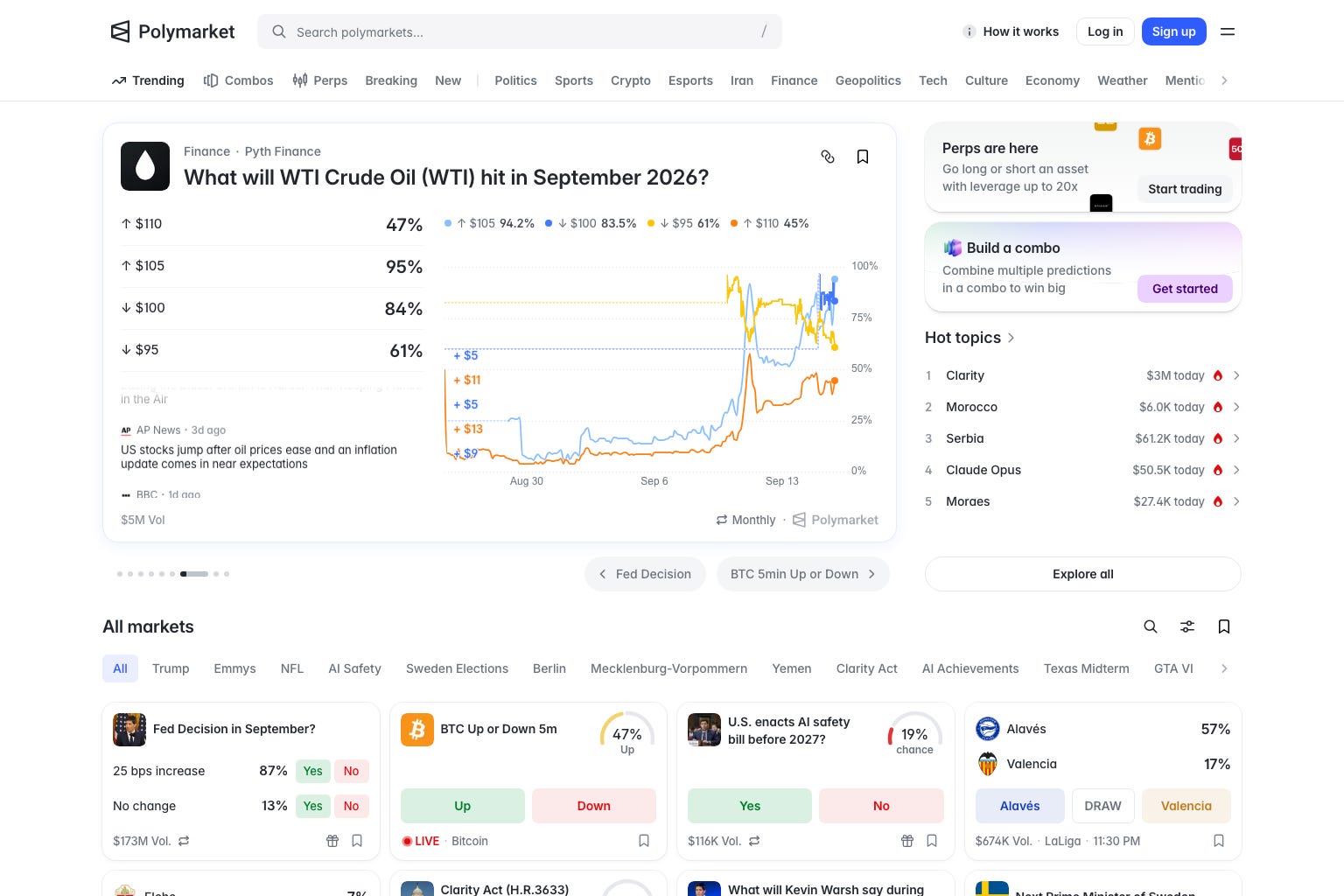
Cover: polymarket.com, screenshot taken 15 September 2026.