



The claim: TCI’s newly disclosed $636mn Italian hotel debt book, widely read as diversification away from Chris Hohn’s famous concentrated equity bets, is the same single name concentration philosophy in a different wrapper.
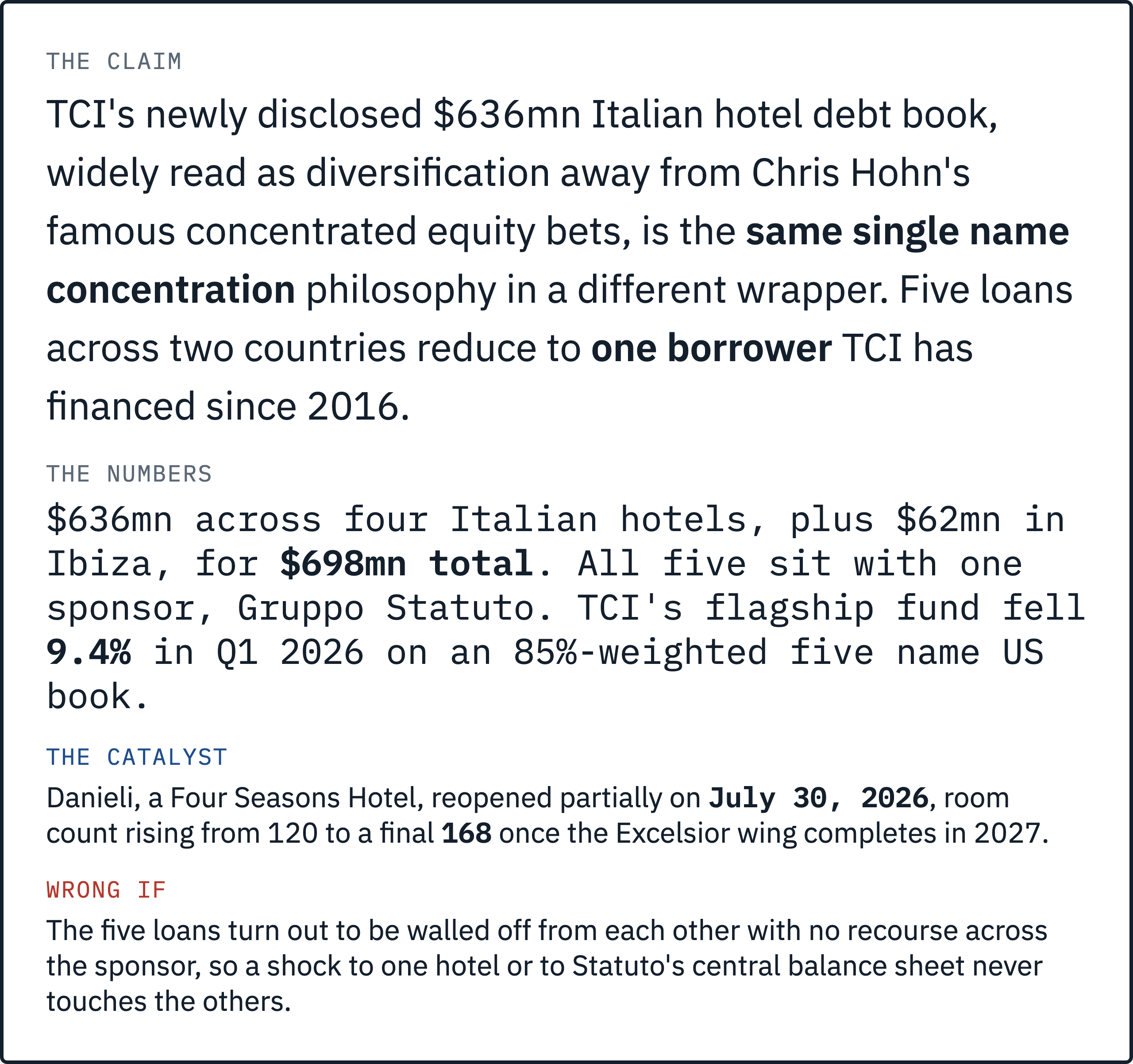
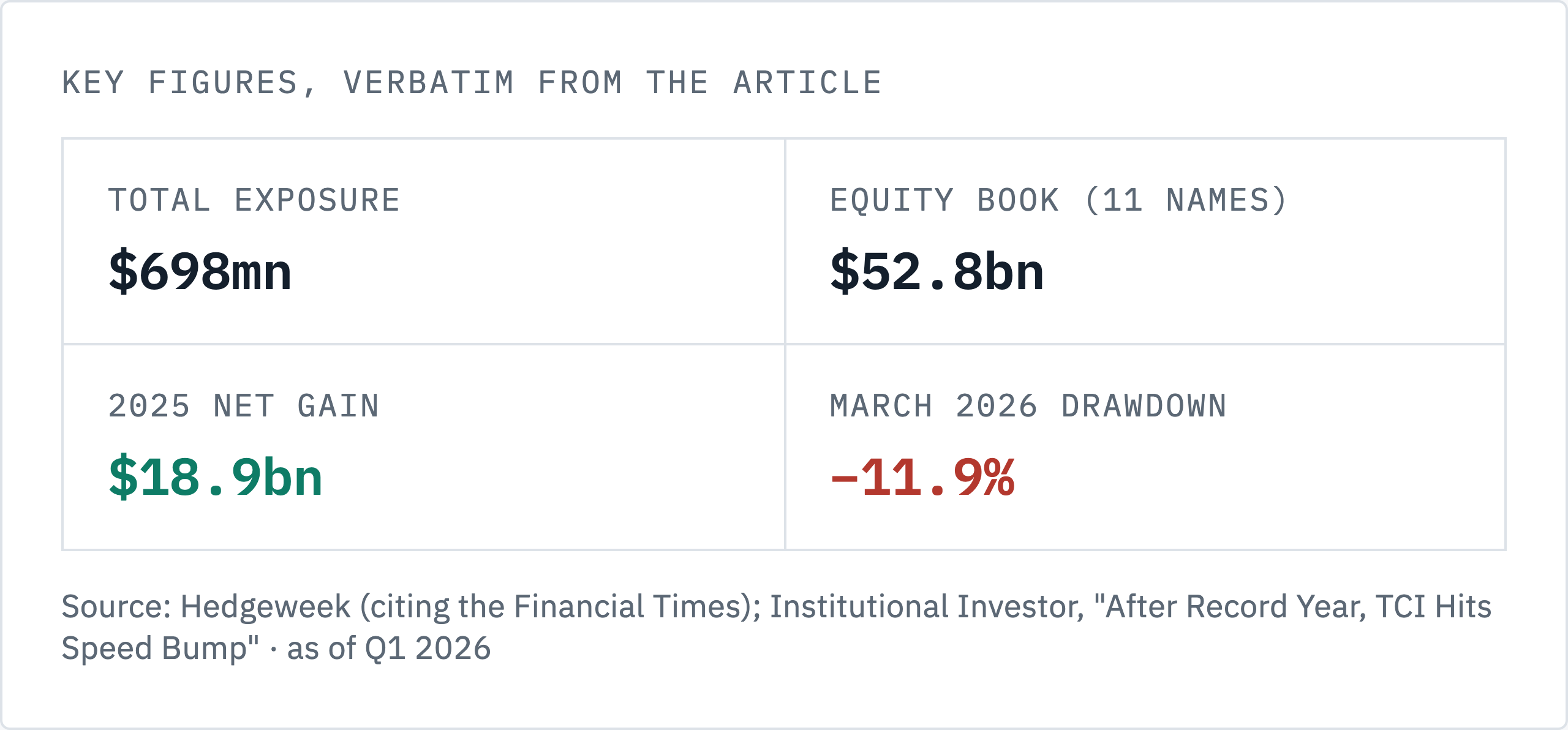
Sir Christopher Hohn built TCI Fund Management into a $77bn hedge fund doing one thing better than almost anyone else alive. He finds businesses with pricing power, buys a handful at a size most funds would call reckless, and holds through the volatility. Eleven US listed equities carry $52.8bn of that book as of TCI’s most recent quarterly filing. GE Aerospace alone is roughly a third of it (TCI’s Q2 2026 13F-HR via 13f.info). That concentration produced a record $18.9bn net gain for investors in 2025, the largest single year dollar profit any hedge fund has ever booked, and an estimated $4.9bn for Hohn personally, the most any hedge fund manager has ever made in one year (Institutional Investor). The same concentration cost the fund 11.9% in a single month this March, when the US strike on Iran hit GE Aerospace, Visa, Microsoft, Moody’s and S&P Global all at once. The quarter closed down 9.4% (Institutional Investor). A brutal month, inside a good year.
So when the Financial Times reported this month that TCI has built a $636mn book of loans secured against four of Italy’s most exclusive hotels (Financial Times; reproduced in full by Hedgeweek and independently covered by Il Sole 24 Ore), the coverage read it as continuity, not departure: Hedgeweek notes the hotel book “fits closely with Hohn’s broader investment philosophy” of pricing power and scarce supply, the same case he makes for GE Aerospace. That framing is correct on strategy. My disagreement is narrower: continuity of PHILOSOPHY is not the same claim as diversification of RISK, and the second claim is the one that matters for sizing this.
The bull case: four hotels, four brands, uncorrelated income
The case for calling this diversification is a good one, and I want to state it before I argue against it. TCI’s $392mn position sits in debt against the Danieli in Venice, a fifteenth century palazzo converting from Marriott to Four Seasons. A further $132mn backs the Caesar Augustus in Capri, $74mn sits against the Six Senses on Lake Como, and $38mn against the Mandarin Oriental in Milan (Hedgeweek). Four different cities. Four different brands. Four different loan sizes. On a spreadsheet, that reads as a portfolio. Not a position.
I will grant the asset class itself is structurally uncorrelated to TCI’s equity book, and that matters. Real estate debt pays cash coupon income. It sits senior against hard collateral. It does not reprice every morning against an Iran headline the way GE Aerospace does. Italy’s luxury hospitality market backs the thesis with real numbers too: RevPAR across the country rose 53% between 2019 and 2025, the strongest of any European market, with average daily rates up 55% over the same stretch, per Cushman & Wakefield’s year end 2025 report (Hospitality Net).
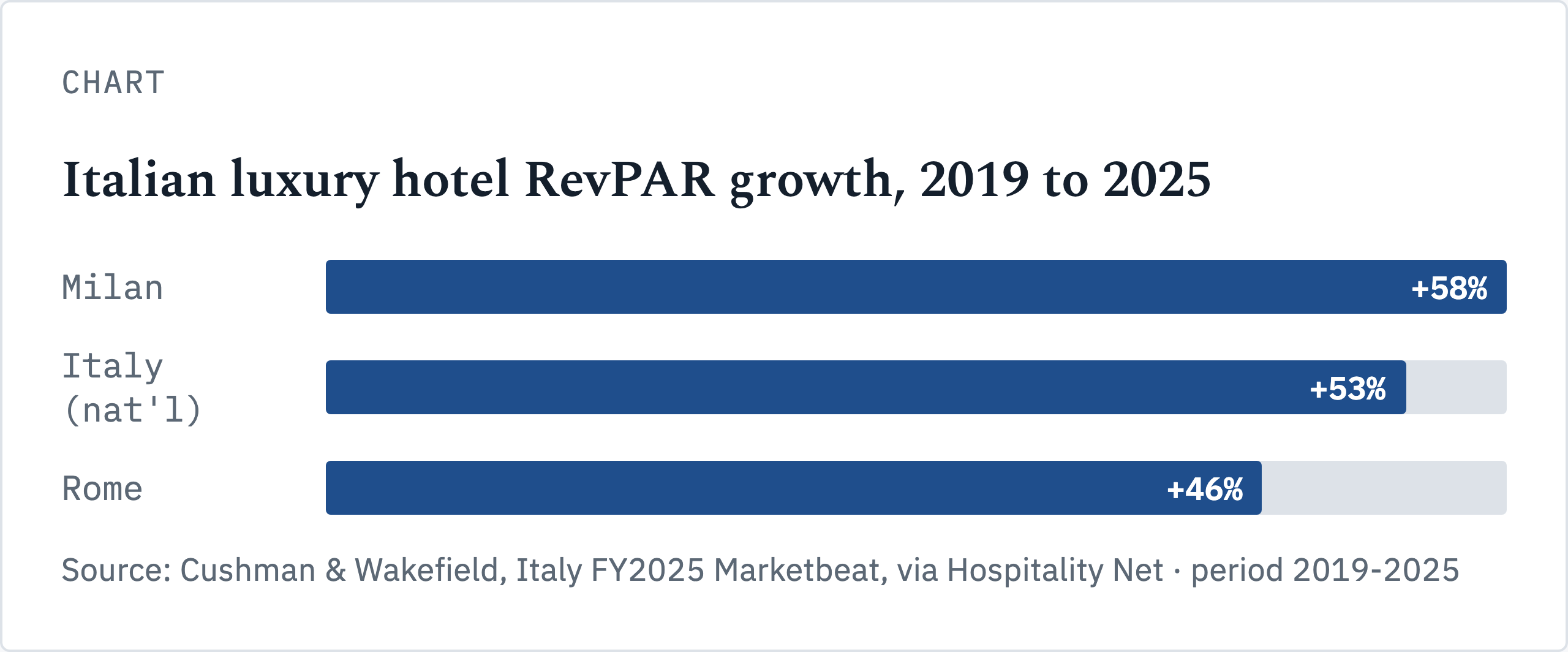
Scarce five star inventory in cities wealthy travelers keep visiting is the same pricing power Hohn has spent two decades buying in public markets, just financed through debt instead of equity this time. TCI is not originating these loans itself, either. It takes participations in loans arranged by TCI Real Estate Partners, a credit shop Martin Fräss-Ehrfeld has run since 2011, which gives Hohn’s fund a specialist underwriter’s judgment on every deal rather than its own (Hedgeweek). Read only the headline number, and a sophisticated allocator walks away thinking TCI just bought itself some ballast.
The variant view: one sponsor owes every dollar
My read is different, and it rests on one fact none of the initial coverage foregrounds. All five loans, in both countries, sit with a single sponsor: Gruppo Statuto, the hotel group controlled by Giuseppe Statuto (Hedgeweek; BeBeez). This isn’t a new relationship TCI is testing with a diversified basket of first time borrowers. In my reading, it’s the deepening of a credit exposure that is a decade old, concentrated in a single name, and has already lived through one shock.
TCI financed Statuto’s purchase of the San Domenico Palace in Taormina in 2016. It was already holding debt linked to the Danieli with a 2022 maturity well before this year’s expansion, per BeBeez, the Italian trade publication that tracks the country’s private debt market (BeBeez). By May 2020, with Covid lockdowns having emptied every hotel in Italy at once, Statuto needed to recalibrate its capital structure across the whole group. TCI sat alongside Banco BPM (roughly €500mn of exposure, down from €900mn three years earlier), Amco (around €126mn inherited from the failed Veneto Banca, one of two regional lenders the Italian state wound down that year (European Central Bank)) and bonds held by Cale Street Partners’ own investment vehicle, all exposed to the same sponsor at the same moment. I read that as the closest real test this relationship has faced, though I should be precise about what it tested: Covid closed every hotel in Italy at once, regardless of who owned them, so this shock arrived at the sector level, not as something unique to Statuto. What it still shows is that Statuto’s OWN response to a shock was coordinated across the whole group in one negotiation, not handled property by property. The shock didn’t stay contained to one property. It hit the sponsor’s whole book at once, whatever triggered it. One negotiation, not five.
I make the current exposure $698mn, not $636mn, because the FT reporting Hedgeweek reproduces adds a fifth position: $62mn against the Six Senses in Ibiza, also owned by Gruppo Statuto, sitting outside the Italy total the headline figure describes (Hedgeweek). $392mn plus $132mn plus $74mn plus $38mn. That is $636mn before Ibiza even enters the count. Nobody covering this story so far has added that fifth number to the other four. Once you do, the four city framing understates the position by almost ten percent, and the “diversified across Italy” framing drops a hotel that isn’t even in Italy. Five trophy assets. Two countries. One name on every note. That matters.
And this isn’t an allocation TCI made at arm’s length into somebody else’s fund. TCI Fund Management Limited’s own SEC Form ADV, amended June 29, 2026, lists TCI Real Estate Partners Limited and four associated general partner entities, one per fund vintage, as related persons of the firm (SEC Form ADV, TCI Fund Management Limited, CRD #269954). A 2023 investment memorandum Pennsylvania’s public pension system published when its staff recommended a $200mn commitment to TCI Real Estate Partners Fund IV names the firm behind the vehicle as TCI Fund Management Limited itself, with Fräss-Ehrfeld running origination and underwriting day to day (Pennsylvania PSERS memorandum, TCI Real Estate Partners Fund IV LP, August 2023). The same memo discloses a key person clause naming both Fräss-Ehrfeld and Hohn: if either stops being involved, the fund’s investment period ends. I read this as Hohn’s own balance sheet, run by a specialist he backs. His book. Not a diversifying check into someone else’s.
Why five hotels behave like one credit
Here is the part that turns a coincidence of ownership into an actual risk claim, not just an observation.
Concentration risk in a lending book is not primarily about how many loan agreements exist. It is about how many truly independent sources of repayment sit behind them. A lender holding four mortgages on four unrelated homeowners has four independent credit risks. One borrower’s job loss does not touch the other three. A lender holding four mortgages on four hotels owned, managed and centrally financed by one family group has, in the scenario that actually matters, one credit risk wearing four collateral packages. The number of loan documents tells you about legal structure. It tells you nothing about correlation. And correlation, not the document count, decides whether a shock produces one bad quarter or a portfolio event.
The 2023 PSERS memo makes this point explicit for the fund structure generally, not for the Statuto loans specifically. It names “Concentrated Portfolio” as a disclosed risk category for TCI Real Estate Partners’ funds, which run just eight to twelve underlying loans at any time with an average size of roughly $200mn each. Its stated mitigant is “the focus on high quality properties in prime locations… with experienced, institutional quality equity sponsors and borrowers” (PSERS memo). That mitigant addresses collateral and sponsor quality. It says nothing about sponsor correlation, and that, in my read, is exactly the gap the Statuto book is now testing. When four or five of a small fund’s loans trace back to one sponsor, the fund’s own stated diversification, eight to twelve names, shrinks toward one in precisely the dimension that matters under stress. Eight to twelve becomes one.
I worked through this same mechanism at more length in a separate note, running the sponsor concentration math against TCI Real Estate Partners’ own stated averages: TCI’s $698M Statuto book, on how eight to twelve names becomes one.
What ring fencing blocks, and what it cannot
This is the strongest objection the piece has to answer. Institutional real estate lenders structure a book like this as without recourse, ring fenced special purpose vehicles, so one asset’s distress cannot legally reach another’s collateral. That structuring is the industry default, and I have no evidence these five loans depart from it. That argues against my own framing, and I am not going to dress it up.
Ring fencing blocks legal cross default. A missed payment at the Caesar Augustus cannot, on its own, put the Danieli into default. It does nothing to block correlated performance. What generates each loan’s cash flow is not just the building. It is Statuto’s management bandwidth, its brand conversion execution, and its access to the next refinancing, all priced at the sponsor level whatever the loan documents say. Own five ring fenced loans to five different sponsors, and a stumble by one team says nothing about the other four. Own five ring fenced loans to one sponsor running three simultaneous luxury conversions, and a stretched management team is the one variable every loan shares. Ring fencing or not.
The Danieli position tests that construction discipline directly. $392mn against a stated average of $200mn is not a marginal overweight. I make that 392 divided by 200, or 1.96, close enough to double the size TCI Real Estate Partners itself uses to describe a normal position in this strategy (PSERS memo). A fund that sizes one loan at roughly two average positions, inside a book that already runs on only eight to twelve names, has made a concentrated bet inside an already concentrated strategy. I read the extra sizing as conviction in the Danieli’s brand conversion specifically, not an accident of underwriting. It is also, by definition, the single loan most exposed if that conversion runs into execution trouble before 2027.
I would draw the same distinction Hohn’s own equity book forces on anyone analyzing it. GE Aerospace, Microsoft, Visa, Moody’s and S&P Global are five different tickers. They stop being five independent risk factors the moment a shock like a war headline hits every large cap US industrial and financial name at once, which is exactly what happened in March, when GE Aerospace fell 17% and dragged the fund down 11.9% for the month (Institutional Investor). I do not think Hohn is averse to diversification by accident. He has run an 85 percent in five names US book for years and built his career on the returns concentration can generate when it is sized right. My point is narrower than “concentration is bad.” The same manager applying the same logic to hotel debt has built something concentrated on the one axis, sponsor credit, that a five city, two brand loan book is least likely to disclose on a first read.
Signa, and the €623 million lesson in what “diversified” hid
There’s a live example of what happens when this exact structure fails, and it’s instructive precisely because the scale is so much larger. René Benko’s Signa Group collapsed into insolvency in late 2023 across a reported 1,000-plus interlinked entities (Euromoney), with Signa Holding, the entity at the top of the structure, later facing €8.35bn in creditor claims (Global Banking & Finance). Julius Baer alone booked a €623mn loss tied to the group (PEI Private Real Estate). Signa’s portfolio spanned trophy hotels, department stores and offices across several countries under separate legal names, exactly the structure that let lenders feel comfortable extending credit against each asset one at a time. Euromoney’s read of the collapse names the mechanism plainly: “debt service costs are going up while property values are going down,” a shock that hit across a structure so opaque that creditors were “struggling to trace the flow of funds between what may be up to 1,000 interlinked entities,” every one of them tracing back to Benko’s control (Euromoney). Statuto is not Signa. Add up TCI’s own $698mn, Banco BPM’s roughly €500mn and Amco’s €126mn, low billions across Statuto’s named lenders, against Signa’s €8.35bn in creditor claims and 1,000-plus entities, and nothing suggests Statuto is near that scale of complexity or distress. But the mechanism that broke Signa’s lenders, a sponsor level shock reaching every asset sharing that sponsor’s balance sheet at once, is the same class of risk the 2020 Statuto episode showed at a smaller scale, even granting Covid as the trigger rather than something Statuto-specific. Scale differs by orders of magnitude. The mechanism does not. Same shape, smaller frame.
There’s a structural reason this kind of book exists at all, and it explains why TCI keeps adding to one name instead of spreading $700mn across ten unrelated hotels. Bank lending against European commercial real estate has been retreating since the post-2022 rate cycle, and part of Statuto’s older debt, per BeBeez, traces back to Veneto Banca, one of two regional lenders the Italian state wound down in 2017. The PSERS memo names the opportunity for a lender like TCI Real Estate Partners directly: wider spreads and lower loan to value ratios, available because “retrenchment of regional banks and heightened liquidity pressures facing many levered lending platforms” have thinned the field (PSERS memo). That’s a real edge, and every private credit fund raised since 2022 is chasing it. It doesn’t change my argument. Spread is not safety. It never was. A bank retreating from Statuto’s debt for its own capital reasons is a different signal than a bank concluding Statuto’s credit is safe.
The repeat borrower defense, and where it stops working
The obvious rival explanation is that this is simply how private real estate credit works. Concentrated lenders routinely back repeat borrowers, because a repeat relationship gives the lender better information than a stranger would, and a sponsor with a proven record through one cycle really is lower risk than an unknown one. TCI Real Estate Partners has completed more than $14bn of transactions since 2011 with what the PSERS memo calls “an attractive loss ratio,” and Fund III generated a 10.8% net internal rate of return against a leveraged loan benchmark as of March 2023 (PSERS memo). On that reading, five loans to Statuto aren’t a concentration failure. I’d call them the payoff from a decade of diligence on a borrower TCI now understands better than any new counterparty it could underwrite cold. A decade of homework, not a shortcut.
What separates my reading from that one is the size trajectory, not the relationship itself. Financing a trusted borrower again and again is a different claim from watching that exposure grow from one Sicilian hotel in 2016 to five trophy assets and roughly $700mn today, much of it in one asset still under renovation. Trust earned through history justifies extending credit to a known borrower. On its own, I don’t think it justifies letting that borrower become the largest disclosed concentration inside a fund whose own paperwork names concentration as a risk category. My reading and the rival one agree on every fact here. Somewhere between one hotel and five, relationship became risk. That is the whole disagreement. Nothing more, nothing less.
What I can’t verify
I can’t see the loan documents, and that matters more here than in most pieces I write. I’ve already granted that without recourse, ring fenced structuring is the industry default for exactly this kind of book, and I have no evidence these five loans depart from it. What I can’t verify is anything finer than that default: whether Statuto’s facilities carry any cross collateralization or shared covenants at all, and whether TCI’s own internal risk limits treat this as one name or five for capital purposes. Both would matter to how correlated the legal exposure actually is, and both are private. Both stay private.
I also can’t verify what share of each loan TCI itself holds versus its other investors, since every account describes TCI’s positions as “interests” and “stakes,” never as sole exposure. The $392mn Danieli figure could be TCI’s full participation or one tranche of a larger loan. Nor do I have Statuto’s current balance sheet. BeBeez’s reporting that the group needed to “recalibrate its capital structure” is from May 2020, inside the Covid shock described above, not a current finding, and I have not found a 2026 source making the equivalent claim.
What would change my mind
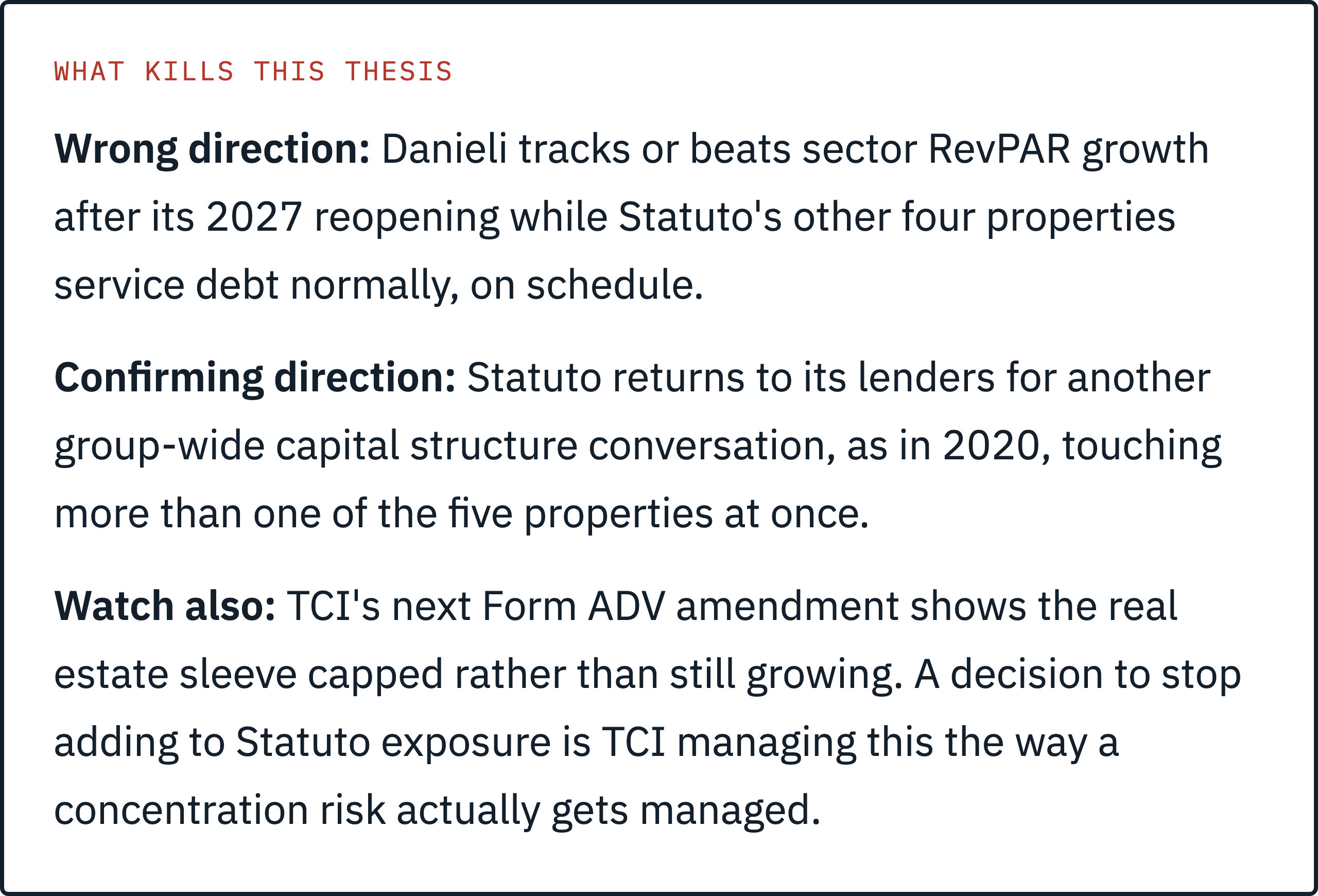
My falsifier here is concrete and dated. If Danieli’s performance after renovation, once the Four Seasons conversion finishes in 2027, tracks or beats the sector’s RevPAR growth while Statuto’s other four properties keep servicing debt normally, that’s direct evidence the loans behave as independently as the headline count implies, and my correlation claim is wrong. If Statuto instead goes back to its lenders for another capital structure conversation, the way it did in 2020, and that conversation touches more than one of the five properties at once, that confirms the loans move together exactly as I argue. I’d also revise this view if TCI’s next Form ADV amendment shows the real estate sleeve holding steady in size rather than growing.
Three things to watch, none of them a trade
A PM tracking TCI doesn’t need to short anything here to act on it. The trade, as I see it, is watching, not positioning. I’d track three things over the next four quarters. Whether Danieli’s occupancy and rate performance after the 2027 reopening validates the RevPAR thesis in isolation. Whether any new TCI Real Estate Partners vintage adds further Statuto exposure or deliberately caps it. Whether Banco BPM, Statuto’s other major lender, shows any sign of moving its own exposure, though its current number isn’t public. The only figure on record is BeBeez’s 2020 read, so this is a lead to chase rather than one to track precisely. A widening gap between what TCI is doing and what its other lenders are doing would tell you more than any single loan level disclosure can. Divergence is the tell. Watch for it.
My question isn’t whether Hohn still believes concentration beats diversification. Obviously he does. My question is whether anyone reading the coverage of this deal has actually noticed he just made the same bet again, in an asset class where the collateral is marble and the correlation stays invisible until the sponsor’s cash runs short across every postcode at once.
I post this same research on YouTube and LinkedIn as it publishes.
The Decision-Grade Version
This piece is complete on its own. The thesis, the evidence, and what would kill the view are all above, and nothing was held back to sell you a next step.
The Patreon note is a separate piece of work rather than a deeper cut of this article. It works through the sponsor concentration mechanism itself against TCI’s own stated fund averages, with the ring fencing counterfactual and two other limitation cases argued at more length than this article has room for. Written for people who put capital behind a view.
→ Read the TCI sponsor concentration note
→ Or join the Patreon community for every note
Where do you draw the line between a trusted repeat borrower and a concentrated single name credit risk, when the collateral changes but the name on every note stays the same?
Cover photograph: Armin Kleiner, CC BY-SA 4.0, via Wikimedia Commons.