


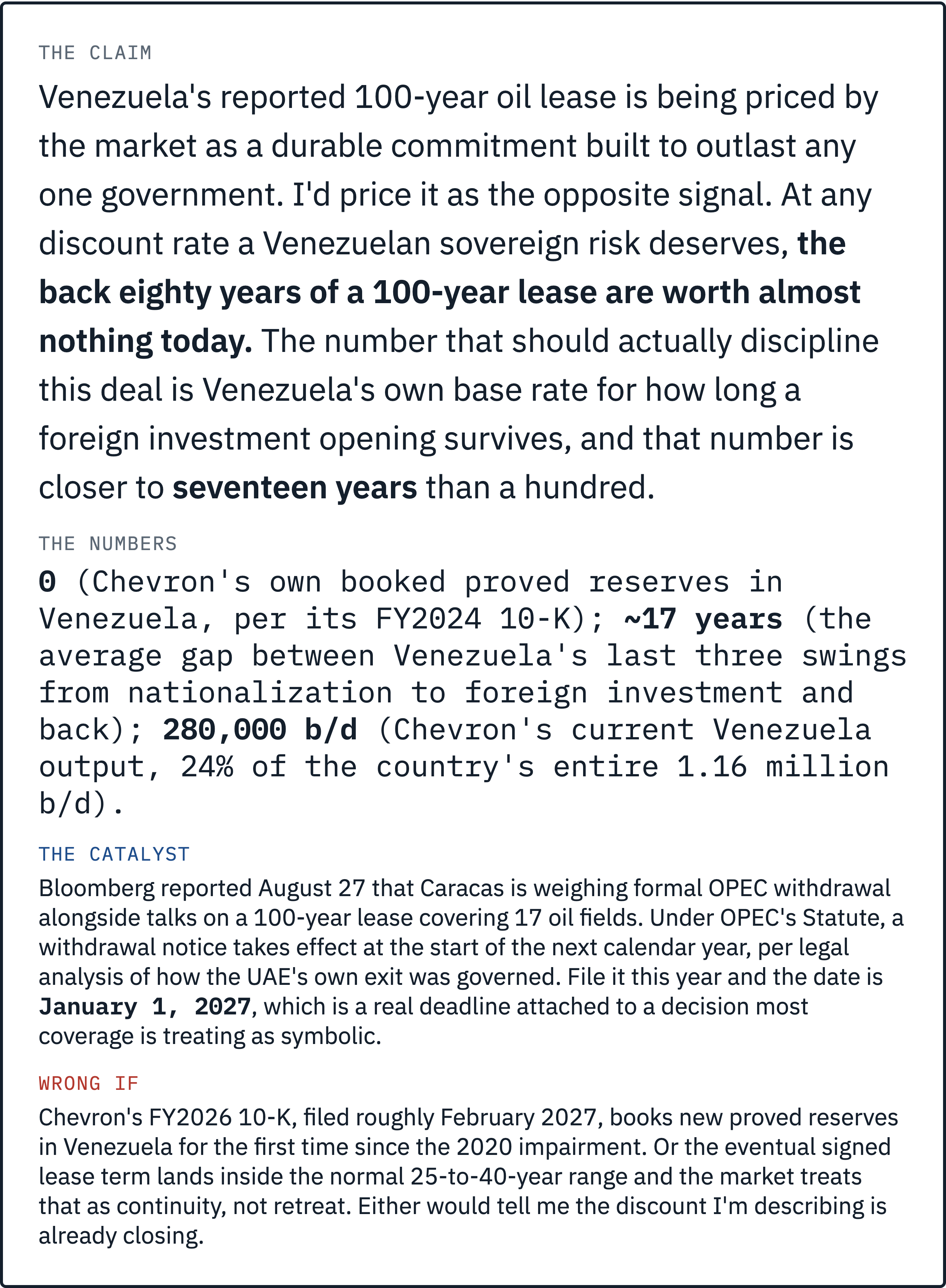
The claim: Venezuela’s reported 100-year oil lease is being priced by the market as a durable commitment built to outlast any one government. I’d price it as the opposite signal. At any discount rate a Venezuelan sovereign risk deserves, the back eighty years of a 100-year lease are worth almost nothing today.
Consensus: a retirement party, not a departure
The reporting on Venezuela’s possible OPEC exit has converged on one reading, and it is a reasonable one. Bloomberg’s own account, carried by Investing.com, notes the country’s departure “would have limited immediate impact on global oil markets,” given how little it produces today against its own past output. Venezuela has sat outside OPEC’s formal quota compliance since 2016, when collapsing output made its assigned target meaningless. It has produced without reference to a cartel ceiling ever since. A country that already ignores its quota loses nothing by making the exemption official. Nothing lost, nothing new.
The UAE left OPEC+ in May for capacity reasons of its own. It was producing 3.4 million b/d against an estimated 4.2 million of effective capacity, and it wants 5 million by 2027, which the quota it just left would never have allowed. That exit barely moved the strip. Venezuela’s, on this reading, is a smaller version of the same story: paperwork catching up to a relationship that’s already public, one confirmed departure and one live deliberation raising a legitimate but slower moving question about how much pricing power Saudi Arabia and Russia have left. The sell-side version of this same smaller story is narrower and fair on its own terms: Citi’s Scott Gruber told Bloomberg the oilfield services opportunity is real regardless of who owns the lease, a services revenue argument, not a reserve ownership one, and a drilling contractor paid this quarter does not carry the same risk as an equity holder in year 41. A different risk entirely.
There’s a second, stronger version of the consensus, and it deserves a real hearing rather than a dismissal. This time, the argument goes, actually is different. Nicolás Maduro was captured in a US raid on January 3, and Washington has controlled the marketing of Venezuelan crude since, with President Trump saying in late July that sales had already cleared $13 billion. Energy Secretary Chris Wright put the logic plainly at a Goldman Sachs energy conference: the US intends to control Venezuelan oil sales “indefinitely,” saying it needs that leverage to drive change in Venezuela. A reform of the Hydrocarbons Law took effect January 29, letting private companies hold majority upstream positions for the first time since the 2007 mixed company structure. Chevron’s Venezuela output is already up 15% over six months, guided toward 50% growth by the end of 2028. The growth is genuine.
On the strongest telling, a 100-year lease is not bravado. It is the natural conclusion of a government that finally has both the legal framework and the foreign backing to commit for the long run, and the earlier reversals belong to a Venezuela that no longer exists. I take that case seriously. But it is not the discriminating question, in my view. The discriminating question is what happens once US attention moves on, and nothing about a 100-year number answers it.
The variant view: the number is the tell
Here’s what the “no impact” framing misses. Venezuela’s exit changes nothing about barrels this year. That’s true. It is not evidence that nothing about the exit matters. Small does not mean irrelevant.
The 17-field lease being negotiated alongside it is the actual story. Its headline term, a century, isn’t a sign of confidence. It’s a sign the number has stopped doing economic work and started doing political work. No oil company prices cash flow a hundred years out. My read of the reserve math below shows why: at any discount rate that belongs on Venezuelan risk, years 41 through 100 of a lease are worth low single digits of its total value. Almost nothing, by design.
A company that actually expected to collect for a century wouldn’t need to say so. The contract would just run its economically relevant course and get renewed, the way Chevron’s existing Venezuela agreements already do: terms expiring in 2039, 2041, 2047 and 2050, all comfortably inside the window where the arithmetic still matters. A hundred years isn’t a cash flow assumption. It’s a claim about permanence, aimed at persuading investors, lenders, and Venezuela’s own public that this arrangement won’t be reversed the way the last two were. That claim would only need making if the market’s actual prior is that it will be. A tell, not a guarantee.
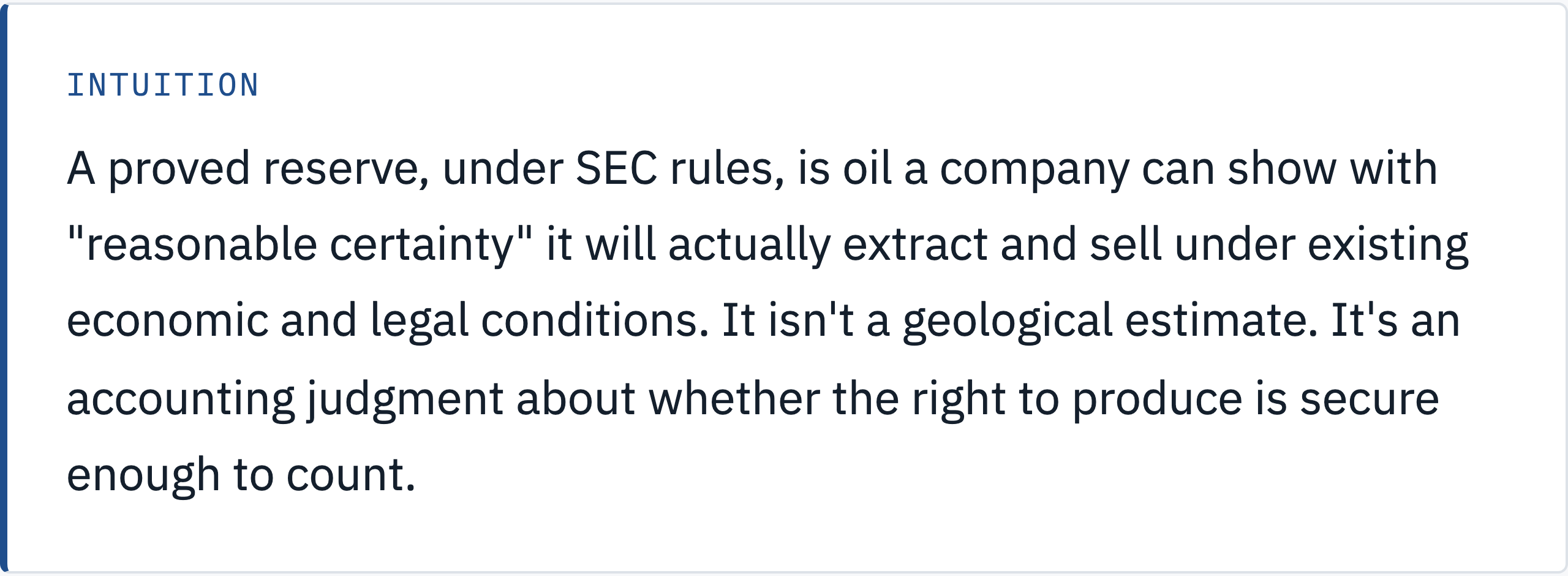
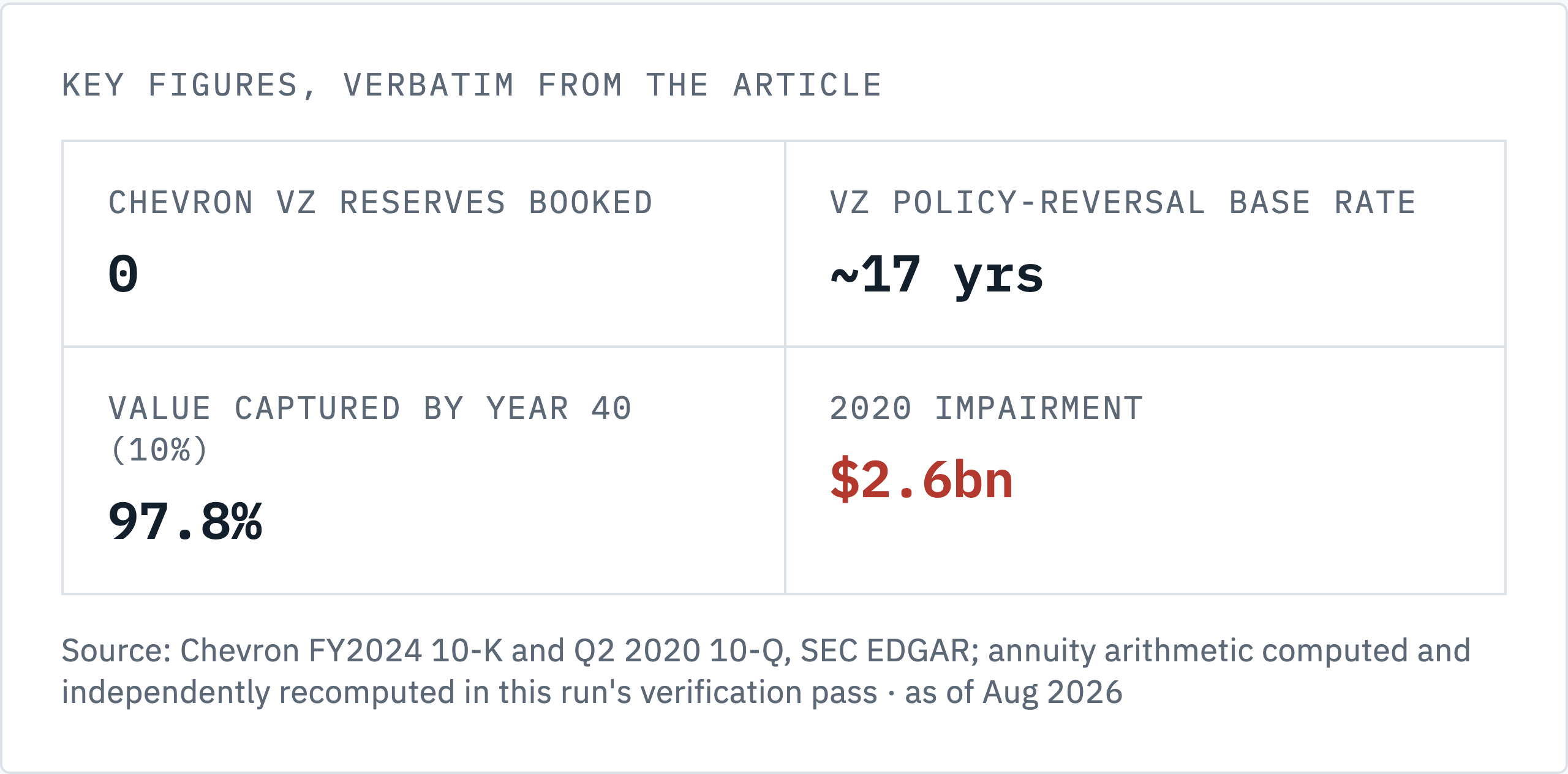
That judgment already exists, and it’s the sharpest data point in this whole story, though not for the reason it first looks like. Chevron’s own 10-K for fiscal 2024 states it without qualification: “As of December 31, 2024, no proved reserves are recognized for these interests” in Venezuela. This from the one company that never left, that operated straight through Chávez’s 2007 nationalization. It carried roughly 160 million barrels of proved Venezuela reserves on its books right up until 2020, when it took a $2.6 billion full impairment and removed every one of them. Gone, all at once.
Here’s the part I think actually matters: what triggered that impairment wasn’t a Venezuelan expropriation. It was Washington. The US sanctioned PDVSA, Chevron’s own joint venture partner, in January 2019, and months of narrowing licenses later, Chevron’s accountants concluded the loss was no longer temporary. The reserve line has never been restored since, not through five years of licenses granted, revoked and regranted, most recently when the White House pulled Chevron’s operating license outright in February 2025 and then handed back a new one months later, the same relief this piece already credits with Chevron’s current output growth.
That’s the market’s actual, central view of Venezuelan title security, and it isn’t really about Venezuela at all. It is a live demonstration that Chevron’s entire Venezuela exposure runs on a license Washington can revoke on a phone call, which is exactly the discretionary account risk this piece keeps coming back to on the money side too. The reserve line was filed with the SEC under penalty of law in February 2025, months before anyone was discussing a 100-year lease, and it still has not moved. The lease term is a marketing number. I’d treat the reserve line as the real one, for what it actually measures. The filing is the fact.
The mechanism: why 100 years is not worth what it sounds like
Start with the arithmetic, because it is the whole case. A lease’s value is the sum of its future cash flows discounted back to today, and the discount rate does almost all the work in a story this long. Venezuelan sovereign risk, even under the current arrangement, sits in the 8-to-12% range a frontier energy asset typically carries, in my judgment. Nothing exotic about that number.
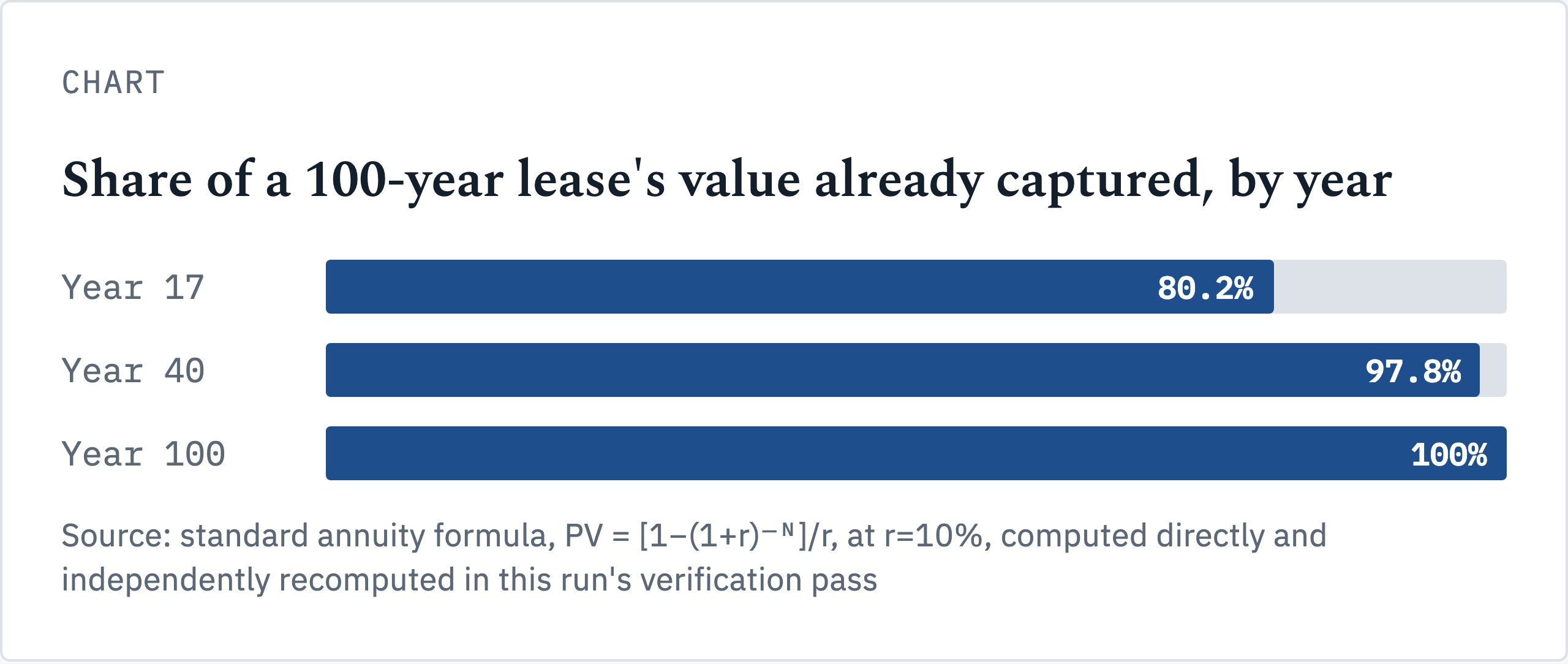
I ran the standard annuity formula, present value of $1 a year for N years at rate r equals one minus (1+r) to the power of negative N, divided by r, across a full 100-year term against shorter windows. The split is stark. At a 10% discount rate, the first 40 years capture 97.8% of a 100-year lease’s entire value. The last 60 years add just 2.2%. Push the rate to 12%, appropriate for a deal this exposed politically, and years 41 through 100 shrink to 1.1% of total value. Even at a generous 8%, they are only 4.6%. The tail barely moves the total.
I make that the back six decades of “a hundred years” worth somewhere between one and five cents on every dollar the headline implies.
I walk through the full worked example at three discount rates, plus how to apply the same framework to any long-duration sovereign concession, in The Sovereign Concession Discount.
Venezuela’s own base rate is faster than the discount curve
Now replace 40 years with Venezuela’s own measured history, because that is the number that should actually discipline this deal.
The country nationalized its oil industry outright on January 1, 1976, forming PDVSA under President Carlos Andrés Pérez. It reopened to foreign capital through the Apertura Petrolera in the early 1990s, producing the four Orinoco strategic association agreements that became Chevron’s current joint ventures. In 2007, roughly three decades after the original nationalization, Hugo Chávez converted those associations into PDVSA-majority “mixed companies,” and ExxonMobil and ConocoPhillips walked rather than accept the new terms. Chevron, Statoil, BP and Total stayed. Nineteen years after that reversal, the Hydrocarbons Law reform reopened the sector again, this January. The cycle turns again.
Three cycles. One direction each time. The three gaps, 1976 to the early-1990s opening, that opening to 2007, and 2007 to this January, each run somewhere between fourteen and nineteen years. I will use seventeen as the representative gap for the arithmetic below, the middle of that range. Seventeen years, not a hundred.
At a 10% discount rate, the first seventeen years of a 100-year lease already capture 80.2% of its total value. Whatever Venezuela’s own history says about how long an opening actually lasts, I would argue the market has already been paid most of what the full century was ever going to be worth, in present value terms, by the point that pattern would typically turn again.
None of this is unique to Venezuelan crude, as far as I can tell. It is the same math every long duration concession runs into, and the historical record backs the arithmetic instead of complicating it. William Knox D’Arcy’s 1901 concession in Persia ran 60 years on paper; Britain lost it in 1951, at year 50, when Iran nationalized the Anglo-Iranian Oil Company. Kuwait Oil Company, founded in 1934 on a concession commonly put at 75 years, was fully nationalized by the state in 1975, at year 41. Both companies held, on paper, some of the strongest legal protection a foreign concessionaire could get in their era. Both lost control decades before their contractual term ran out: D’Arcy’s grant had ten years left on paper, Kuwait’s had thirty four. Neither one made it.
No concession this long has ever actually run its full course, in either of these two cases, and I found nothing in the historical record that runs the other way. Neither one was actually a hundred years, which makes the pattern more damning for a 100-year claim, not less: even 60 and 75-year grants, shorter and on paper safer, got cut short by decades. Venezuela’s own average across its three cycles, seventeen years, is not an outlier against that record, in my read of it. It is just a faster version of the same pattern, playing out on a shorter clock. A faster clock, same story.
The discriminator: what actually makes this different, and why it cuts the other way
The strongest version of “this time is different” rests on US involvement being categorically new. Bigger, and different in kind. That’s correct as description. Where it breaks down is the assumption that direct US control makes the deal more durable. I think it does the opposite. Legitimacy at home is what actually decided the last two reversals, and legal drafting had almost nothing to do with either one. Politics decided it, not paperwork.
The 1976 and 2007 nationalizations weren’t imposed on a reluctant Venezuela. They were popular. Pérez nationalized in 1976 with broad domestic support during a high oil price boom. Chávez’s 2007 move was a central plank of a presidency that had just won reelection. Both leaders drew domestic legitimacy from taking Venezuelan oil back from foreign companies. Popular moves, both times.
The current arrangement inverts that structure completely. It follows a foreign military operation that captured a sitting head of state, installed an interim government whose own constitutional 90-day mandate lapsed in early April with no confirmed extension vote from the National Assembly, and routes oil sale proceeds through accounts the US Energy Department’s own fact sheet describes as disbursed “at the discretion of the U.S. government.” A State Department official told Congress in April that only about $3 billion of the $13 billion collected has been accounted for, and a congressional watchdog has since opened a formal review. I don’t read any of that as a stronger foundation for a hundred years of commitment than 1976 or 2007 had. I read it as weaker, because it carries no domestic electoral mandate at all. Only a foreign one. And every reversal in this piece’s history came from a government asserting that the deal in front of it wasn’t its own. No local mandate this time.
I should name the strongest counter directly: raw external power has sustained illegitimate arrangements for decades with no local consent at all. The US has held Guantánamo Bay on a lease Cuba has refused to cash the rent checks for since 1959, sixty seven years and counting, on the patron’s staying power alone. But Guantánamo is a fenced enclave needing no functioning courts, no cooperative workforce, no administrative continuity across 28 million people. A national oil sector needs all three, so I think legitimacy matters more here, but I won’t pretend the comparison is airtight. An imperfect parallel, still useful.
What the market’s own burned players think
The clearest evidence the market already agrees sits with the two companies who lived the last reversal directly. ExxonMobil and ConocoPhillips are negotiating a potential return to the 17-field opportunity, and both are visibly reluctant.
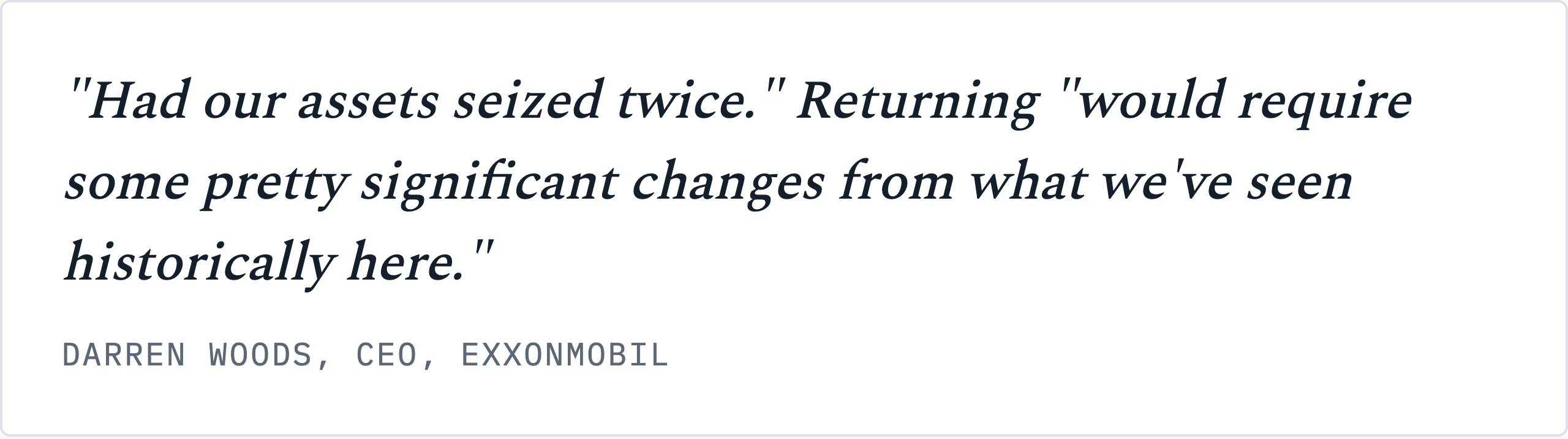
ExxonMobil chief executive Darren Woods has said the company has “had our assets seized twice,” and that returning “would require some pretty significant changes from what we’ve seen historically here,” calling Venezuelan oil “uninvestable” without “durable investment protections” and legal change.
I read that as the closest thing available to an expert market view from inside the trade. It’s priced not in a research note but in a chief executive’s own reluctance to commit shareholder capital.
I went into the arbitration record expecting two clean wins for the companies burned last time. It isn’t there. ConocoPhillips is still owed the bulk of an $8.7 billion ICSID award from the 2007 seizure, an amount that has grown past $11 billion with interest after Venezuela lost its annulment appeal. ExxonMobil’s own 2014 ICSID award started at $1.6 billion and went the other way: an annulment committee struck roughly $1.4 billion of it in 2017, leaving the company with closer to $200 million from that proceeding. Binding international arbitration was already the strong legal protection tried once, after the last cycle turned. Where it held up, collecting took the better part of a decade. Where it didn’t, the loss came from the same system that was supposed to be the guarantee. My read: a fresh 100-year lease document doesn’t erase that history. It sits directly on top of it, and the two firms with the most reason to trust a new promise are negotiating hardest against trusting it.
The limits: where the case actually weakens
I won’t pretend the discount I’m describing is total. Chevron’s growth this year is real. 280,000 b/d today, up 15% in six months, against a national total of 1.16 million b/d, means Chevron alone already accounts for close to a quarter of everything Venezuela produces. A real and growing share. Sanctions relief and the new Hydrocarbons Law are functioning changes to the operating environment. I’d count them as more than announcements.
And the degree of direct US financial control here, proceeds settling into US-controlled accounts instead of PDVSA’s own, has no precedent in any of the historical cases I’m comparing it against, whether that’s Iran under the D’Arcy concession, Kuwait under its 1934 grant, or Venezuela’s own two prior openings. If Washington’s involvement persists for years, well beyond one administration’s term, the risk profile could shift in ways my base rate doesn’t capture. A genuine unknown, stated plainly. I have no comparable case of a producing country’s oil sector run this directly by a foreign government for an extended stretch. I can’t rule out that this is a real structural break, not a repeat.
A third limit: Brent and WTI both drifted lower the same week the OPEC-exit report landed, mostly on broader demand worries, and I can’t point to desk commentary pricing a distinct Venezuela premium into the curve. I’m reading that as complacency. A fair critic would read the same silence as a reported number with no signature simply not deserving a reaction yet, and I can’t fully rebut that until a real term sheet exists.
This mispricing has a short shelf life, which I want to say plainly rather than let it read as a standing inefficiency. The moment a term sheet leaks or gets confirmed, whatever gap exists between the headline and the deal’s real economics closes in a single trading session. Fast, once it happens. That is a matter of months, in my estimate, not years, given how actively both governments are negotiating.
The other honest gap: nobody outside the talks has actually seen one. “100 years” comes from Bloomberg’s own unnamed sources alone, per reporting out of Rio Times tracking the same day’s coverage: Reuters and Axios covered the same story without citing any lease length at all, and no government has confirmed a figure. That same Rio Times piece adds the detail that does the most work for my own argument: a hundred years is, by its own account, “a length Venezuelan law does not provide.” If that’s right, the number was never going to be signed as written in the first place. Dead on arrival, maybe. Hydrocarbons minister Paula Henao, appointed in March, has publicly invited American firms to invest, but the specific fields and the specific term she has in mind haven’t been made public. The number could well get replaced by something closer to the 25-to-40-year range Chevron’s existing joint ventures already use. If that happens, the “headline theater” reading I’m making gets confirmed, not refuted. But I should say plainly, here, that I’m reacting to a reported number, not a signed one, and to one outlet’s sourcing at that.
What would change this view
Three things would move me off this read, and all three are dated and checkable, which is the point of writing them down now.
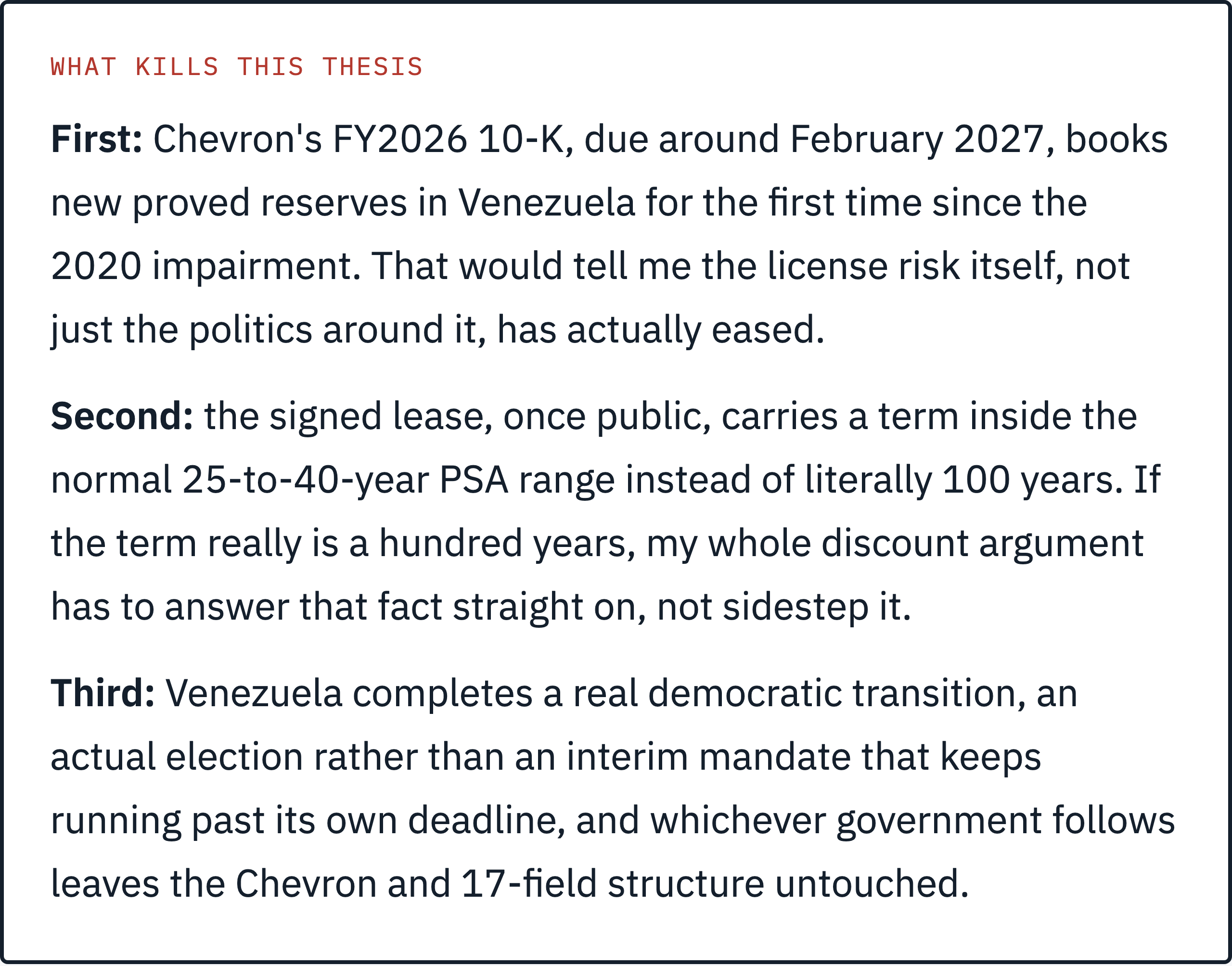
That would be real progress on the first. The second confirms my read directly; no dodging that outcome if it doesn’t hold. That third one is the real test, in my view. Every reversal in this piece’s history came from a government asserting a predecessor’s deal wasn’t its own to honor. The current arrangement hasn’t faced that test yet. It hasn’t had an elected successor yet, by construction. The test has not happened yet.
The close: price the book Chevron actually keeps
If you’re underwriting Venezuela exposure through Chevron, or through any other name that ends up inside the 17-field talks, the instrument to price isn’t the 100-year headline. It’s the paper Chevron already holds.
Joint ventures running to 2039, 2041, 2047 and 2050 sit inside a 13-to-24-year window, almost entirely within the part of the discount curve where the arithmetic still counts. A company with every commercial incentive to book Venezuela at a positive number still won’t put one on its balance sheet, because the license under it can be pulled faster than any Venezuelan government could move. Treat anything past that window as pure optionality, priced the way Chevron itself is already pricing it. At zero. I’d trust that book over this week’s headline.
So which would you rather hold: Chevron’s proven, dated paper through 2050, carried on its own books at zero, or a fresh 100-year lease priced by a negotiating table that has shown no such discipline at all?
I post this same research on YouTube and LinkedIn as it publishes.
The Decision-Grade Version
This piece is complete on its own. The thesis, the arithmetic, and what would change my mind are all above, and nothing was held back to sell you a next step.
The Patreon note is a separate piece of work rather than a deeper cut of this article. It walks the same mechanism as a general framework for pricing any long-duration sovereign concession, with the full three-rate worked example and a section on where the framework breaks that this article doesn’t have room for. Written for people who apply this kind of arithmetic to positions, not just to one headline.
→ Read the sovereign concession discount note
→ Or join the Patreon community for every note
If you strip the country name off this, is a hundred-year contract ever actually worth pricing past year forty, or is a number that long always doing more marketing than arithmetic?
Cover photograph: Dreamyshade, CC BY-SA 4.0, via Wikimedia Commons.