

Two sessions open Monday: 7:30 to 9:25, and 4:00 to 4:15
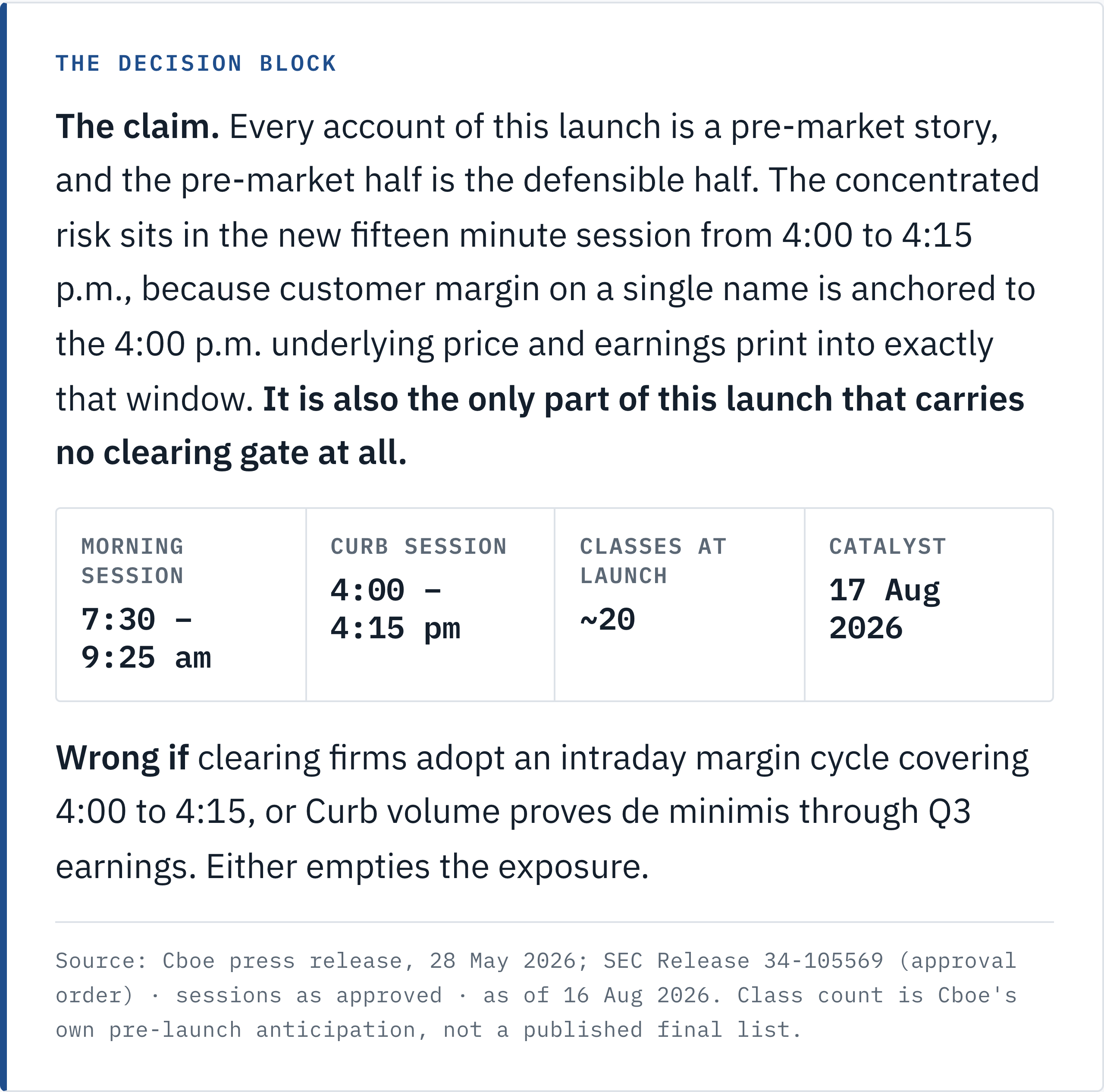
On Monday Cboe Options Exchange begins trading single name options in two windows: Global Trading Hours, 7:30 a.m. to 9:25 a.m. ET with order acceptance from 7:15, and Curb, 4:00 p.m. to 4:15 p.m. Cboe put the list at roughly 20 names when it announced approval in May, the Magnificent 7 plus AMD, Broadcom and Palantir among them, and has published no final list since.
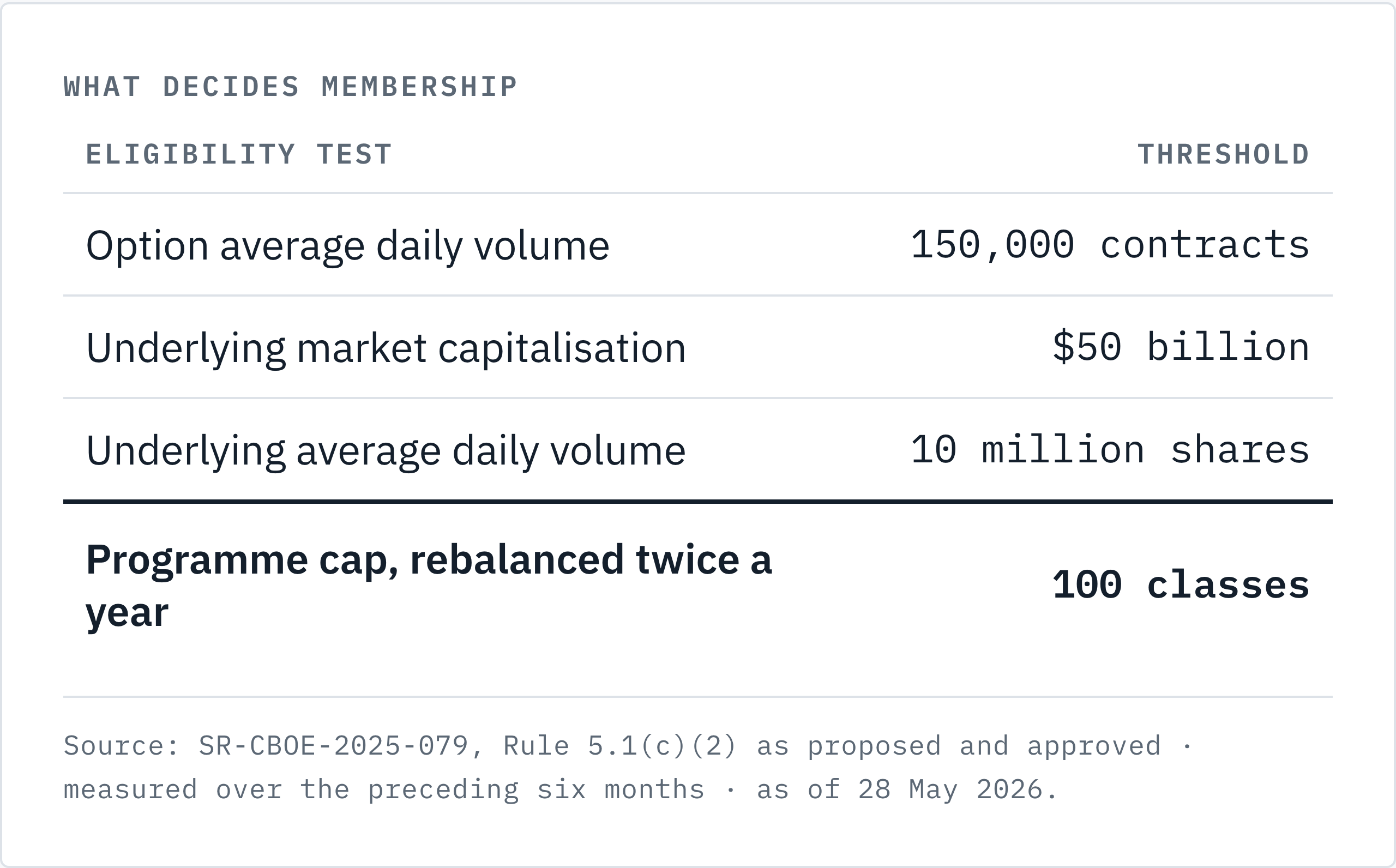
Three criteria decide membership over the preceding six months: option average daily volume of 150,000 contracts, underlying market cap of $50 billion, and underlying volume of 10 million shares. Cboe caps the program at 100 classes and rebalances twice a year.
Two operating details belong in front of your operations desk before Monday. Limit orders only: market, stop and stop-limit orders are refused in both sessions. And prints from both are not last-trade eligible and do not count toward the daily high or low, carrying an extended-hours condition code instead (Cboe FAQ).
The consensus, in Cboe’s own words
The prevailing read is a good argument. Options on the most heavily traded stocks have been unavailable for two hours each morning while the shares traded freely from 4:00 a.m., so overnight news had to be absorbed at 9:30 in one crush. Extending the session lets holders hedge when the information arrives, and Cboe gated it to the deepest names, capped it at 100 classes, banned the order types that misbehave in thin books, and phased it. Meaghan Dugan, Cboe’s Head of U.S. Derivatives: “By launching first with a select group of single-name options, we are deliberately taking a measured approach to help ensure market safeguards and investor protections remain in place.” The residual risk is thin books and poor fills, a cost falling on whoever trades there.
I agree with almost all of it, and the morning session is well built. Cboe stated the binding constraint itself: “Since equity options generally will not trade unless the underlying security also trades, any trading hours outside of RTH available for equity options are limited to extended trading hours available for underlying equity security” (SR-CBOE-2025-079). The 7:30 start sits inside an equity pre-market that has worked for decades. There is a reference price. There is a book. Thin is not absent.
Where I part company is on where the risk went, and I think the answer sits at the other end of the day.
Margin anchors at 4:00 p.m. The option session closes at 4:15
Start with the clock, because that is where I think the whole thing turns. US equity markets close and mark at 4:00 p.m. Customer margin is generally computed from values as of that close, and many clearing firms use OCC theoretical values that are typically anchored to the 4:00 p.m. underlying price. Under the new structure the option trades another fifteen minutes against an underlying that has already been marked. I have read that sentence a dozen times looking for the part that closes the loop, and it is not there.
SIFMA set out the consequence in its 19 March 2026 letter to the Commission: “If positions are established or materially changed between 4:00 p.m. and 5:00 p.m., particularly around earnings or material news, a significant after-hours move in a single stock may not be reflected in customer margin until the next calculation cycle” (SIFMA, 19 March 2026).
Now put the corporate calendar on top. US issuers release results outside regular hours in two standard slots, before the open and after the close, which is why the pre-market and after hours equity sessions exist in the shape they do. Both of Cboe’s new windows sit inside one of those slots, and the afternoon one is the harder case: on a material number of days each quarter those fifteen minutes are the fifteen in which a single name reprices hardest. A position opened at 4:10 into a double digit earnings gap is carried against a mark struck before the news existed.
SIFMA named the same break: “There is a disconnect in timing, since the equity markets close and are marked at 4:00 p.m. Yet, under the Proposal, certain equity options will remain open until 4:15 p.m. This could create clearing issues in determining customers’ positions, values, and risks.”
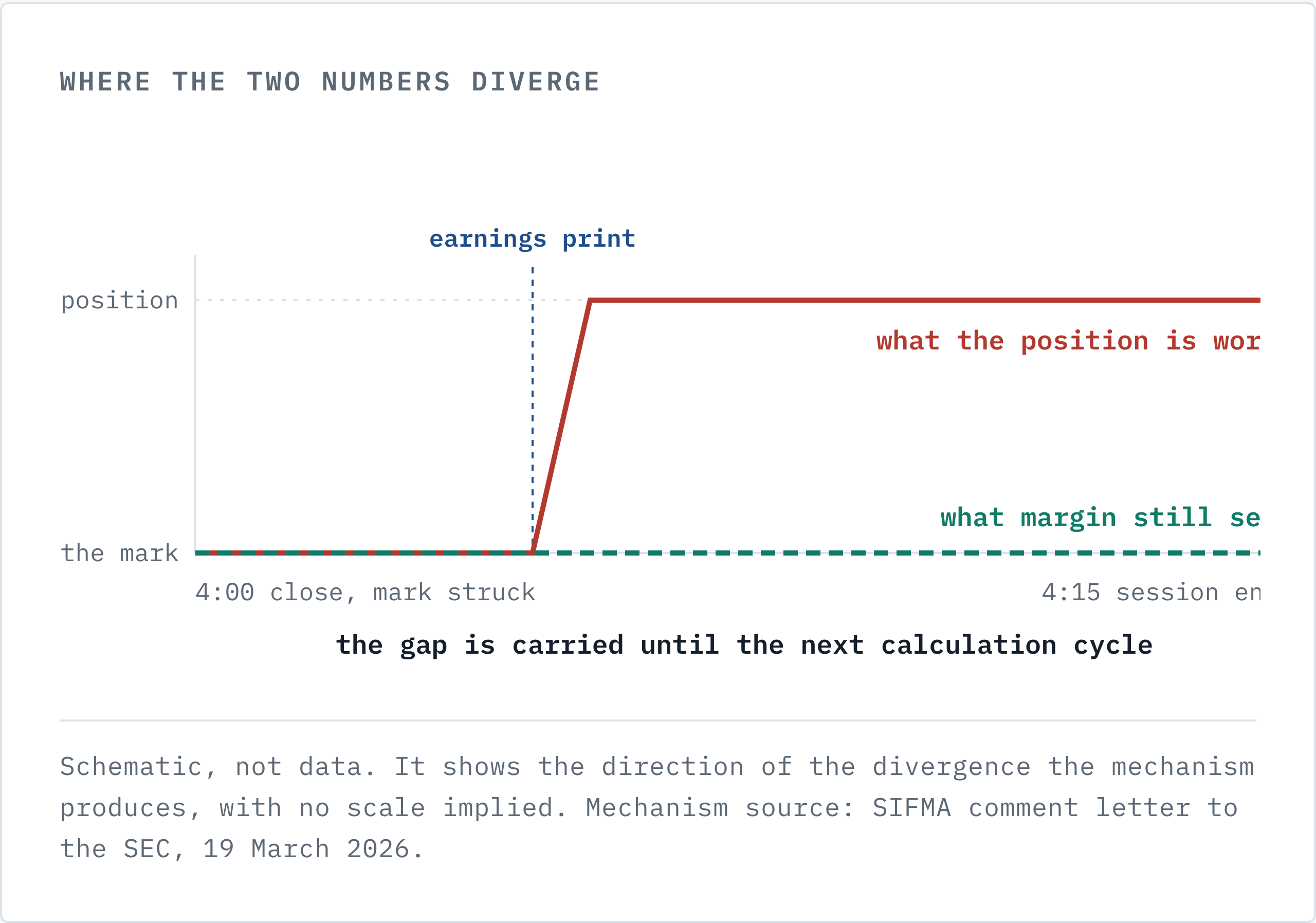
That is the exposure. It is not an execution quality problem and it does not sit with whoever chooses to trade the session. It sits in the margin layer between a customer and a clearing firm, and it is largest on exactly the days the position is largest.
I worked that through with round numbers, end to end, in a separate note on Patreon: a $40,000 mark against a $300,000 position, and where the two diverge minute by minute.
The ETF precedent is the one thing that does not transfer
The standard reassurance is that this ground is settled. Index options and, on SIFMA’s count, around 40 ETF option classes already trade until 4:15 p.m. Nothing broke. Single names are the next increment.
That argument fails, and for a reason the industry stated on the record rather than one I had to invent. From the same SIFMA letter: “While ETF options already trade until 4:15 p.m., diversification within an ETF basket generally dampens single-name volatility and limits margin variance. A concentrated single-stock move presents a more pronounced potential gap in the customer margin layer.“
Read it as a statement about variance and it is obvious. The 4:00-to-4:15 anchor has been survivable because the instruments left open in that window reference baskets, and a basket does not gap 15% on one company’s guidance. Diversification is doing the work, and it is the only thing doing it. Extending the window to AAPL, NVDA and TSLA removes what made the precedent safe while keeping its reassuring shape.
The clearing gate on the afternoon session appears once, in a footnote
This is the part I find hardest to explain away. It turns on one sentence, and on where that sentence is not.
Cboe filed the original proposal on 30 September 2025. In that version both windows were Global Trading Hours sessions: it proposed “shorter GTH sessions running from 7:30 a.m. to 9:25 a.m. and 4:00 p.m. to 4:15 p.m.” On 23 December 2025 the Commission instituted proceedings under Section 19(b)(2)(B) (SEC Release 34-105063), the step the SEC takes when rejection is on the table. On 2 April 2026 Cboe filed Amendment No. 1, superseding the original and reclassifying the afternoon window as a Curb session.
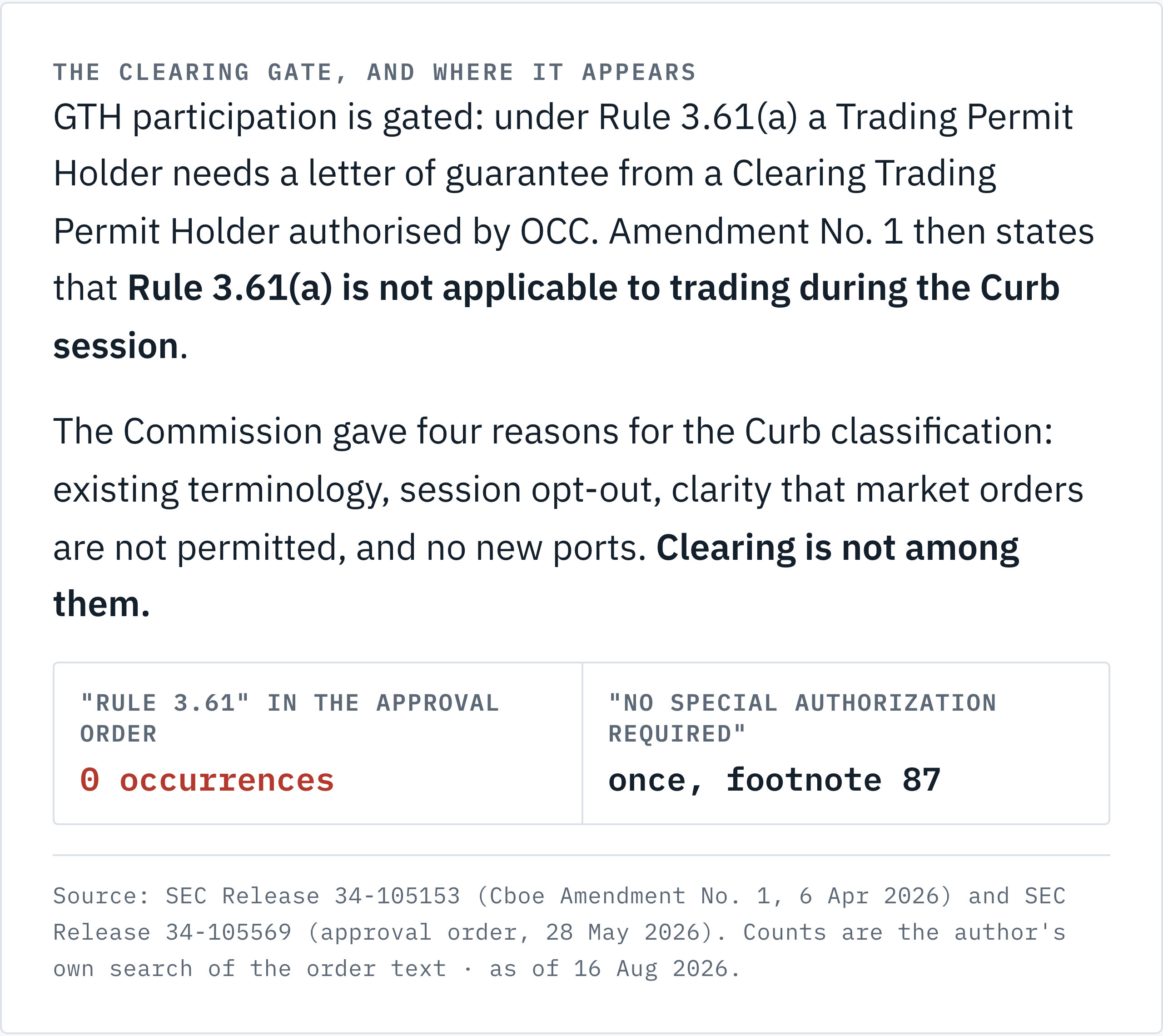
GTH participation is gated. Under Rule 3.61(a) a Trading Permit Holder needs a letter of guarantee from a Clearing Trading Permit Holder authorized by OCC to operate in the GTH session, and Cboe will not authorize any firm OCC has not. Amendment No. 1 then states, verbatim: “Rule 3.61(a) is not applicable to trading during the Curb session“, and later, “there is no special authorization required for participation in the Curb session” (SEC Release 34-105153).
Here I have to be fair to the Commission, because the easy version of this argument is wrong. The reclassification was not slipped past anyone and it solved a real problem. The Commission found Curb “addresses this commenter’s concerns” and gave four reasons: it aligns with existing terminology, it lets participants opt out of that session, it “provides clarity that market orders would not be permitted”, and it avoids new ports (SEC Release 34-105569). All four hold, and the order-type protection survived.
What those four reasons do not include is clearing. The sentence about the Curb session needing no special authorization appears exactly once in the approval order, in footnote 87, attached to a discussion of something else. Rule 3.61 appears zero times. The classification was weighed on terminology, flexibility, order types and ports; the clearing consequence was recorded and never examined. I am not claiming the Commission missed it. I am claiming the record shows it noted and did not weigh it, which is a different and more checkable thing.