


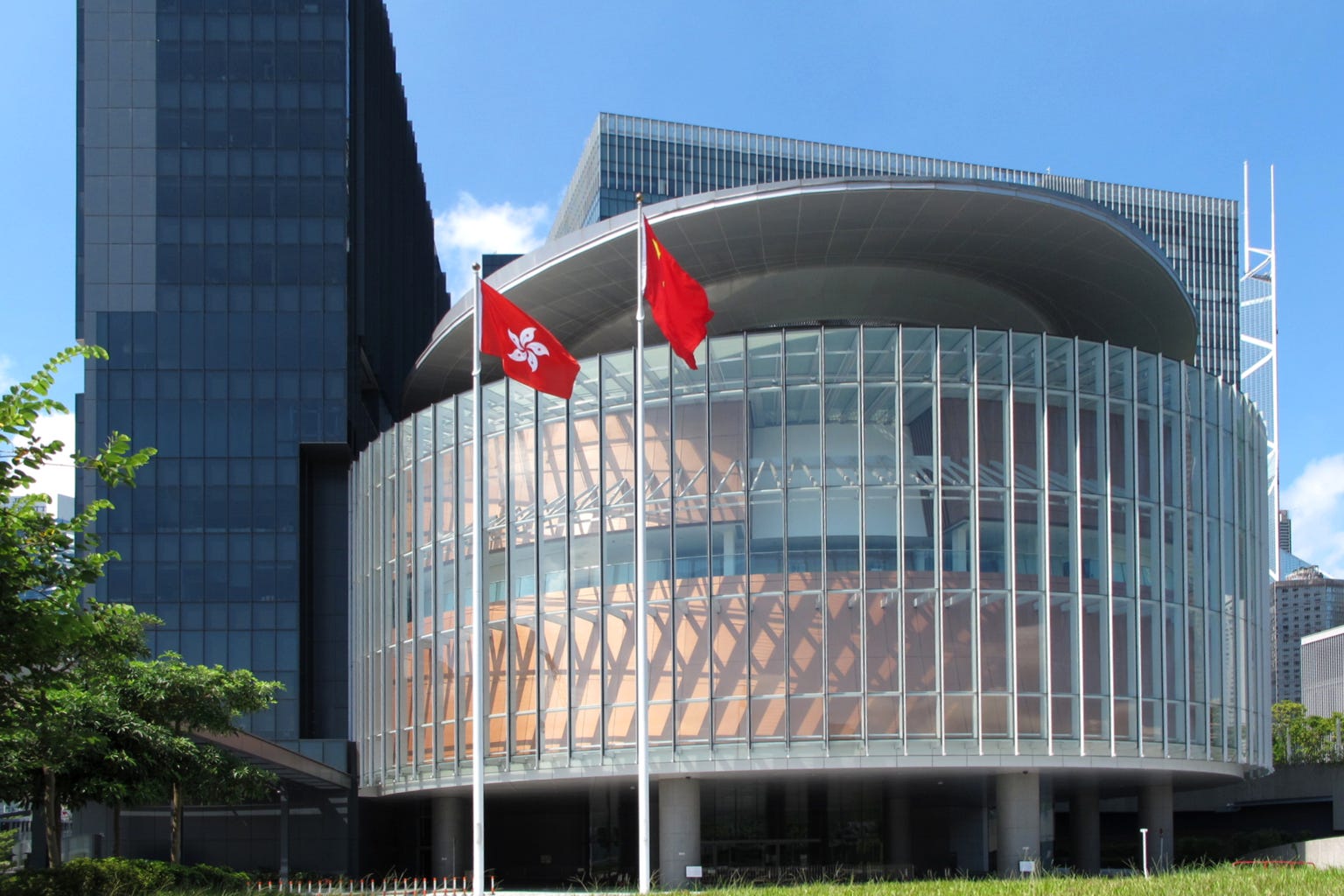
Hong Kong’s carried interest tax expansion is a gazetted bill with a retrospective tax date already written into its text. Singapore’s competing pledge is a press release with no rate, no draft legislation, and a Year of Assessment that doesn’t start until 2027. Those are not the same kind of event.
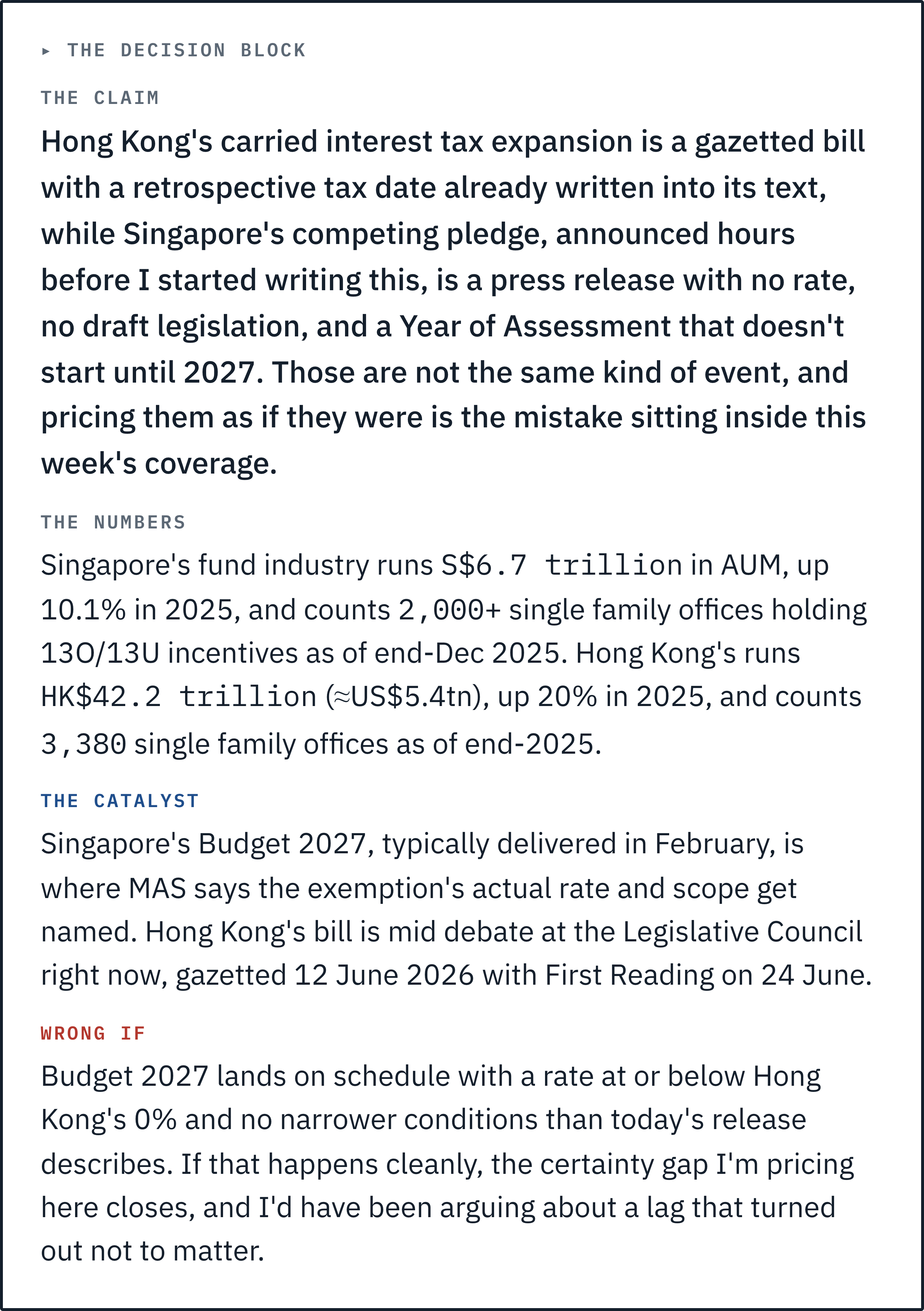
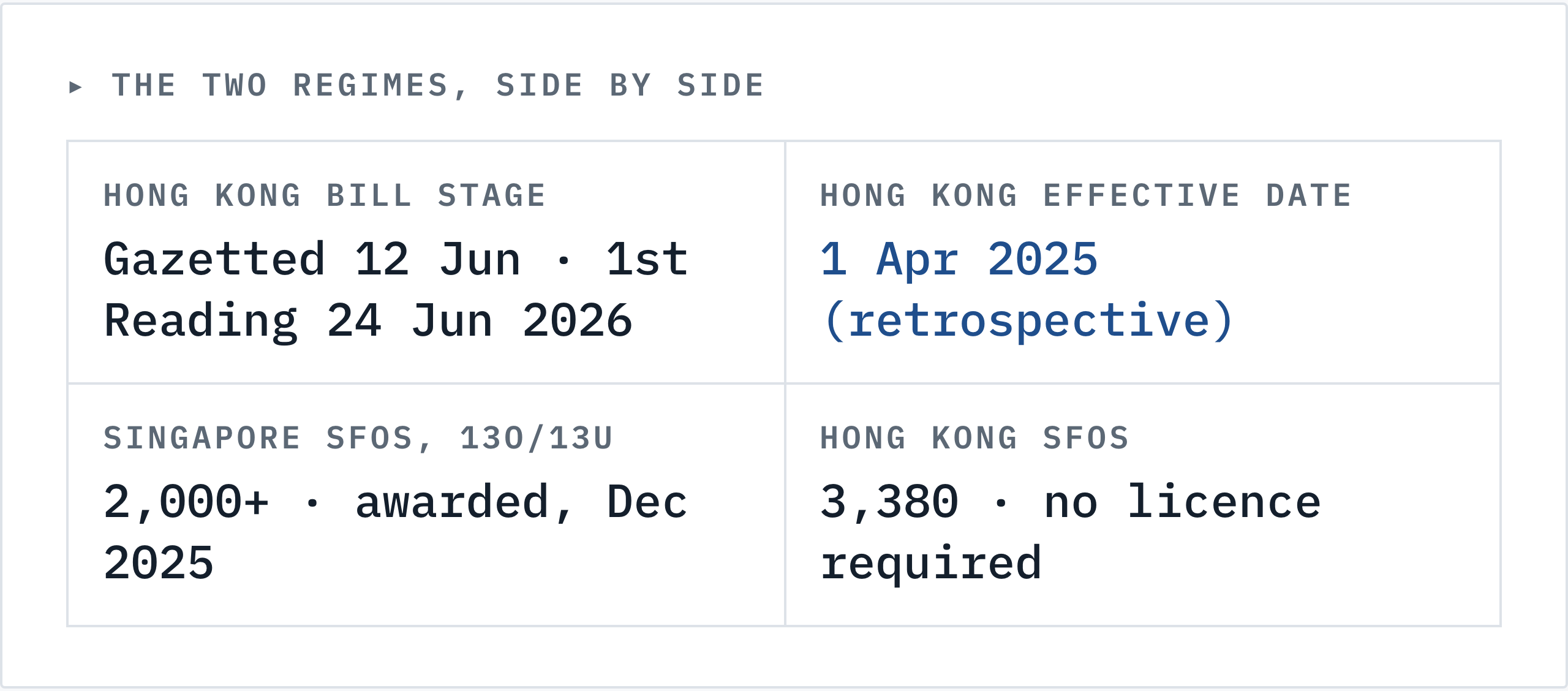
I put the two governments’ own filings on screen for this one, the gazette clause and the parliamentary answer, and let the nine month arithmetic run rather than just stating it.
The consensus, stated at its strongest
I will say the steelman plainly. On 19 August 2026, the Monetary Authority of Singapore announced three measures in one release (MAS media release): a tax exemption on fund managers’ profit related returns, a hedge fund co investment programme, and a revised immigration track counting performance pay toward the salary bar for senior professionals. Capital, tax and people, moved in one afternoon. The Edge Malaysia headlined it as Singapore answering Hong Kong directly. AIMA’s Asia Pacific co head Kher Sheng Lee put it well: “Two of Asia’s financial centres are going all-in on backing our industry in a big way in the same season” (via The Edge Malaysia).
MAS deputy chairman Chee Hong Tat did not dodge the comparison, saying plainly “we don’t see the competition with Hong Kong as zero sum,” and that “the region is big enough” for both cities to grow (reported by Mothership). The stakes are concrete: asset management is 15% of Singapore’s financial sector output, 13% of its employment, and grew 7.5% a year for five straight years (MAS media release). Real money, real jobs. A government doesn’t roll out three coordinated levers on a Wednesday because it is bored.
The second measure, the Hedge Fund Investment Programme, is a different tool than a tax rate: MAS co investing directly alongside hedge fund managers who commit to building or expanding a Singapore presence, a cheque that lands the moment a firm signs up rather than a deduction due eighteen months out at a Budget speech. It is the strongest lever in this week’s release and the one with the least detail: MAS says only “more details will be shared when ready”: no size, no structure, no vintage. Biggest lever, least detail.
So the consensus read is that Singapore matched or beat Hong Kong’s push, and the strongest form of it is not even in this week’s headlines. Hedgeweek, citing people familiar with the plans, reports Singapore’s changes “could ultimately apply to a wider group of investment professionals than” Hong Kong’s (Hedgeweek), while noting MAS has not yet disclosed the programme’s size or the tax measures’ cost and scope. That is a claim about eventual generosity from unnamed sources, not about today’s paperwork, the distinction the rest of this piece turns on. I do not think the consensus is wrong about the intent. I think it is wrong about the clock.
The variant view: one has a bill number, the other has a due date
Here’s the specific fact that forces a different reading. Hong Kong’s Inland Revenue (Amendment) (Preferential Tax Regimes for Funds, Family-owned Investment Holding Vehicles and Carried Interest) Bill 2026 was gazetted on 12 June 2026 (Hong Kong government gazette notice). It had its First Reading in the Legislative Council on 24 June (IRD press release). It is drafted. It has a bill number. It carries a retrospective effective date, Year of Assessment 2025/26, running from 1 April 2025 (KPMG). Carry earned by a qualifying Hong Kong fund since that date is already inside the intended scope once the bill clears its remaining readings.
Singapore’s equivalent, read straight from paragraph 4 of its own release, “is expected to take effect from the Year of Assessment 2027,” and “further details will be announced at Budget 2027.” No rate. No bill. No draft clause. What exists today is a stated intention that a share of fund manager profit will be exempt, contingent on “economic substance requirements, including minimum headcount,” details still to come. Nothing to book yet.
I ran the two effective dates side by side, using each side’s own convention. Hong Kong’s is 1 April 2025, drafted into the bill’s text. Singapore’s own preceding year assessment rule means Year of Assessment 2027 taxes income earned in calendar year 2026 (Forvis Mazars, on Singapore’s YA convention), which puts the exemption’s own effective start around 1 January 2026. That’s a nine month gap in effective date, on top of one entire stage of legislative process, gazettal, that Singapore hasn’t reached yet. Hong Kong has a bill number. Singapore has a paragraph. A hedge fund GP deciding where to book a new carry structure this quarter is choosing between an instrument with a text he can read today and a promise with a due date next February. Those do not discount the same way.
I ran that discount as an actual number in a separate note on Patreon: solving for the bill passage probability at which Hong Kong’s discounted cost equals Singapore’s known rate, and the break even is not where the nine month gap alone would suggest.
The mechanism: why a promise discounts differently than a bill
Rank the two jurisdictions by how far each has travelled toward zero tax carry, and the picture sharpens.
Hong Kong’s base regime has been law since 2021: the Inland Revenue (Amendment) (Tax Concessions for Carried Interest) Ordinance 2021, enacted 7 May 2021, setting a 0% profits tax rate on qualifying carried interest, retroactive to income accrued from 1 April 2020 (Dechert, on the enacted ordinance). Five years of standing law that Mintz’s own client note calls “underutilized and impractical due to its narrow scope and administrative complexity” (Mintz). Hong Kong’s government reached a similar verdict independently: its November 2024 consultation paper, proposing to widen the regime, cited the certification process and administrative burden as reasons the concession “has not been widely adopted” (KPMG, on the FSTB’s 2024 consultation). All of it was written for private equity style carry, excluding hedge funds almost entirely. Written for someone else.
The 2026 bill fixes that narrowness, building on the 2021 base rather than replacing it: it widens the definition of “fund” to private credit and digital assets, drops the old 5% incidental transactions threshold, and relaxes special purpose entity treatment. 2021 gave Hong Kong a working zero rate for a narrow slice of the industry. 2026, once passed, gives it a working zero rate for most of the rest. That is a government finishing a law it wrote five years ago.
I should be precise here: gazettal is Hong Kong’s formal publication step: a bill becoming a real, numbered legal text open for public scrutiny, which a policy statement never gets. Neither it nor First Reading is passage, but both are further along than anything Singapore has published. Singapore has published nothing.
What the 2026 bill repairs is more mechanical than “expands the definition” lets on. The old regime required carried interest paid through the qualifying person and tied to a hurdle rate in the fund’s own constitutive documents (Legislative Council brief). A hurdle rate is a private equity construct: the GP earns nothing until the fund clears a stated return, then takes its cut above it. Most hedge funds don’t run that structure; they run high water marks against a NAV that resets monthly, with no single “disposal” event. A test shaped for private equity had nowhere to attach. It never did. The 2026 bill deletes the hurdle rate requirement, deletes the mandatory HKMA certification step (Charltons), and lets carried interest flow through a carry vehicle or personal investment entity rather than only “through the qualifying person,” confirmed independently by Baker McKenzie: three specific administrative locks, removed by name. Hong Kong’s FSTB also drew a boundary on 12 August: a proprietary trading business, one trading only its own capital, does not qualify as a “fund” (FSTB response via regfollower). One test, drawn narrow.
Singapore’s own rate: 10%, never once zero
Singapore never had a zero rate carry mechanism. Sections 13O and 13U exempt the FUND vehicle’s “specified income” from “designated investments,” saying nothing about what the fund MANAGER earns. A manager’s own performance fee has always been ordinary income, taxed at up to 24% personally above S$1 million, the top marginal rate since Year of Assessment 2024 (ASEAN Briefing, Singapore individual income tax). Run it through a management company instead and it hits the Financial Sector Incentive’s concessionary 10% corporate rate. That is conditional on a Capital Markets Services licence, minimum staffing, and at least S$250 million under management. Not every manager qualifies. Budget 2025 layered an enhanced 5% tier on top for a manager whose own firm lists on the SGX (DLA Piper), which tells me MAS already knew 10% wasn’t pulling its weight against Hong Kong’s zero. It has never once been zero.
