

The claim: The population of managers who owe a Form 13F in any given quarter is not maintained by anyone, and the filings themselves carry the SEC’s own machine-readable proof of it. Fifteen notices filed on time for Q2 2026 name a manager that filed nothing at all.
The numbers: 264 managers filed a 13F-HR in the Q1 filing window and neither a holdings report nor a notice in the Q2 one, carrying $804.6bn of positions as last reported, 1.21% of the $66.46tn of value reported that quarter. Eight of those managers were named by 15 notices filed on time as the manager that would report someone else’s holdings. Their combined book, as last reported, is $67.6bn. Jefferies Financial Group is one of the eight.
The catalyst: The Q2 2026 deadline was 14 August 2026. Every figure here was read on 16 August, two days after.
Wrong if: the eight named managers file late and a completed Q2 settles back to the ~10 orphaned notices per quarter I measure in Q4 2025 and Q1 2026. That would put this quarter inside the normal band for a small standing defect. It wouldn’t make the standing defect go away.
CalSTRS, Capstone, Sarofim and Ohio PERS: four unbroken records, four blanks
The California State Teachers’ Retirement System has filed a Form 13F every quarter since March 1999. Its Q1 2026 report covers $94,490,983,194 across 2,925 positions (13F-HR cover page). For the quarter ended 30 June 2026 there’s no holdings report and no notice. I pulled its submissions record on 16 August: the most recent 13F of any kind is still the Q1 one, filed 18 May.
One caveat governs every number below. A 13F value is a manager’s long US-listed equity and options at quarter-end, filed 45 days later, excluding shorts, swaps, non-US listings, cash and credit. So $94.49bn is what CalSTRS reported on 31 March 2026 under that definition, not what CalSTRS manages. I use these values to size what left the dataset, which is the one thing they measure exactly.
Three more look the same. Capstone Investment Advisors, the volatility manager, has filed 74 consecutive quarterly reports since December 2007. Q1 2026: $57,413,662,700 across 1,558 positions, signed by chief compliance officer David Zimmerman on 15 May (cover page). Nothing for Q2. The firm isn’t wound down: its registration reads ACTIVE on the SEC’s adviser database.
Ohio PERS has missed one period in 27 years, back in 1999, across 118 filings. Its Q1 book was $30,916,647,037 across 2,345 positions, signed by executive director Karen E. Carraher. Then nothing.
Fayez Sarofim & Co filed something more elaborate: a 13F COMBINATION REPORT for Q1, $39,083,555,297 across 536 positions, covering itself and four other managers at once. Q2 is blank. It’s the cleanest artefact here and I’ll come back to it.
Those four managers reported $222bn between them in Q1 and nothing in Q2. My first instinct was that they’d simply filed late, so I tested it by rereading each firm’s submissions feed directly instead of searching by name. Two days past the deadline, all four are still blank. Two days isn’t long and stragglers are normal: WhaleWisdom, which processes these filings commercially, says there are always filers who take days or weeks. Hold that thought: the structural claim below doesn’t rest on these four.
The reform argument assumes the filer list is known
Critics of 13F data don’t talk about missing filers. The 45-day lag makes it stale on arrival, the form ignores shorts, swaps and non-US listings, and the reported values carry errors that survive into every downstream dataset. All three are true and well documented, and the academic work sits in the same place: Anderson and Brockman’s Form 13F (Mis)Filings documents off-list securities, wrong prices and amendments less accurate than the originals. Every one is an audit of filings that exist.
The most recent institutional push makes that case. A September 2024 rulemaking petition from the Society for Corporate Governance, NIRI and NYSE Group argues the 45-day window is an artefact of paper filing and that “much of the data in 13F filings will be out of date after a 45-day delay, yet many companies still use it because they have few reasonably priced alternatives.” The last clause is the part I’d underline: dependence on this dataset is conceded by the people asking to fix it.
It says nothing about non-filing. Nothing about delinquency, filer identification, or whether the agency knows who owes a report. The reform conversation is about how fast and how complete each filing is, and it takes the roster as given.
I think the roster is the weaker link, and the evidence is inside the filings.
Rule 13f-1(a)(1) makes the obligation unconditional for the year
The obligation attaches to the prior calendar year, which matters more than it sounds. Under Rule 13f-1(a)(1), a manager that crossed $100m of section 13(f) securities in any month of 2025 must file “within 45 days after the last day of such calendar year and within 45 days after the last day of each of the first three calendar quarters of the subsequent calendar year.”
The SEC’s own staff put it in plainer words in the Form 13F FAQ: a manager “subsequently will need to submit filings for the March, June, and September quarters of the following calendar year, even if the market value of your Section 13(f) securities falls below the $100 million level.”
So a manager cannot leave part way through the year by shrinking. Redemptions, a strategy change, a book that fell under the threshold in February: none of it discharges the 2026 obligation for a manager that qualified in 2025. 245 of the 264 filed a Q1 2026 report, so each of those was above the threshold and knew it. The other 19 last filed earlier still, which lengthens their gap and does not shorten it.
That’s what turns a missing filing from an ambiguity into a fact. I don’t have to establish that these managers still run $100m. They told the SEC they did. Thirteen weeks earlier.
Fifteen notices name a manager that filed nothing
Form 13F has two shapes. A 13F-HR carries holdings. A 13F-NT is a pointer, naming the manager whose report will carry the filer’s positions. A notice is worth exactly what the report it points at is worth.
Nothing validates the pointer. EDGAR accepts a notice naming a manager that files nothing, with no check at submission and none afterward. So the system produces its own evidence, in a structured field, every quarter.
For Q2 2026 I read every 13F-NT cover page and checked whether each named target filed. Eight managers filed a Q1 2026 report, filed nothing for Q2, and were named by 15 on-time notices as the manager that would report.
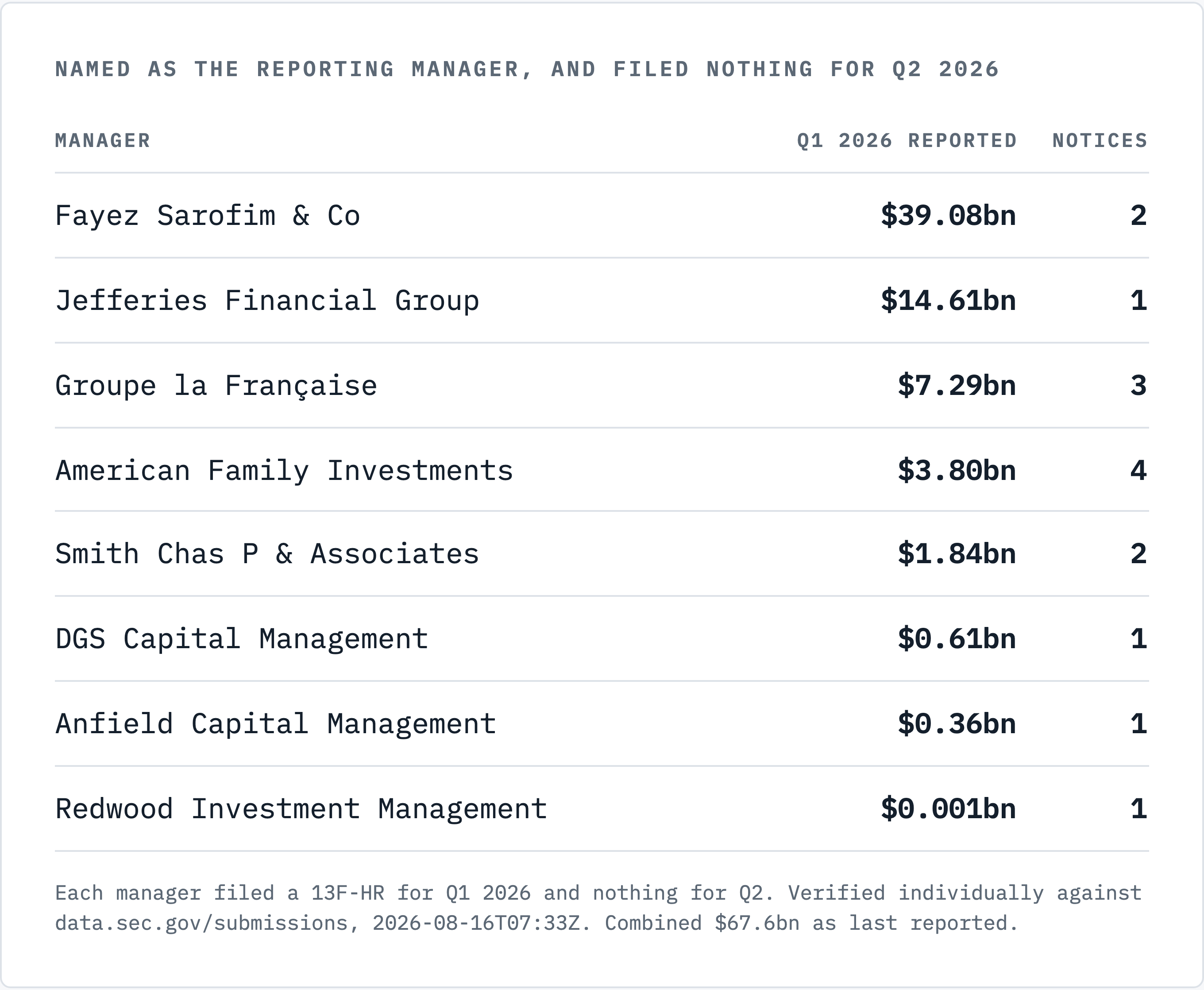
The Sarofim chain closes on itself. On 14 August, Sarofim Trust Co and Sarofim International Management Co each filed a notice naming Fayez Sarofim & Co, file number 028-10991, as the manager reporting their holdings. Sarofim Trust’s was signed by William D. Hanna; Sarofim International’s by Raye G. White, who also signed the Q1 combination report both point at. The same officer sits on both ends of a pointer that leads nowhere. The pointer is live and the target is absent.
Jefferies is the one I’d put in front of a risk committee. Jefferies Capital Services filed on time, naming its parent, the NYSE-listed investment bank Jefferies Financial Group, as reporting manager. The parent’s most recent 13F covers Q1 2026, filed 8 May. Four American Family entities and three Crédit Mutuel entities repeat the shape: a compliance function working correctly, pointing at a document nobody filed.
One precision, the objection a good analyst raises immediately. Sarofim is named on three Q2 holdings reports, from Northern Trust, BNY Mellon and Northwestern Mutual. It sits in their otherManagersInfo block, the cover-page cross-reference for shared discretion, and in none of their otherManager2Info lists, where included managers’ holdings actually sit. Being cross-referenced is not being reported.
