


On 28 September Boaz Weinstein’s Saba Capital had its biggest day yet buying BlackRock’s listed private credit fund. Its Schedule 13D, filed 14 October, names BlackRock TCP Capital Corp. (TCPC), which closed that day at 69 cents per dollar of its pro forma net assets.
Weinstein is buying BlackRock loans at a discount that either doubts the marks or prices something else.
It prices something else. A buyer paid around 90 cents per dollar of marks for half the loans; the shares price the rest lower, a gap only a cash exit collects, and TCPC’s board lists one. The same officers run BlackRock’s non-traded private credit funds, whose marks a public sale would test.
BlackRock sold half the loans
On 4 August TCPC sold most of a continuation vehicle, set up to hold the loans, to funds managed by Pantheon, a private credit secondaries buyer, for about $152m. The vehicle held about $523m of TCPC’s loans, 48% of its debt book at fair value. I rebuilt that price from Appendix A, the pricing schedule in TCPC’s 8-K, then priced the shares against their sector and each exit.
Phil Tseng, then chief executive, described the deal in the 6 August release as done “while realizing a substantial premium relative to the value implied by the Company’s current share price”. The pro forma balance sheet filed that day shows the other base: net assets fall $57.1m, or $0.68 a share. June’s net asset value (NAV) of $6.58 becomes $5.90.
Both are true on different bases: the premium is against a $3.50 share price the day before, barely half of June’s NAV, and the loss is against BlackRock’s marks.
A buyer’s price tests the marks, not the wrapper: the listing, the fees and a board that decides whether holders get the loans’ cash. Cherkes, Sagi and Stanton tied closed-end fund discounts to the liquidity a listed fund offers against its manager’s fees. On 6 August the board also hired KBW (Keefe, Bruyette & Woods) to weigh reinvesting, buybacks, “strategic combinations” or “completing an orderly realization of portfolio assets”.
A buyer paid 89 to 95 cents
Appendix A of the 8-K prices the vehicle in five steps, and they rebuild Pantheon’s cheque:
Start from the loans at 95% of their 31 December value: about $565m on $595m.
Add $74m of cash TCPC put in for unfunded commitments.
Subtract $43m repaid since December.
Subtract $30m of income since December and other adjustments, handed to the buyer by the December pricing date.
Subtract the $406m the vehicle’s collateralised loan obligation (CLO) owes.
That leaves $160m of equity; 95% of it is $152m, the gross proceeds TCPC reported.
The deal was struck at 95% of December values, and by June BlackRock had marked the same loans about 6% lower, so on the loans alone the price sat close to June marks. With the income handed back and the costs, TCPC’s NAV fell $57.1m on about $520m of loans moved at June marks: an all-in cost of about 11 cents a dollar, roughly half of it that income.
Appendix A does not say how much of that income is price, so Pantheon paid between about 89 and 95 cents per dollar of June marks. If BlackRock’s marks explained the discount, the buyer would have demanded a deep cut on loans valued on unobservable inputs; it did not.
The market’s price for the loans has not moved. Net of debt and cash, the shares valued TCPC’s investments at about 80 cents per dollar of marks on both June balance sheets: the reported one at $3.50, before the sale, and the pro forma one at $4.08.1 BlackRock sold half of TCPC’s loans at 89 to 95 cents; the market still prices the rest near 80, and only an exit collects the gap.
The price rose on lower leverage
Lotfi Karoui of PIMCO wrote on 17 August of business development companies (BDCs), the listed funds that lend to private companies, that “BDC equities continue to trade at significant discounts to NAV, reflecting skepticism toward reported marks.”
Exhibit 1 · TCPC rose three times as fast as the BDC ETF · Source: Yahoo Finance; TCPC pro forma · as of 7 Aug 2026
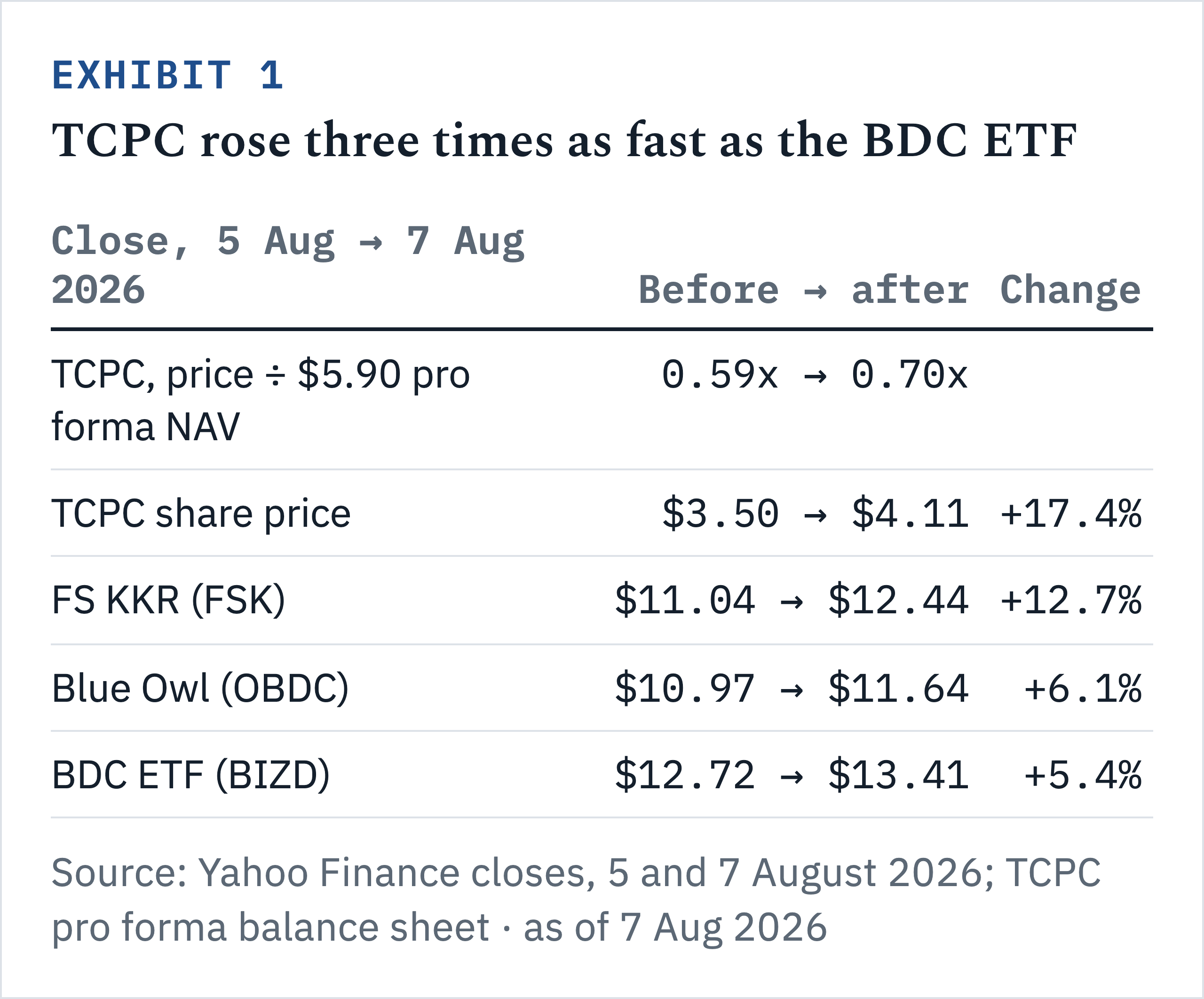
Source: Yahoo Finance closes, 5 and 7 August 2026; TCPC pro forma balance sheet.
TCPC beat the BDC ETF by 12 points, and the price moved to about what the same 80 cents on the loans implies once the sale’s cash paid down debt: about $4.04. The sale and the repayments since June cut net debt from 1.38 times net assets to about 0.4.
Blue Owl Capital Corp. (OBDC) shows where that re-rating stops. It sold about $400m of loans in February “at fair value, equivalent to… 99.8% of par”, and trades at 0.71x its June NAV. TCPC’s 0.69x sits between FS KKR’s 0.58x and Ares Capital’s 0.96x. Selling at marks did not lift OBDC above 0.71x.
Own TCPC beside Saba now, or only once TCPC’s board names a route: the ticket sets the trigger, the size and a kill line, first tested on 5 November.
Below the paid line:
Exhibit 2: TCPC valued in a cash exit, line by line.
Exhibit 3: each route on KBW’s list, priced per share.
Exhibit 4: Saba’s 2024 campaigns, counted by outcome.
The position: trigger, payoff, kill line and odds.
