

Every claim sourced to primary evidence. Nine trade architectures spanning oil, natural gas, corporate bonds, and shadow fleet assets. Named managers, confirmed returns, quoted CEO interviews, OFAC enforcement documents, investor letters, and Bloomberg transcripts.
Deep-Research Analysis | March 2026 | Primary Sources Throughout
🎬 Prefer to watch instead of read? This article has a full video overview — generated and narrated for you. ▶ Watch on YouTube
About the Author: Navnoor Bawa — Quantitative researcher and institutional-grade analyst covering energy markets, commodity trading, and macro finance. ▶ YouTube — The Mathematical Trader | LinkedIn
📌 Patreon Subscribers: The institutional-grade companion to this article — every trade broken down with
[CONFIRMED]vs[INFERRED]labels, per-trade instrument tables, failure mode analysis, and a full replicability matrix — is published exclusively on Patreon. → Read: Russia Sanctions Arbitrage — Nine-Trade Institutional Reference
The Setup: Why a $30 Spread Does Not Arbitrage Itself
Before the invasion, Urals crude had traded within $1–3 of Brent for decades — a pure quality discount for its heavier, sulphurous chemistry. According to Swiss NGO Public Eye’s investigation of the commodity trading sector, between 50 and 60 percent of Russian export oil was sold through Swiss-based trading houses. The Baltic ports of Primorsk and Ust-Luga were among the most reliably tendered delivery points on earth. European refineries held multi-year Rosneft and Lukoil supply contracts.
The invasion changed that in phases. Western oil majors self-sanctioned within 72 hours. Formal architecture followed: the U.S. import ban in March 2022, the EU seaborne embargo effective December 5, 2022, and the G7’s $60 per barrel price cap on Russian crude — permitting G7 maritime services only on cargoes priced at or below that ceiling. Russia was structurally forced to seek buyers in India, China, and Turkey — each of whom understood their monopsony leverage and extracted corresponding concessions.
The Core Spread: Federal Reserve Bank of Dallas research found that when formal sanctions fully took effect in March 2023, Russian Urals exports traded at a $32/barrel FOB discount to Brent — the peak of the sanctions-era spread, before narrowing to $13/barrel by September 2023. At 8–10 million barrels per day in Russian exports, that peak spread represented $256–320 million in transferable value every single day. Even as the discount later narrowed to $13/barrel, daily value transfer remained above $100 million. That premium did not represent destroyed value — it represented enforced mispricing created by a legal wall. Every dollar of that spread was profit for anyone able to build a legal or logistical bridge across it.
Chapter I — Trade #1: Andurand Capital — The Asymmetric Thesis Positioned Before the Trigger
Pierre Andurand’s 2022 returns were not a reaction to February 24. They were the culmination of a multi-year structural thesis to which the invasion was the final, catastrophic accelerant. Andurand Capital manages discretionary fundamental hedge funds specialising in energy financial instruments, with an investment strategy aimed at delivering asymmetric and convex returns through analysis of short, medium and long-term supply and demand balances.
The first leg of Andurand’s pre-invasion thesis was structural underinvestment. ESG pressure, COVID demand destruction, and shale’s capital discipline pivot had collectively reduced upstream capex for a decade. The market had almost no production buffer going into 2022. The second leg was a specific read on Russian supply permanence. On Bloomberg’s Odd Lots podcast on March 17, 2022 — which published a full transcript — Andurand stated: “I don’t think that suddenly they stop fighting, the oil comes back. It’s not going to be the case. The oil’s going to be gone for good.” He estimated that 4 million barrels per day had been effectively removed from Western circulation.
“Russian oil will likely be out of the market even if Putin agrees some sort of imminent ceasefire with Ukraine — shale producers and some OPEC members will also struggle to boost production after years of underinvestment.”
— Pierre Andurand, Bloomberg Odd Lots podcast, March 17, 2022 — bloomberg.com/news/articles/2022-03-17/hedge-fund-manager-pierre-andurand-sees-a-path-to-200-oil-by-end-of-the-year
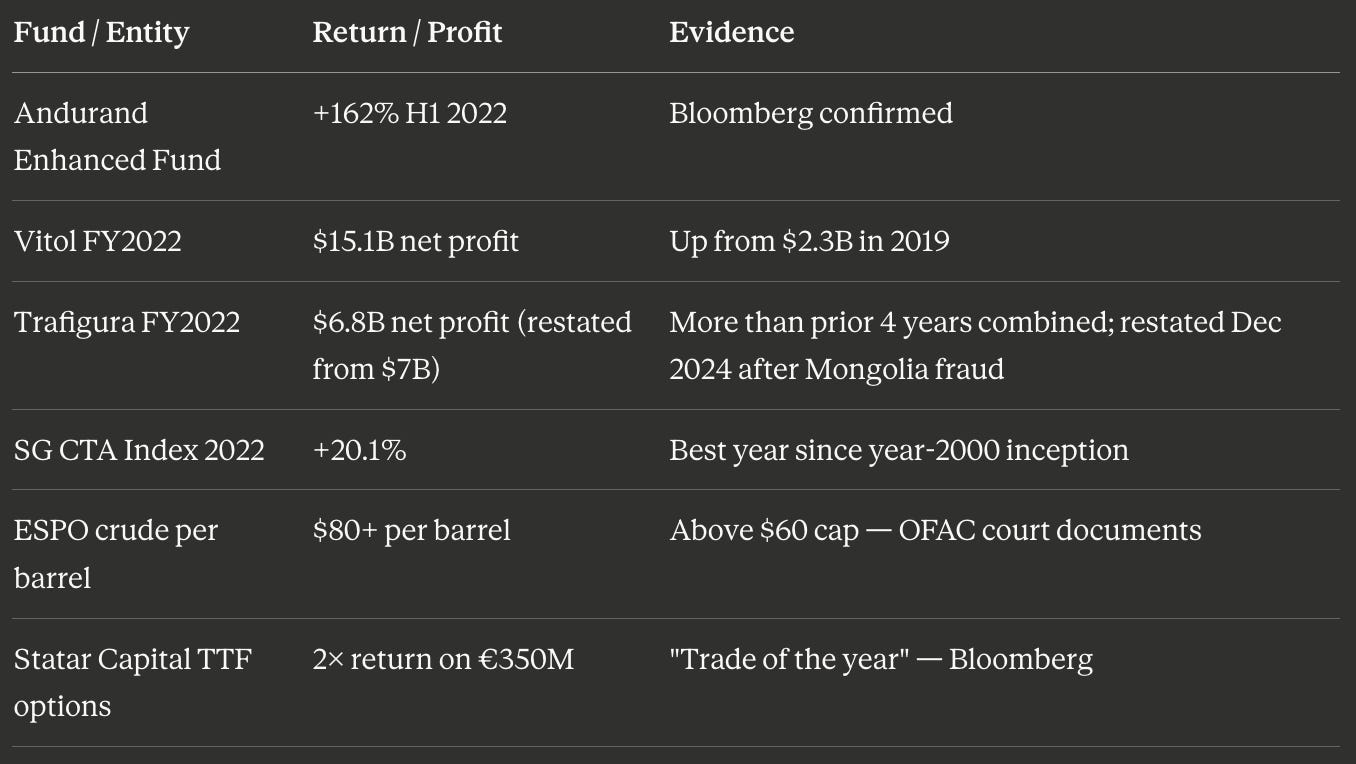
Investors who followed Andurand from his previous fund BlueGold in 2008, then into Andurand Capital at launch in 2013, before switching to the Discretionary Enhanced Fund at its launch in June 2019, would have made 5,350% net of all fees as of July 1, 2022. The Andurand Commodities Discretionary Enhanced Fund individually posted 154% in 2020, 87% in 2021, and 162% through June 2022.
The execution was entirely derivatives-based: long Brent futures (front-month and calendar spreads to express backwardation conviction), long crude call options structured to preserve the asymmetric payoff, and secondary energy equity positions. The Hedge Fund Journal’s detailed profile documents Andurand’s core methodology: a 3.5 to 1 upside to downside ratio as the minimum threshold for entry, with drawdowns managed to preserve the asymmetric profile. This is not directional prediction — it is option-like positioning where the cost of being wrong is pre-capped.
The 2023 postscript is equally instructive. The Andurand Commodities Discretionary Enhanced Fund — the same fund that posted +162% H1 2022 — fell 54.7% in 2023, its worst annual loss on record. The lower-risk Andurand Commodities Fund fell a more modest 10% over the same period. Andurand acknowledged publicly that Russian supply proved far more resilient than his model had projected. “The balance could easily be off by 500kbd due to noise, so we would need to expect a deficit or surplus larger than 1.5mbd to have a strong directional view,” he told the Hedge Fund Journal. Even the most accurate commodity model in the market can be right on direction while wrong on magnitude.
Chapter II — Trade #2: The CTA Momentum Machine — How Algorithms Held the Energy Supercycle
While Andurand was making an explicit supply-demand bet, a far larger capital pool — the global CTA (Commodity Trading Advisor) universe — was capturing nearly identical returns through purely systematic means. CTAs do not form views on Russia. They detect sustained price momentum and automatically size into it.
The Société Générale CTA Index gained 20.1% in 2022 — its best annual performance since Société Générale initiated the index calculation in 2000. Gains came from simultaneous sustained directional trends across energy, fixed income, and currencies — rare multi-market breadth that allowed systematic funds to pyramid positions without cancellation.
Specific fund-level evidence from investor letters:
Graham Capital Management’s Tactical Trend fund was up 11.4% and its Quant Macro fund up 4.7% in just the first two months of 2022, per investor letters seen by the Financial Times. Graham’s model had been positioned short wheat going into the invasion — a correct pre-positioning — and switched to long commodity exposure within days, using news sentiment signals to detect the regime change. The full-year 2022 result for Graham’s trend fund was +31%, earning the firm Risk.net’s Quant Investment Firm of the Year award.
From the same Financial Times investor letter reporting: Aspect Capital’s Diversified fund ($9B+ AUM) was up 8.6% year-to-date through early March 2022, with energy described as its “biggest bet” in its investor letter. Leda Braga’s Systematica BlueTrend fund was up 11% over the same period, “helped by positions in commodities.” Dynamic Beta’s DBMF fund was up 11% with “crude oil being by far the biggest contributor,” per fund manager Andrew Beer.
David Harding’s Winton quant funds were up 8.8% through late February 2022 alone — before the formal invasion had even fully settled — achieving their most consistent profitable streak since 1998. The pre-invasion gains reflect a critical feature of trend-following: commodity momentum had been building since November 2021, allowing systematic funds to pre-position before the shock.
Chapter III — Trade #3: Vitol — The $9.3 Billion Cash Moat and the “Secret Sauce”
Vitol’s FY2022 net profit of $15.1 billion — up from $2.3 billion in 2019 — is the single largest absolute profit capture in this entire episode. Understanding how requires understanding Vitol’s structural position entering 2022, which CEO Russell Hardy and the firm’s banking counterparties have described in detail on the record.
“The secret sauce in trading is your pool of cash.”
— Jean-François Lambert, former senior commodities banker, on Vitol’s 2022 edge — swissinfo.ch/eng/global-trade/vitol-the-secretive-trading-giant-minting-fortunes-for-its-employees/89939672
Swiss Info’s deep investigation, based on interviews with CEO Russell Hardy and former banker Jean-François Lambert, provides the clearest documented account of Vitol’s competitive advantage. Vitol’s accounts showed $9.3 billion of cash and short-term deposits at end-2021. When the energy crisis caused many trading houses to face huge margin calls, Vitol had the cash on hand to capitalise on dislocations. When competitors were paralyzed by margin calls, Vitol bid aggressively for distressed cargoes at prices still above Russian FOB but below the global market — capturing the spread others could not hold.
Vitol profit trajectory: $2.3B (2019) → $4B (2021) → $15.1B (2022) → $13.2B (2023) → $8.7B (2024). The $15.1B peak in 2022 represented the largest single-year profit of any private commodity trading house in recorded history.
Chapter IV — Trade #4: Trafigura’s Record $7 Billion Year — The CEO on What Drove It
[Under CEO Jeremy Weir’s leadership, Trafigura achieved record financial performance with net profits reaching $7 billion as originally reported in FY2022 — more than the previous four years combined, marking a significant surge from $1.6 billion in 2020. Note: Trafigura subsequently restated FY2022 profit to $6.8 billion after discovering a $1.1 billion fraud in its Mongolian oil business in 2024 — the originally reported $7B figure is used throughout this article as it reflects the operating reality of that trading year.](https://grokipedia.com/page/Jeremy_Weir) Revenue surged to $318.5 billion.
“We’re not sitting there actually having a price direction and a view on price direction of what we do. We’re effectively looking to mitigate the risk.”
— Jeremy Weir, Trafigura CEO, Fastmarkets Fast Forward Podcast — fastmarkets.com/insights/fast-forward-podcast-episode-3-full-transcript/
The nuance in Weir’s framing is operationally precise. Trafigura’s profit came from geographic price arbitrage: buying where oil was legally forced to be cheap (Baltic and Black Sea ports) and routing it where oil was priced at global rates (Asian refiners hungry for discounted feedstock). That is “risk mitigation” in the physical trading sense — the risk being the spread between buy price and sell price, not directional commodity exposure.
Cargo-level ship-tracking evidence: Reuters, using Refinitiv Eikon ship-tracking data, confirmed that Trafigura alone loaded 12 Urals cargoes in March 2022 — its busiest month since June 2021 — while Vitol loaded 10 cargoes over the same period, combining for approximately 16.7 million barrels. Both firms were buying at the $30+ Urals discount and selling at or near Brent parity — the entire spread captured in the transition period before the December 2022 embargo closed the European buyer market.
Gunvor posted a record $2.4 billion profit in 2022, even after taking a $501 million impairment on its Ust-Luga Russian terminal and a $200 million legal provision. The juxtaposition — hundreds of millions in Russian write-downs alongside record profits — precisely quantifies how large the global arbitrage was relative to the Russian asset impairments.
Chapter V — Trade #5: The Indian Refinery Loop — Bloomberg’s “War Windfall” and the Loophole Borrell Named
The most structurally durable and persistently profitable trade of the sanctions era required no Russian exposure, no shadow fleet tankers, and no sanctions legal risk.
Step-by-Step Mechanics
Step 1 — Feedstock purchase: Reliance Industries (Jamnagar, Gujarat — world’s largest single-site refinery complex at 1.24 million bpd combined capacity) buys Urals crude FOB Primorsk at $55–65/barrel while Brent trades at $85–95/barrel — a structural $30–35 discount.
Step 2 — Refinery ramp: Bloomberg reported in May 2022 that Reliance “deferred maintenance work at the world’s biggest oil refining complex to churn out more diesel and naphtha after prices surged,” describing the arbitrage opportunities as “so enticing.” Refinery utilization increased materially to capture the margin window.
Step 3 — Feedstock escalation: According to RBC Ukraine’s analysis of Foreign Policy data, in May 2022, 27% of Jamnagar’s feedstock came from Russian oil — up from just 5% in April. By mid-2025, Russian oil made up over 50% of Jamnagar’s 1.36 million bpd intake.
Step 4 — Product export: Refined diesel, gasoline, jet fuel, and naphtha are exported to European buyers at full ICE gasoil/Platts pricing. Origin is molecularly undetectable — refined products from a complex blending multiple crude streams cannot be attributed to any single feedstock. The law cannot close a gap it cannot detect.
Step 5 — The legal gap named: EU High Representative Josep Borrell explicitly stated: “If diesel or gasoline is entering Europe, coming from India and being produced with Russian oil, that is certainly a circumvention of sanctions.” It was legal under existing EU law — a regulatory gap that persisted for years.
Step 6 — Revenue scale: Reliance earned an estimated €724 million from exporting fuel made from Russian crude to the United States alone between January 2024 and January 2025, according to CREA data. In December 2024, Reliance signed a ten-year contract with Rosneft to procure 500,000 barrels per day — approximately $13 billion per year. This is not opportunistic trading — it is a decade-long structural commitment to the discounted-feedstock arbitrage.
Chapter VI — Trade #6: The Price Cap Addendum Structure — Documented by OFAC, Described by a UAE Trader On the Record
The G7’s $60/barrel price cap was the most creative sanctions mechanism in the architecture. The theory was elegant. The execution created the most profitable small-trade ecosystem in modern commodity markets — documented in granular detail by both government enforcement actions and an on-the-record trader account.
The Addendum Structure — In the Trader’s Own Words:
Swiss NGO Public Eye’s investigation includes a direct quote from a UAE-based trader describing the mechanism: “You can always state in the contract that you bought the barrel of Ural for USD 56, show it to the shipowner and then, for example in Dubai or Turkey, add an addendum that provides for payment of an additional USD 12 to be paid to the Russians to make up the difference.”
The shipper receives a G7-compliant attestation at $56. The actual Russian payment settles at $68 — above the cap — through a second document outside the compliance chain.
OFAC court documents — specific vessels confirmed:
OFAC Oct 12, 2023: The Yasa Golden Bosphorus (IMO 9334038), owned by Türkiye-based Ice Pearl Navigation Corp, carried ESPO crude priced above $80/barrel — a $20 violation per barrel. The SCF Primorye (IMO 9421960) used U.S.-based service providers while transporting Russian-origin oil above the cap.
OFAC Jan 2024: Hennesea Holdings Limited designated — the UAE entity owned 18 vessels including the HS Atlantica and had been established in late 2022 specifically to acquire older tankers that ship Russian crude.
Chapter VII — Trade #7: Statar Capital’s “Trade of the Year” — Betting on Fear’s Collapse
The most surgically precise trade in the entire Russian energy cycle was not about oil at all. It was executed by a Miami hedge fund in European natural gas options, using a strategy that required neither Russia expertise nor physical commodity access — only the ability to correctly model when the fear premium in a market had become structurally overdone.
Statar Capital was founded in September 2018 by Ron Ozer, a former Citadel portfolio manager who had specialized in natural gas commodities. The firm launched with approximately $140 million in capital and had grown to $2.8 billion in AUM as of April 30, 2022 — first reported by Bloomberg on May 4, 2022 — reflecting 332% net returns since inception. Ozer had been hired to Citadel in 2015 as head portfolio manager for U.S. natural gas, was promoted after his first year to report directly to founder Ken Griffin, and led a team of 8 analysts, traders and meteorologists.
The Execution — confirmed by Bloomberg and Hedgeweek:
€50 TTF put options: bought at €13–15, closed at ~€25. The €350M investment doubled.
The thesis: European gas storage had filled to record levels by autumn 2023 without Russian supply. The acute crisis was structurally resolved. But implied volatility in TTF options remained priced as if the disruption was ongoing — a mispricing. The strategy was directional on volatility compression — a second-order bet on the resolution of the Russian energy crisis, not on gas price levels. Bloomberg reported that traders who observed the position close called it “the trade of the year.”
Chapter VIII — Trade #8: The Russian Bond Negative Basis — Goldman’s Pitch and the Settlement Trap
Not all Russian oil alpha was captured in commodity markets. The most technically precise fixed-income trade of the episode exploited a simple structural gap: Russian energy company bonds had sold off catastrophically not because the companies were insolvent, but because Western institutions could no longer legally hold them.
Goldman Sachs and JPMorgan were both active in purchasing beaten-down Russian corporate bonds in March 2022, warehousing them from distressed institutional sellers and clearing them to hedge fund clients. Goldman was simultaneously active in CDS markets on names including Evraz, Gazprom, and Lukoil.
The structure: Buy Russian energy corporate bonds at 10–30 cents on the dollar from Fidelity, T. Rowe Price, and UBS — all of which wrote their Russian assets to zero. Simultaneously buy CDS protection on the same names. The negative basis — the gap between the CDS spread and the bond yield — created a theoretical arbitrage: if Russia defaults, CDS pays out; if it does not, hold to recovery at an enormous yield. Bloomberg reported in April 2022 that the trade was generating “near-guaranteed profits,” with one fund manager describing it as “years, even decades could go by before another relative-value trade this attractive comes along.”
Chapter IX — Trade #9: The Shadow Fleet Asset Play: How Western Shipowners Extracted $6 Billion
One of the most straightforwardly lucrative trades required no view on oil prices, no derivative expertise, and no sanctions-perimeter analysis. It required ownership of aging oil tankers at the moment Russia urgently needed hundreds of them.
An international investigation by Follow the Money found that Western shipowners received over $6 billion from selling tankers to Russia’s shadow fleet. The breakdown: Greek owners received close to $4 billion; UK-based companies sold 22 tankers for $590 million; German owners earned $190 million. These were vessels approaching commercial retirement. Russia’s unconditional demand converted scrap value into premium.
By the end of 2022, over 600 ships had been assembled into Russia’s shadow fleet, with total assembly costs estimated at approximately $14 billion. The highest concentration of purchases happened in Q4 2022 and Q1 2023 as the price cap came into force.
The Alpha Architecture: What All Nine Trades Had in Common
Across nine distinct strategies, a structural pattern is visible. The trades that worked were not bets that Russian oil was cheap. They were bets on the persistence of enforced mispricing — the time it would take for workaround infrastructure to close the gap between the sanctioned price and the market-clearing price. That persistence window was the profit window.
The Alpha Source Hierarchy — Ranked by Barrier to Entry
Physical access + pre-positioned liquidity — Vitol ($15.1B) and Trafigura ($6.8B restated) sat closest to the discounted barrel. Their advantage required decade-long Rosneft/Lukoil relationships, Baltic port allocations, tanker charter books, and $9.3B in pre-positioned cash. Irreplicable by financial funds.
Regulatory gap identification — The Indian refinery loop, the Dubai addendum structure, and Paramount’s ESPO flow all exploited gaps between the letter of sanction law and enforcement reach. Highest sustained margin; maximum regulatory risk as the perimeter tightened post-2023.
Directional fundamental conviction pre-positioned before the catalyst — Andurand’s 162% came from a thesis built 18 months pre-invasion. The invasion did not create the trade; it accelerated it to magnitude. Requires model discipline and volatility tolerance.
Systematic trend detection — CTAs (Graham +31%, SG Index +20.1%, Winton, Aspect, BlueTrend) extracted returns by detecting and sizing into sustained momentum. No Russia-specific knowledge needed; no information asymmetry required.
Second-order volatility mispricing — Statar’s doubled €350M bet was not a commodity trade at all. The Russian crisis created the fear pricing and, by resolving, the mispricing that Statar harvested.
What failed: The Andurand Commodities Discretionary Enhanced Fund — the high-leverage vehicle behind the 162% H1 2022 run — fell 54.7% in 2023. Russian supply proved more resilient than any Western model predicted; Iranian barrels recovered; OPEC+ discipline partially offset the shortfall. Pure derivatives exposure without information asymmetry or physical edge is noise-tradeable out of position when disruption magnitude is uncertain.
The Template for the Next Dislocation
The Russian oil episode is a fully documented template. When a major commodity producer is geopolitically isolated, three things reliably occur: the commodity trades at a forced discount in the originating geography; a legal-logistical wall prevents the obvious arbitrage from closing quickly; and the persistence of that wall — typically 12–36 months before workaround infrastructure is fully assembled — creates exceptional margins.
Iran has operated in this paradigm since 1979. Venezuela entered it in 2018. Russia joined them in 2022 at a scale three to five times larger than either precedent. The Urals-Brent spread has since narrowed from its $30–34 peak toward $10–15 as Russia successfully assembled alternative logistics. Reliance halted Russian crude processing at its export-only refinery in November 2025 to comply with EU sanctions — the first major sign of the loophole finally closing, three and a half years after it opened.
The most important operational insight: Russian supply proved more resilient than virtually every Western model predicted. The funds that structurally outperformed were not those with the most precise price-level forecast. They were those with asymmetric positioning — where the cost of being wrong was pre-capped and the reward for being right was many multiples of that cost. In an environment where the magnitude of disruption is genuinely unknowable, investors who structure exposure as options rather than forecasts will consistently outperform those who mistake conviction for certainty.
That is not a Russia-specific lesson. It is the complete logic of macro commodity trading stated plainly. The Urals-Brent spread was the instrument. The asymmetric structure was the alpha. The next version of this trade will be priced with the same logic — in a different geography, with a different spread, and a different wall.
📊 Want Deeper Quantitative Analysis?
This research required extensive data collection, primary source verification, and cross-referenced analysis across OFAC enforcement documents, Dallas Fed research, Bloomberg transcripts, CEO interviews, and ship-tracking databases.
If you found value in this deep-dive, I publish exclusive quantitative research, trading strategies, and institutional-grade analysis on Patreon — covering the structural mechanics behind macro commodity dislocations, sanctions arbitrage, and systematic trading frameworks that don’t appear in mainstream financial media.
By joining, you’ll be supporting this work and motivating more primary-sourced research like this.
→ Join the Patreon community here
You can also follow the ongoing analysis here: ▶ YouTube — The Mathematical Trader | LinkedIn — Navnoor Bawa
Full Primary Sources
Andurand Capital — Interviews, Transcripts, Performance
Bloomberg Odd Lots transcript: “oil’s gone for good,” 4Mbpd removed, $200 forecast (March 17, 2022)
3.5:1 upside/downside methodology; 35%+ annualized net since 2008
2024 profile: “long and wrong” 2023; 500kbd noise floor; fund down 10%
109% gains early March 2022; CTA investor letters (Graham, Aspect, BlueTrend, DBMF, Makuria)
CTA / Systematic Funds
Graham Capital Trend Fund +31% FY2022; model switch mechanics
Winton up 8.8% through late Feb 2022; most consistent streak since 1998
Graham Capital history, quant macro launch, strategy overview
Vitol — CEO Interview, Financial Data
Trafigura — CEO Interview, Cargo Data
Full Fastmarkets podcast transcript: Jeremy Weir on Trafigura strategy
Full financial history; Vostok Oil stake; Jeremy Weir biography
Reuters/Refinitiv ship-tracking: Trafigura 12 cargoes, Vitol 10 cargoes March 2022
533M barrels total; Vitol 113M, Gunvor 109M; $14.8B crude value
Indian Refinery Loop
Bloomberg: Reliance deferred maintenance; “arbitrage opportunities so enticing”
Russian crude 27% of feedstock May 2022 (up from 5% April); €724M from US exports
10-year Rosneft contract; 500,000 bpd; $13B/year; Russian crude halt Nov 2025
Price Cap & OFAC Government Documents
U.S. Treasury: $60 cap mechanics; two-year effectiveness review
OFAC Oct 12, 2023: Yasa Golden Bosphorus & SCF Primorye SDN designations; ESPO above $80/bbl
OFAC Dec 1, 2023: three additional entities sanctioned; Deputy Secretary Adeyemo statement
OFAC Dec 2023: “opaque traders shipping up to half of Russia’s exports”
OFAC Jan 2024: Hennesea Holdings; HS Atlantica; UAE entity established late 2022
OFAC April 2023 Alert: AIS spoofing; Kozmino ESPO above cap; deceptive shipping practices
K&L Gates: first-ever SDN designations for price cap breach; Tier 1/2/3 actor legal framework
Swiss / Public Eye Investigations
Statar Capital — Ron Ozer
Russian Bonds & Fixed Income
“near-guaranteed profits”; negative basis mechanics; “decades” quote
Goldman Sachs and JPMorgan warehousing Russian bonds March 2022
Anonymous EM fund manager: hedges stopped working; custodian failures; GDR cancellation
Shadow Fleet & Tanker Trades
Cover photograph: Alexxx1979, CC BY-SA 4.0, via Wikimedia Commons.