


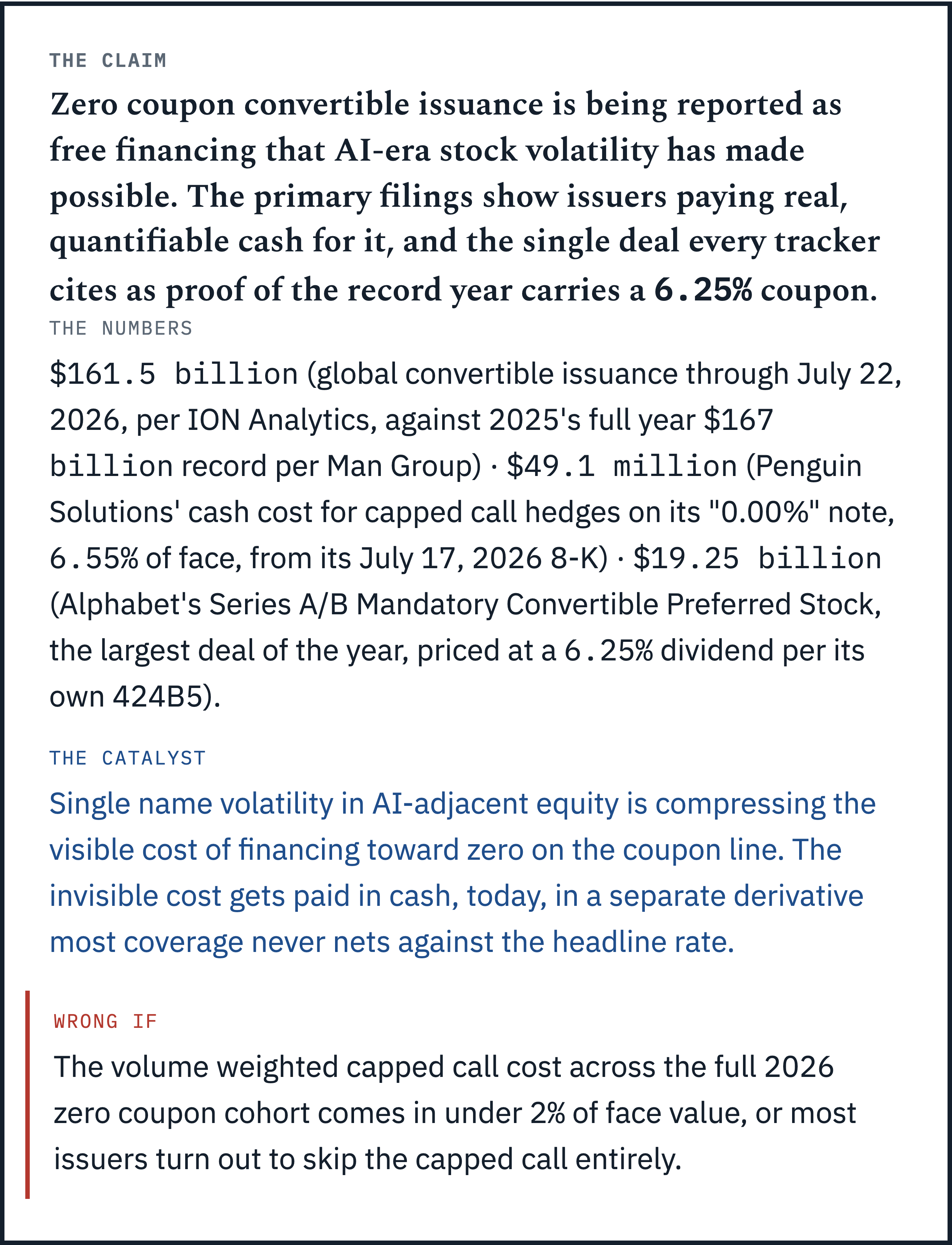
Zero coupon convertible issuance is being reported as free financing that AI-era stock volatility has made possible. The primary filings show issuers paying real, quantifiable cash for it, and the single deal every tracker cites as proof of the record year carries a 6.25% coupon.
Below the paid line:
- The capped call cost table across Penguin Solutions, Alphabet’s Series B tranche, Tempus, and Bitdeer, with cap prices, premiums, and annualized cost
- The 51-filing EDGAR cross section of 2026 capped call issuers outside AI, and why that sector spread changes the story
- The mechanism proof, line by line, for why a capped call’s price reveals the value of the option the “0% coupon” headline treats as costless
- The convertible arbitrage buy side: delta hedging, gamma capture, and why dedicated arb allocation shrank from roughly 20% of a hedge fund book in 2000 to 1% to 2% today, even as issuance sets records
- The exact falsifier threshold: under 2% of face kills this thesis, and where the four name sample sits against it today
The story every desk is telling: $161.5 billion and a free option
Every desk covering convertibles this year is telling a version of the same story. I do not think it is a dumb one. Rates have stayed high through 2026. Straight high yield debt is expensive. AI-linked equities swing hard enough that the option to convert a bond into stock is worth something real to a buyer. Volatility is the product.
Numerix counted $84.6 billion across 96 global convertible deals in Q2 2026 alone. That is a 67% jump over Q2 2025. A record quarter. Of those 96 deals, 44 priced at a 0% coupon, 46%. ION Analytics puts the year to date global total at $161.5 billion through July 22, already 23.6% above the prior full year pace record set in 2021. Man Group’s own credit desk puts full year 2026 issuance on pace to exceed 2025’s record of $167 billion. The pace is real.
The mechanism analysts cite is standard convertible bond pricing theory, correct as far as it goes. A convertible’s value splits into a straight bond component and an embedded call option on the stock, and that option’s price rises with implied volatility. Push implied vol high enough and a company can sell the option for a 0% coupon while investors still buy the bond at par, paid entirely in optionality instead of cash. Barclays and BofA research, cited across the trade press, frame it as a substitution: companies that would have paid 6% to 8% on high yield debt are instead paying nothing, funded by volatility itself.
The sector concentration behind those totals is worth sitting with, because it is more lopsided than “AI is driving issuance” implies. Computers and electronics accounted for $86.23 billion of the $161.5 billion global year to date total, 53.4% of every dollar raised in the convertible market this year, across 139 deals, per ION Analytics. Healthcare ran a distant second at $12.7 billion, 7.9%. Not close. AI-adjacent supply is not one flavor among several here. It is close to being the whole market for 2026, which is exactly why a mispriced assumption inside that sector’s dominant instrument would matter more this year than in almost any prior one.
My read is that this framing survives exactly as long as nobody opens the prospectus supplement.
Alphabet’s own straight debt told a related story earlier this year: a $20 billion bond offering priced spread compression tight, without any embedded option at all.
Penguin Solutions spent $49.1 million to buy back what it just sold for nothing
I went looking for the cost of that “free” option, because a financial instrument does not cost nothing just because the number on its face is zero. What I found in the filings is that issuers are not treating their own zero coupon deals as free. They are spending real cash, disclosed in dollars, to buy a large chunk of that option straight back.
Penguin Solutions issued $750.0 million of 0.00% Convertible Senior Notes due 2031 on July 17, 2026. The notes carry no regular interest and do not accrete principal, about as close to a literal zero cost instrument as debt gets on paper. Four paragraphs later, in the same 8-K, the company discloses it spent approximately $49.1 million, 6.55% of face value, on capped call transactions to reduce the dilution those same notes create. That is not a rounding error. It is the company underwriting the accuracy of the “free money” pitch with its own cash, and I do not think it fully believes the pitch.
Alphabet’s Series B Mandatory Convertible Preferred Stock, priced the same quarter at a real 6.25% annual dividend, still carried $439.7 million of capped call spending on the base tranche alone, per its own 424B5. Against that tranche’s roughly $8.375 billion in gross proceeds, that is 5.25%. Bitdeer Technologies, the crypto mining company that has spent the past two years converting mining capacity into AI and HPC cloud infrastructure, spent $29.2 million on capped calls against $315.1 million of net proceeds from a February 2026 convertible refinancing. That is 9.27%, the highest ratio of the four names here, on notes that carry a real coupon. Tempus AI, the healthcare data company, priced a true 0.00% coupon note on May 7, 2026 and spent $27.2 million against $384.1 million in net proceeds on the base offering, 7.08%.
Four unrelated issuers. Four separate deals, four different coupon structures. Four capped call costs, all clustered between 5% and 9% of proceeds. That clustering, across issuers who share almost nothing else, is the tell. Four strangers, one number.
The capped call is a receipt: what real dollars reveal about a “free” option
The size of the check an issuer writes for a capped call is the whole argument, so start with what the instrument actually does. Selling a convertible note makes a company short a call option on its own stock: the right the bondholder has to convert debt into equity at the conversion price. If the stock rockets, that option transfers real value from existing shareholders to bondholders, dollar for dollar, on every share issued above the conversion price. A capped call is the company buying that option back from a bank, up to a cap price, recapturing the dilution between the conversion price and the cap.
Penguin Solutions set its conversion price at $116.70 a share and its cap at $175.05, a 125% premium over its July 14 closing price of $77.80. Between $116.70 and $175.05, Penguin is now hedged. Insurance costs money. Every time. Above $175.05, it is exposed again. The price of that hedge was not a fee for paperwork. $49.1 million is the market’s own valuation of the equity optionality Penguin just wrote into its notes, priced by the banks who structured the deal. A dealer’s own margin sits inside that price too, so I read it as a floor on the option’s value rather than a clean clearing price. The floor still runs at real money.
Here is the arithmetic the “0% coupon” headline erases. Amortize Penguin’s $49.1 million over the note’s five year life to maturity in 2031, and you get roughly $9.8 million a year. That is 1.31% of face value annually. Not the highest cost of capital in the market. Also not zero. The company’s own transaction structure proves it.
I make Alphabet’s Series B capped call spend, $439.7 million against roughly $8.375 billion of base tranche gross proceeds, at 5.25%. That sits close to Penguin’s 6.55%, even though Alphabet is investment grade and pays a real coupon that Penguin’s notes carry none of. Two issuers, wildly different credit quality, land within 130 basis points of each other. Credit rating barely moved the price. Vol did.
The reason: a capped call’s cost tracks implied volatility on the underlying stock far more than it tracks the issuer’s credit rating. That’s precisely the variable AI-adjacent equity has pushed to multi year highs, across mega caps and mid caps alike. Bitdeer’s higher ratio, 9.27%, fits the same logic from the other side. A smaller, more volatile name pays more per unit of dilution protection than Alphabet does. Coupon structure doesn’t enter into it. Vol sets the price.
