


This analysis deconstructs Bill Ackman’s $2.6 billion COVID hedge, John Paulson’s $15 billion subprime CDS trade, and Elliott Management’s $2.4 billion Argentina litigation—drawing from court documents, SEC filings, investor letters, and verified sources.
The Credit Alpha Framework
Before examining the three trades, understanding the landscape of credit strategies provides essential context.
Event-Driven Credit targets episodic mispricings through concentrated positions:
CDS-driven strategies: Using credit derivatives for asymmetric payoffs (Ackman, Paulson)
Distressed/litigation: Exploiting bankruptcy, restructuring, or sovereign debt defaults (Elliott)
Structured credit: Engineering asymmetry through CDOs, CLOs, or complex securities (Magnetar)
Systematic Credit harvests spread premiums through diversified portfolios:
Long/short credit pairs capturing relative value
High-yield portfolio management generating consistent spread alpha
Active credit monitoring and sector rotation
The three headline trades represent event-driven strategies at their most extreme—concentrated bets on specific catalysts generating 100x to 1,000x returns. Systematic strategies, while less explosive, have generated reliable 269 bps annual alpha over 39 years (detailed later via Oaktree data).
Trade 1: Bill Ackman’s $27 Million to $2.6 Billion (February-March 2020)
The Setup
In February 2020, as COVID-19 emerged from China, Bill Ackman recognized structural vulnerability in corporate credit markets. Rather than liquidating Pershing Square’s equity portfolio—which would create market impact and crystallize losses—he purchased insurance through credit default swaps.
The Mechanics
Ackman bought CDS protection on investment-grade and high-yield credit indices (CDX IG, CDX HY, ITRAXX Main) at historically tight spreads of approximately 50 basis points. The hedge cost Pershing Square $27 million in premiums—a small fraction of the fund’s multi-billion dollar capital base.
Credit default swaps function like insurance contracts:
Premium paid: Fixed cost to purchase protection (Ackman’s $27M)
Trigger event: Credit spread widening or default
Payout: Increases as spreads widen, with theoretically unlimited upside
Risk profile: Maximum loss = premium paid; gain potential unlimited
Pershing Square’s official investor letter describes “very large notional” CDS positions without specifying exact size, though analytical estimates place the notional at $65-75 billion based on premium-to-spread calculations.
The Outcome
By March 23, 2020, as credit spreads widened from 50 bps to 135-140 bps, the position generated $2.6 billion—a 100x return in 21 days.
Ackman’s strategic brilliance extended beyond the hedge:
Closed the entire CDS position on March 23, 2020—the exact market bottom
Immediately redeployed $2.3 billion into equities at generational valuations
Added to existing positions in Hilton, Lowe’s, Berkshire Hathaway
Established new position in Starbucks
Pershing Square’s 2020 return: +70.2%, the fund’s best performance on record.
Why It Worked
The trade succeeded through three elements:
Timing: Purchased protection when spreads were historically tight (low premium cost)
Convexity: Asymmetric payoff structure (limited downside, unlimited upside)
Catalyst recognition: Early identification of COVID-19’s systemic credit implications
Trade 2: John Paulson’s $15 Billion Subprime Short (2006-2007)
The Setup
In 2006, John Paulson identified systematic mispricing in subprime mortgage securities. Wall Street’s securitization machine was packaging increasingly risky mortgages into AAA-rated bonds, creating massive profit opportunities for those willing to bet against the structure.
The trade is documented extensively by Gregory Zuckerman in “The Greatest Trade Ever.”
The Mechanics
Paulson’s strategy targeted BBB-rated tranches of subprime mortgage-backed securities through credit default swaps:
Trade structure:
Asset: CDS protection on BBB-rated subprime MBS tranches
Annual premium: ~1% of notional (the “insurance” cost)
Payout on default: 100% of notional value
Risk/reward: Pay 1% annually to receive 100% if mortgages default
Scale: Paulson accumulated billions in notional CDS exposure across hundreds of specific mortgage pools, focusing on 2005-2006 vintage subprime loans with deteriorating underwriting standards.
The Outcome
As subprime mortgages began defaulting in 2007, Paulson’s CDS positions exploded in value:
Another $5 billion in gains during 2008
The flagship fund returned 590% in 2007
Paulson personally earned approximately $4 billion in 2007 alone—equivalent to more than $10 million per day for 365 consecutive days. The profit dwarfed George Soros’s famous $1 billion gain against the British pound.
Why It Worked
Fundamental analysis: Paulson’s team analyzed actual mortgage pools, identifying toxic loans that rating agencies had missed
Structural arbitrage: Exploited the gap between AAA ratings and actual credit quality
Timing: Positioned before the market recognized systemic risk
Scale: Accumulated massive exposure while premiums remained cheap
Trade 3: Elliott Management’s $2.4 Billion Argentina Recovery (2001-2016)
The Setup
In 2001, Argentina defaulted on $95 billion in sovereign debt—the largest sovereign default in history at the time. While most creditors accepted a restructuring at 30 cents on the dollar, Elliott Management’s NML Capital unit refused and pursued a different path: litigation.
The Mechanics
Elliott acquired defaulted Argentine bonds at an estimated 20-30 cents on the dollar between 2001-2008, accumulating approximately $617 million in face value.
Legal strategy:
Sued Argentina in U.S. federal court for full repayment
Invoked “pari passu” clause (equal treatment provision) in bond contracts
Argued Argentina couldn’t pay restructured bondholders without paying holdouts
Timeline:
2001-2008: Elliott accumulates bonds at distressed prices
2012: U.S. District Judge Thomas Griesa issues unprecedented “pari passu” injunction blocking Argentina from paying restructured bondholders unless it pays holdouts at 100% first
2012: Elliott attempts to seize Argentina’s naval vessel ARA Libertad in Ghana—demonstrating global enforcement capability
2014: U.S. Supreme Court upholds Griesa’s ruling; Argentina enters technical default
2016: New Argentine government under Mauricio Macri negotiates settlement
The Outcome
Argentina settled for $2.4 billion in February 2016. Bloomberg reported Elliott received 369% of the bonds’ face value.
Return calculation:
Purchase price: ~$125-185 million (20-30 cents on $617M face value)
Settlement: $2.4 billion
Return on invested capital: >1,000%
Holding period: 15 years
Why It Worked
Legal infrastructure: Elliott possessed sovereign litigation expertise and global enforcement capability
Strategic patience: 15-year commitment outlasted three Argentine presidents
Precedent creation: Griesa’s pari passu interpretation created unprecedented legal leverage
Political timing: Awaited regime change to government willing to settle
What These Three Trades Teach Us: Common Patterns
Despite operating in different credit markets, Ackman, Paulson, and Elliott’s trades share structural similarities:
1. Asymmetric Risk/Reward Profiles
All three trades featured convex payoff structures:
Ackman: Risked $27M premium to make $2.6B (100:1 upside)
Paulson: Paid 1% annually to capture 100% on default (100:1 upside)
Elliott: Risked 20-30 cents to recover 369% of face value (12:1 upside, >10:1 realized)
This asymmetry is the defining characteristic of elite credit trading: defined downside, explosive upside.
2. Catalyst-Driven Timing
Each trade required precise entry timing:
Ackman: February 2020, when credit spreads were historically tight
Paulson: 2006, before subprime deterioration became consensus
Elliott: 2001-2008, during maximum distress and price dislocation
Entry during calm markets (Ackman, Paulson) or maximum chaos (Elliott) created favorable risk/reward ratios.
3. Informational Edge
All three possessed non-consensus views:
Ackman: Recognized COVID-19’s credit implications before markets
Paulson: Analyzed actual mortgage pools while rating agencies relied on models
Elliott: Understood sovereign immunity law better than Argentina’s legal team
This wasn’t luck—it was differentiated research creating proprietary insights.
4. Infrastructure Requirements
These trades demanded specialized capabilities:
Ackman: CDS market access, real-time spread monitoring, derivatives expertise
Paulson: Mortgage analytics, CDS structuring, risk management for massive notional
Elliott: International litigation, asset seizure capability, political analysis
Replicating these returns requires institutional infrastructure, not just capital.
5. Conviction and Patience
Each manager endured periods of paper losses or uncertainty:
Ackman: Paid monthly CDS premiums with no guarantee COVID would cause market dislocation
Paulson: Held short positions through 2006 while housing market continued rising
Elliott: Pursued litigation for 15 years through multiple failed negotiations
Conviction to maintain positions despite short-term volatility was essential to realizing profits.
These five patterns—asymmetry, timing, informational edge, infrastructure, and conviction—represent the common thread across history’s largest credit trades. But CDS-driven trades and sovereign debt litigation aren’t the only paths to credit alpha. Other strategies have generated substantial profits through different mechanisms entirely.
Beyond the Big Three: Other Credit Alpha Mechanisms
While Ackman, Paulson, and Elliott represent the largest documented credit profits, other strategies have generated substantial returns through different mechanisms.
Structured Credit Engineering: The Magnetar Trade
During the 2006-2007 housing bubble, Magnetar Capital employed a controversial structured credit strategy documented by ProPublica’s Pulitzer Prize-winning investigation.
Strategy mechanics:
CDO Equity Purchase: Bought riskiest “equity” tranche (~20% of deal size) of collateralized debt obligations
Asset Selection Influence: Magnetar “exercised significant influence over collateral selection,” according to SEC findings, often pushing for riskier underlying mortgages
CDS Short: Simultaneously purchased protection on senior CDO tranches
Asymmetric P&L: If CDO performed → equity returns; if it failed → CDS payout exceeded equity loss
Results: Magnetar sponsored approximately $40 billion in CDOs. An independent PF2 Securities Evaluations analysis commissioned by ProPublica found 96% of Magnetar-linked CDOs had defaulted by end of 2008, compared to 68% for comparable CDOs.
Legal outcome: J.P. Morgan paid $153.6 million; Merrill Lynch paid $131.8 million to the SEC for failing to disclose Magnetar’s role in CDO creation. Magnetar was not charged in these SEC settlements targeting investment banks’ disclosure failures.
The Boundaries of Credit Alpha: Manufactured Defaults
The evolution of CDS strategies reached a controversial extreme in 2018 when Blackstone’s GSO Capital Partners attempted to engineer a credit event itself—illustrating the legal boundaries of credit alpha generation.
The Hovnanian Case: GSO structured a transaction with homebuilder Hovnanian where GSO would provide favorable refinancing terms in exchange for Hovnanian missing an interest payment on a small debt tranche—triggering a technical “default” that would pay out GSO’s CDS positions.
Rival hedge fund Solus sued, alleging market manipulation after suffering $60 million in mark-to-market losses. GSO ultimately settled and the manufactured default was abandoned.
The case prompted ISDA to revise CDS definitions addressing “narrowly tailored credit events”—establishing the boundary between aggressive strategy and market manipulation. This represents the outer limit of CDS-based alpha: strategies that engineer their own catalysts cross into regulatory scrutiny.
The strategies examined so far—Ackman’s CDS hedge, Paulson’s subprime short, Elliott’s litigation, Magnetar’s CDO engineering, GSO’s manufactured default—represent event-driven approaches: concentrated bets on specific catalysts. These can generate explosive returns but require precise timing, specialized expertise, and high conviction. An alternative path exists: systematic credit strategies that harvest spread premiums consistently over time.
Systematic Credit Alpha: The Spread Harvesting Approach
The longest and most comprehensive public dataset on systematic credit alpha comes from Oaktree Capital, whose co-founder Howard Marks has documented high-yield bond performance across nearly four decades.
Howard Marks’ 39-Year Performance Dataset
Oaktree Capital’s March 2025 memo “Gimme Credit” provides comprehensive public data on long-term credit alpha:
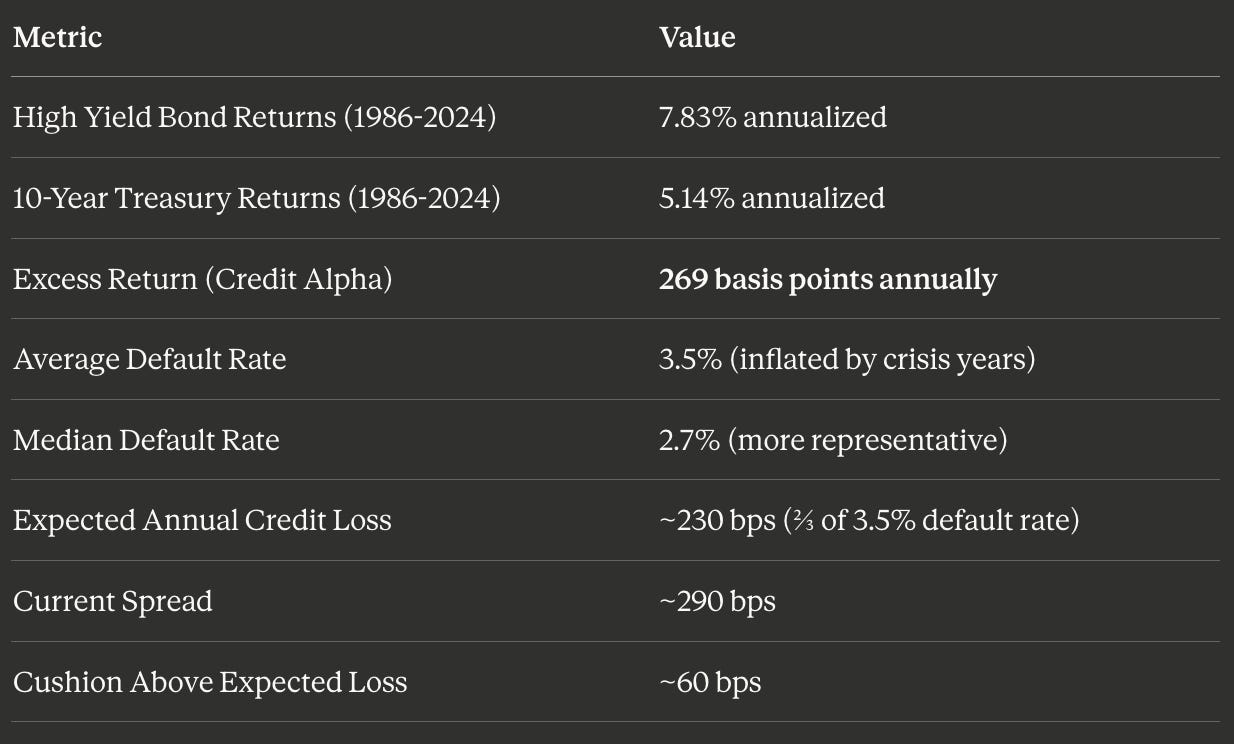
Critical finding: Even purchasing at the all-time tight spread of 241 bps in June 2007—immediately before the Global Financial Crisis—high yield bonds delivered 7.35% annualized returns over the subsequent 10 years, outperforming Treasuries by ~3 percentage points annually.
Implication: Credit spreads have historically provided more than adequate compensation for default risk, creating systematic alpha for managers who navigate the default cycle through:
Disciplined underwriting
Diversification across issuers
Active credit monitoring
Strategic sector allocation
This represents a fundamentally different approach than Ackman/Paulson/Elliott’s concentrated bets—steady compounding versus episodic explosions.
The Private Credit Evolution
The credit strategies documented above—CDS trading, distressed debt litigation, structured credit engineering—operate primarily in public markets where prices are transparent and liquidity exists. Post-2008, a parallel universe emerged: private credit.
As banks retreated from direct lending following Dodd-Frank regulations, non-bank lenders filled the void, creating a $1.5 trillion asset class offering 200-400 basis points above public credit to compensate for illiquidity and complexity.
Leading private credit platforms:
GSO/Blackstone: $150B+ credit AUM across direct lending, distressed debt, and structured credit. GSO’s 2018 Hovnanian case (discussed earlier) illustrates how firms operating across public CDS and private credit markets can structure complex transactions—though that particular strategy ultimately proved too aggressive
Ares Management: Full-spectrum direct lending and CLO platform managing middle-market loans
Oaktree Capital: Opportunistic credit across public/private markets, combining Howard Marks’ distressed expertise with direct lending capabilities
Howard Marks’ cautionary note: “The tide has never gone out on private credit, meaning we haven’t had an opportunity to see its flaws. The main one is the possibility that some managers have been in such a hurry to scoop up capital and put it to work that they relaxed their credit standards.”
The next credit cycle will test whether private credit managers maintained underwriting discipline during the decade-long expansion.
Conclusion: What $20 Billion in Profits Reveals
The three trades that generated $20 billion—Ackman’s $2.6B COVID hedge, Paulson’s $15B subprime short, Elliott’s $2.4B Argentina recovery—share a common DNA:
1. Asymmetric Risk Architecture All three constructed positions where downside was defined but upside was explosive. Ackman risked $27M to make $2.6B. Paulson paid 1% annually for 100% payouts. Elliott bought at 20-30 cents to recover 369% of face value. This structural convexity—not leverage or market timing alone—enabled extraordinary returns.
2. Non-Consensus Conviction Each manager held a view the market rejected. Ackman recognized COVID’s credit implications when spreads were historically tight. Paulson identified subprime toxicity while rating agencies assigned AAA ratings. Elliott pursued 15-year litigation when other creditors accepted 30 cents. These weren’t contrarian for contrarian’s sake—they were differentiated insights supported by rigorous analysis.
3. Infrastructure as Competitive Moat Replicating these returns requires more than capital. Ackman needed real-time CDS market access and derivatives expertise. Paulson required mortgage analytics capabilities to analyze hundreds of loan pools. Elliott possessed international litigation infrastructure and sovereign debt legal expertise. These capabilities—built over decades—cannot be quickly replicated.
The broader credit landscape includes other alpha sources: structured credit engineering (Magnetar’s CDO strategy), systematic spread harvesting (Oaktree’s 269 bps annual alpha over 39 years), and emerging private credit markets ($1.5T+ in AUM). But the three headline trades represent credit alpha at its most extreme—concentrated, catalyst-driven, asymmetric positions that generated returns exceeding 100x.
For institutional investors with the necessary infrastructure, credit markets continue offering repeatable sources of alpha. The mechanisms change—CDS definitions tighten after Hovnanian, rating agencies improve after 2008, sovereign litigation faces new obstacles—but structural inefficiencies persist. Markets mispriced pandemic credit risk in February 2020 just as they mispriced subprime risk in 2006 and Argentine political risk in 2001.
The trades documented here weren’t luck. They were the result of differentiated research, structural advantages, precise timing, and the conviction to maintain positions despite uncertainty.
Connect & Learn More:
YouTube: Subscribe for quantitative finance analysis and systematic trading strategies: The Mathematical Trader
LinkedIn: Connect for more institutional finance insights: Navnoor Bawa
Sources
All claims verified through court documents, SEC filings, investor letters, and investigative journalism. Direct source links embedded throughout text for verification.
This analysis is for informational purposes only. Past performance does not guarantee future returns. Credit investing carries risks including default, liquidity constraints, and market volatility.
Cover photograph: Senate Democrats, CC BY 2.0, via Wikimedia Commons.