


Every sophisticated capital allocator now knows European football clubs are being accumulated by private equity. What they do not know — and what determines whether this trade still works — is that the alpha is bifurcated. At trophy-asset entry points (4–6x EV/Revenue), it is already crowded to near-zero net IRR for fund sizes above $2 billion. At mid-tier entry points (1–2x EV/Revenue), it persists — but the investable universe is shrinking as named capital vehicles compete for a club set that regulatory barriers have materially constrained. What closes the window is not financial logic. It is the structural barriers that restrict two of the five major European leagues, early but documented evidence — so far a single case — that relegation risk is underweighted in PE underwriting, and a mechanism by which PE’s commercial optimization is structurally linked to the on-field decline that triggers that risk.
🎬 Prefer to watch rather than read? A NotebookLM-generated video overview of this article is available here: Watch the video overview → Full analysis, citations, and data remain in the article below.
The Consensus and Its Missing Variable
The dominant published view on PE in European football is accurate as far as it goes: clubs are globally recognized brands trading at 3–6x revenue against peer entertainment assets at 10–12x, implying a structural discount. According to PitchBook’s Big Five football dashboard, more than 36% of Big Five clubs have financial backing specifically from PE, VC, or private debt firms at the start of 2025-26; multi-club ownership networks (MCOs) — a broader category that includes strategic investors and family offices alongside PE — cover 48% of Big Five clubs, up from 41.7% in 2024. Source limitation: PitchBook’s figures reflect publicly disclosed deal information; undisclosed private stakes are not captured and the true penetration rate is likely higher.
European football dealmaking grew from approximately €66.7 million in 2018 to a peak of approximately €4.9 billion ($5.4 billion) in 2022, the year the Chelsea and AC Milan transactions settled, per the PitchBook Q3 2023 Analyst Note. Deal activity has remained elevated since but has not exceeded the 2022 peak, according to PitchBook’s Part III update from August 2025.
What the consensus omits is the distribution within the sector. A club with €600M in revenue priced at 5x EV/Revenue and a club with €80M in revenue priced at 1.3x are not the same trade. Treating them as one asset class generates the illusion that the opportunity is either uniformly attractive or uniformly crowded. It is neither.
The IRR Math: Why Trophy and Mid-Tier Are Different Trades
All documented inputs are cited to primary sources; exit multiples are scenario assumptions explicitly labeled as such.
Documented inputs:
Revenue CAGR: 6.2%, for Europe’s top 32 clubs since Football Benchmark’s inaugural 2016 edition through 2025. Limitation: Football Benchmark is a commercial analytics firm; its figures derive from club-reported financials with variable auditing standards across leagues.
Five-year hold (standard PE football horizon).
Scenario A — Mid-Tier Entry at 1.5x Revenue:
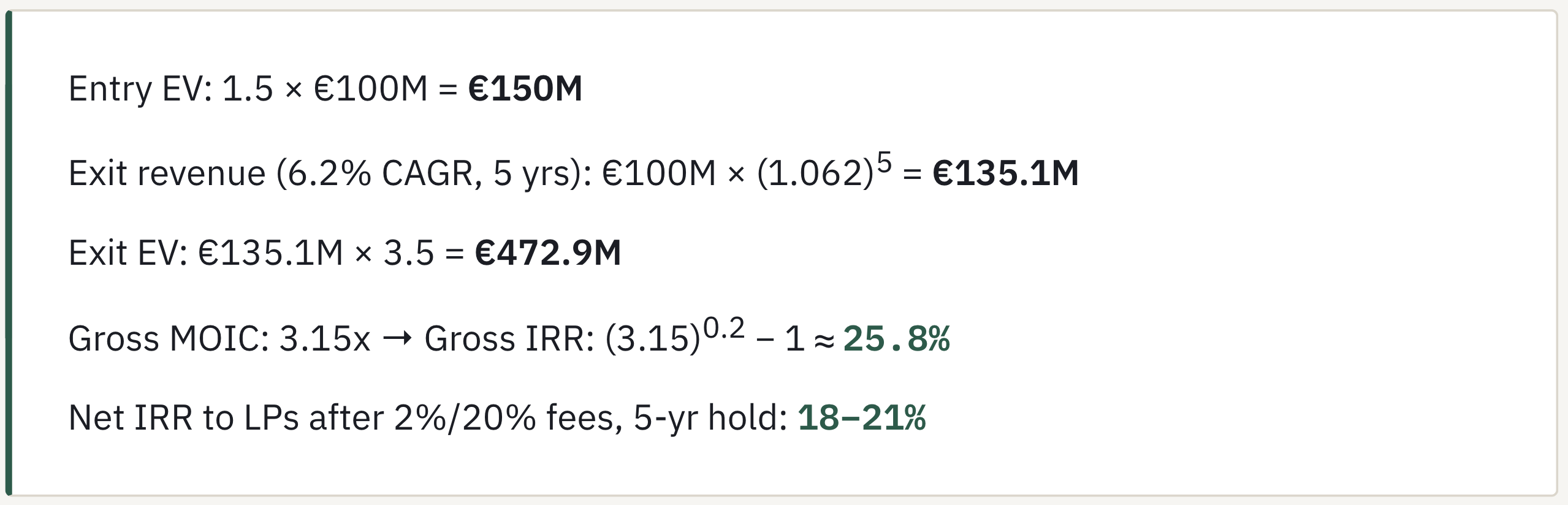
Exit multiple: 3.5x — an assumption reflecting FSR-forced EBITDA normalization and unlocked UCL access. There are no documented PE football exits yet to anchor this figure; it is a scenario input, not an empirical estimate. The first exits from the 2018-2021 cohort will validate or substantially revise it. If only FSR normalizes and UCL access is not achieved, a 2.5x exit yields approximately 17.6% gross IRR. The model is sensitive to this assumption in both directions.
Scenario B — Trophy Entry at 5x Revenue:
Exit multiple: 6x — an assumption of modest expansion from current levels. This is below Manchester United’s documented 6.5x in Football Benchmark 2024 and therefore conservative for the trophy tier, though the 6x exit is itself undocumented for any completed PE football transaction.
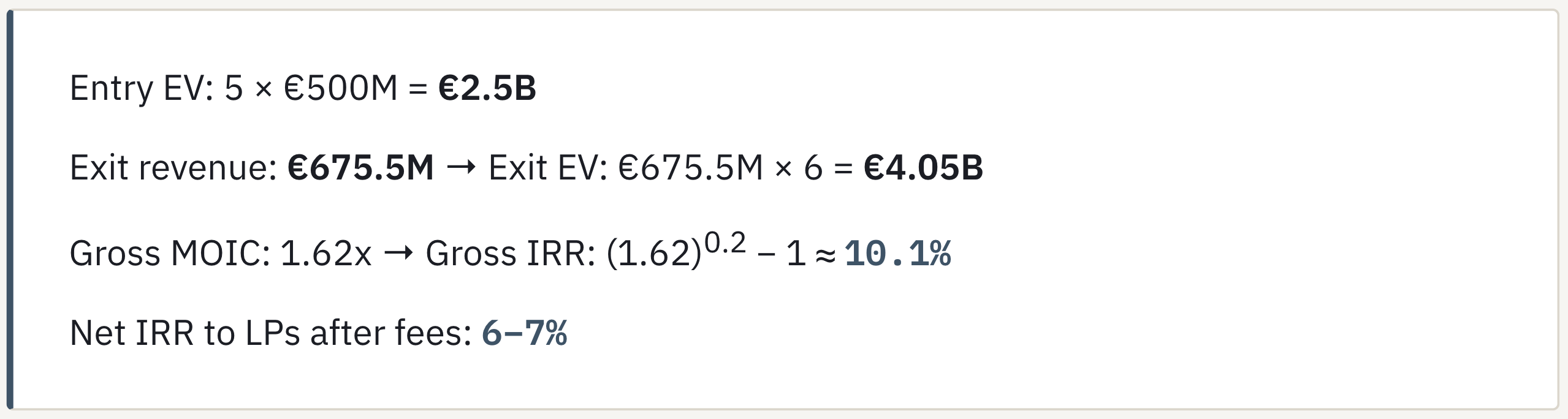
Net IRR to LPs after fees: approximately 6–7%. This does not clear the institutional PE hurdle rate for a $5B+ fund. The 6x exit assumption is generous given Accuracy Group’s analysis of Chelsea (2022) and Manchester United INEOS (2024) shows actual transaction prices ran approximately 20–30% above Football Benchmark’s theoretical valuation — buyers at trophy level paid a control premium before the hold period began.
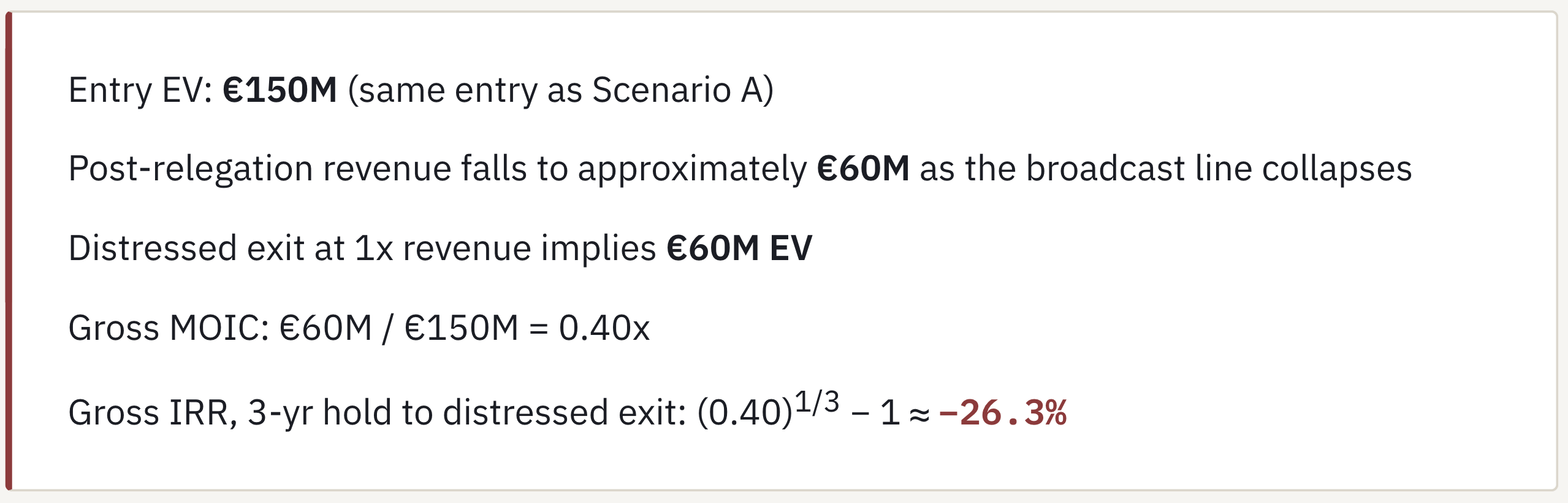
Scenario C — Mid-Tier Entry → Relegation:
Serie A domestic rights for 2024-2029 total €900M/year across 20 clubs, per Reuters’ reporting of the official October 2023 club vote, giving a mid-table club approximately €40–55M annually. Serie B’s total broadcast rights for the 2021-2024 cycle stood at €48.5M for the entire league, per Sportcal’s direct reporting of the Sky + DAZN deal. Limitation: this figure covers the 2021-24 cycle; the current cycle may differ. A primary source for current per-club Serie B distributions was not obtainable. The structural argument — that any individual Serie A club’s annual broadcast share substantially exceeds a pro-rata share of a ~€50M total pool — holds regardless of the exact current figure.
Post-relegation revenue falls toward approximately €60M (broadcast line collapses; other revenues partially hold). Distressed exit at 1x revenue implies approximately €60M EV.

Equal capital split between Scenario A and Scenario C produces a blended MOIC of approximately 1.78x (€532.9M returned against €300M invested) — a materially positive outcome, not the netting-to-zero that a naive average of the two gross IRRs (25.8% and -26.3%) might suggest. That naive average is the wrong calculation: it treats percentage returns as additive across mismatched hold periods (5 years versus 3) and ignores capital weighting. The portfolio implication is the opposite of intuitive — the trade survives even a 50% Scenario C hit rate. What it does not survive is Scenario C clustering non-randomly across a portfolio rather than landing independently, which is the more realistic underwriting concern, and the subject of the next section.
A Case Consistent With the Thesis: Hellas Verona
In January 2025, Presidio Investors acquired Hellas Verona, as confirmed by the joint statement published by the club and Presidio. Financial terms were not officially disclosed. Private Equity Wire, citing a source familiar with the deal, estimated the enterprise value at €120M–130M including existing debt. TheScore.com citing AFP reported Italian media estimated approximately €130M total. According to the managing partner in an interview with ION Analytics/Mergermarket — a practitioner’s statement, not independently verified — no new debt was raised; Presidio bought out the existing equity with existing debt remaining in place.
Hellas Verona was officially relegated from Serie A during the 2025-26 season, per Football Italia’s final standings report, confirmed independently by Yahoo Sports. The club finished 19th — within 17 months of acquisition. The managing partner stated, per the ION Analytics interview, that the firm reviewed approximately “70 to 80 different clubs” before selecting Verona.
This is a single case (n=1). It is consistent with the thesis that relegation risk is systematically underweighted in PE underwriting of mid-tier football clubs. It is also consistent with Presidio simply being unlucky, or with them being poor at evaluating squad quality for survival. One observation cannot establish a pattern. What it does demonstrate is that the tail event is accessible even to investors who conduct thorough deal selection; the number of clubs reviewed is not the relevant variable. The academic evidence below argues the mechanism is structural, not random — but that argument rests on limited evidence and should be weighted accordingly.
Why the Mid-Tier Discount Exists and Why It Is Changing
Three structural factors price mid-tier clubs below their asset value: illiquidity (no exchange-traded market), relegation risk (can destroy 40–60% of EV within a season), and governance weakness (family/founder ownership with no institutional cost discipline). These are real and explain the discount.
Two catalysts are changing the underlying economics in ways backward-looking multiples do not capture.
The FSR Inflection: UEFA’s regulations cap squad costs at 90% in 2023/24, 80% in 2024/25, and establish a permanent 70% ceiling from 2025/26. Football Benchmark 2025 documents the average squad cost-to-revenue ratio declining from 95% in 2023 to 82% in 2025. A club with €100M revenue and squad costs structurally capped at €70M posts a visible forward EBITDA margin for the first time. Standard DCF frameworks will update when 12–18 months of constrained financial statements are published.
The UCL Media Rights Cycle — What the Actual Bids Show: The 2027–2033 tender, managed by Relevent Sports under a mandate announced in March 2025, has produced disclosed results for the big five markets. Bloomberg reported in November 2025 that UEFA will receive approximately €2.5 billion per year from the five major European markets in the next cycle — up from approximately €2 billion in the current cycle, a 25% increase. The total revenue target across all competitions, all territories, and all revenue streams (broadcast, sponsorship, and licensing) exceeds €5 billion per season, per the UC3 joint venture’s stated goal — roughly 14% above current total men’s club competition revenue of €4.4 billion, per UEFA’s own 2024-25 financial results.
The 25% increase in big five media rights is meaningful and confirmed. At a constant 4.9x EV/Revenue multiple, a €20M annual UCL distribution increment for a mid-tier club that achieves qualification translates to approximately €100M in EV — significant option value for a club purchased at 1.5x revenue, even without the secondary catalysts.
The Mechanism That Makes Scenario C Non-Random
The most analytically interesting feature of the Hellas Verona case is not the outcome but the path: Presidio’s value creation strategy would have required rotating to younger, cheaper players to achieve FSR 70% compliance, which simultaneously disrupts the player coordination structures that determine on-field performance. If this observation is general — if the FSR compliance mechanism that drives the financial upside also degrades the squad quality that prevents relegation — then Scenario C is not an independent tail event. It is endogenous to the strategy.
This is a hypothesis, not a demonstrated mechanism. The evidence supporting it is preliminary: a 2024 SSRN working paper by Kristina Lalova-Yuhasz (Michigan State University) studies 96 European clubs (28 PE-backed, 68 non-PE) across the five major leagues in a staggered difference-in-differences design and finds PE investments increase commercial and matchday revenue but decrease player network centrality metrics and on-field match performance. Disclosure: the SSRN submission lists Lalova-Yuhasz as sole contact author; ResearchGate’s indexing of the paper lists Brennan Cimpeanu as co-author alongside Lalova — the same attribution Cimpeanu makes on his LinkedIn profile. The conflict between SSRN (sole author) and ResearchGate (two authors) is not resolvable from public information. ECGI’s publication of the author’s summary captures the tension: PE is “highly effective in enhancing financial outcomes” while this “comes at the expense of on-field performance.” Note: this is Lalova-Yuhasz’s own ECGI blog post, not an independent editorial assessment.
The limitations are significant: pre-peer-review, single season (2023-24), 28 PE-backed clubs, mechanism not externally replicated. The endogeneity claim does not require the Lalova-Yuhasz paper to be correct — it is a structural observation about the strategy’s internal logic. The paper provides preliminary empirical support, not proof. If the finding survives peer review and replication across multiple seasons, the probability that Scenario C is endogenous rather than random increases substantially. If it does not survive, the mechanism reverts to a structural hypothesis with one consistent anecdote.
The practical implication is the same either way: a PE investor who deploys the standard “optimize costs, rotate squad, improve commercial” playbook without modeling the joint probability distribution of FSR compliance and relegation avoidance is misspecifying the return distribution.
The Crowding Signal: Where Alpha Has Already Decayed
The trophy-asset tier is clearly crowded. Accuracy Group’s analysis of Chelsea (2022) and Manchester United INEOS (2024) shows actual transaction prices approximately 20–30% above Football Benchmark’s theoretical valuation. Paying a control premium on an EBITDA-negative asset at 5x revenue is the signature of more capital than deals.
The crowding is accelerating. Named vehicles with documented European football investments or public commitments now include: Apollo Global Management ($5B Apollo Sports Capital, September 2025), Ares Management (sports fund launched 2022, reportedly building a second), CVC Capital Partners (refinancing a sports portfolio valued at £9 billion as of July 2025 per Bloomberg and Sportcal — a PitchBook article from November 2025 cited “$14 billion” for the same vehicle; the discrepancy may reflect portfolio revaluation or different asset inclusions and is not resolvable from public information), RedBird Capital Partners, Clearlake Capital, Oaktree Capital Management, Sixth Street Partners, Arctos Partners, MSP Sports Capital, TPG, Presidio Investors, and Elliott Management. This is approximately 12 vehicles based on publicly confirmed transactions and announcements, and is a lower bound — undisclosed vehicles are not captured. The August 2024 NFL PE approval additionally admitted Blackstone, Carlyle, Dynasty Equity, and Ludis to American sports, expanding the pool of institutional capital with sports-sector exposure.
The Regulatory Barriers That Permanently Reduce the Investable Universe
Germany — 50+1 Rule: In July 2025, the German Federal Cartel Office issued preliminary findings that the Bundesliga’s 50+1 ownership rule is broadly compatible with competition law, while requiring the DFL to enforce open club membership more strictly. The FCO’s guidance is preliminary, not a final ruling, but the practical effect is unchanged: PE cannot hold control positions in Bundesliga clubs, removing approximately 18 Bundesliga 1 teams from the mid-tier PE control thesis.
England — Football Governance Act 2025: The Act, receiving Royal Assent in July 2025, established the Independent Football Regulator with powers to approve ownership suitability, impose licensing conditions on financial planning and fan engagement, and intervene in revenue distribution. Licensing implementation phases throughout 2026, extending deal timelines and constraining operational autonomy for Premier League clubs.
France — Ligue 1 Structural Revenue Crisis: Deloitte’s Football Money League 2026 confirms the DAZN termination “will negatively impact French clubs’ broadcast revenues in the short-to-medium term.”
Capacity Bound: A Transparent Construction
A precise count of qualifying mid-tier clubs is not publicly available. What follows is a transparent derivation from documented inputs, not a database count, and should be read as an order-of-magnitude estimate.
Starting universe: Five Big Five leagues, approximately 96 clubs total.
Filter 1 — Regulatory inaccessibility: Germany’s 50+1 rule removes approximately 18 Bundesliga 1 clubs from PE control consideration. France’s broadcast crisis excludes Ligue 1’s 18 clubs from the near-term accessible universe — not a permanent barrier like Germany’s, but treated the same way for this construction. The accessible universe for control-position mid-tier investments concentrates in England, Italy, and Spain — approximately 60 clubs (96 total, minus 18 Bundesliga and 18 Ligue 1).
Filter 2 — Already PE-backed: PitchBook’s dashboard reports 36% of Big Five clubs have PE/VC/private debt backing. Scaling that penetration rate to the 60-club accessible universe (acknowledging this is an approximation, since the German penetration rate is near zero and distorts the Big Five average) suggests approximately 20–25 accessible clubs are already PE-backed, leaving approximately 35–40 uninvested clubs in accessible leagues.
Filter 3 — Trophy-tier pricing: The top 6–8 Premier League clubs trade at 4x+ revenue (trophy tier, Scenario B territory). Removing these leaves approximately 28–34 mid-tier clubs in accessible leagues currently available for entry at 1–2x.
This construction produces an estimate of approximately 30 qualifying clubs with a range of roughly 25–35. That range is wide enough that the capacity claim cannot be stated precisely. What can be stated: the universe is not large, and with approximately 12 named vehicles actively pursuing it, the deal-to-buyer ratio is thin.
Fund-size implication: A dedicated sports vehicle with $500M–$2B AUM can make 5–10 investments at €150M average check without being forced into trophy assets. At $5B+ AUM, a fund cannot deploy at scale into mid-tier clubs without concentration risk and is functionally pushed into Scenario B. The alpha at mid-tier is structurally inaccessible to large-cap generalist PE — not because of any analytical advantage the smaller funds have, but because they can match their fund size to the available deal flow.
→ A condensed, single-document version of this analysis — the same sourced figures and IRR math, formatted as an institutional reference note — is available on Patreon.
What Would Change This View
UCL big-five media rights disappointing further. The €2.5B/year from big five markets is confirmed for 2027-2031. If subsequent tender waves (Eastern Europe, Americas, Asia-Pacific) yield materially below expectations, total revenue fails to reach the >€5B target and the incremental club revenue uplift is smaller than the 25% already achieved in big-five media rights.
UEFA FSR enforcement asymmetric. The 70% permanent cap must produce documented sporting sanctions — not just fines — against non-compliant clubs in 2025-26 for the EBITDA normalization to materialize.
The endogeneity hypothesis failing to replicate. If peer-reviewed replication of the Lalova-Yuhasz finding shows no systematic on-field decline under PE, or if it shows the effect is fully absorbed by clubs without relegation consequences, Scenario C reverts to a random tail event, the IRR distribution improves, and the mid-tier trade becomes more attractive than Scenario A suggests.
The 2018-2021 exit cohort disappointing. The first realized IRRs from PE football exits will either validate Scenario A assumptions or indicate the exit multiple assumed is too high. If realized exits cluster below 2.5x MOIC, the mid-tier thesis is under-earning and will not attract subsequent institutional capital on the necessary terms.
Actionable Implication
The mid-tier European football club trade has a closing window, the length of which is genuinely uncertain. The capacity construction above suggests 25–35 qualifying clubs remain uninvested; against approximately 12 named vehicles, the supply-demand balance is thin but not exhausted. The trade is accessible to vehicles of $500M–$2B with football operational expertise. The two observable signals worth tracking: (1) UEFA FSR enforcement producing documented sporting sanctions against clubs exceeding the 70% squad cost cap — fines without sanctions mean the cap is not binding; (2) the outcome of post-relegation revenue recovery for Hellas Verona under Presidio’s ownership, which will be the clearest near-term single-club test of whether the operational thesis can survive a Scenario C event.
Deloitte’s Sports Investment Outlook identifies 2025 as the year of first significant PE exits. Those realized returns, as they become public through LP reporting, will be the first empirical test of whether the trade delivered what buyers claimed.
📊 Want Deeper Quantitative Analysis?
This research took considerable time to collect, verify, and analyze. If you found value in this deep-dive, I publish exclusive quantitative research, trading strategies, and institutional-grade analysis on Patreon.
By joining, you’ll be supporting my work and motivating me to publish more content like this.
→ Join the Patreon community here
Navnoor Bawa writes at navnoorbawa.substack.com · YouTube · LinkedIn.
Cover photograph: Marco Assini, CC BY-SA 2.0, via Wikimedia Commons.